
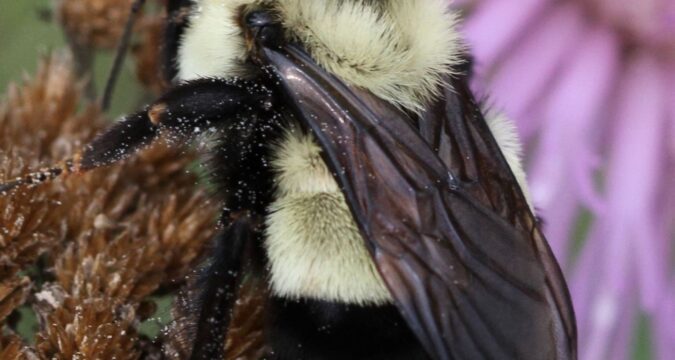
Pollinators are necessary to keep our ecosystems healthy. You’ll learn why and how you can help the cause in “For the Love of Pollinators,” an exhibit at the Dunn Museum in Libertyville, Feb. 14-May 31.
Alyssa Firkus, Director of Education for the Lake County Forest Preserves, said the exhibit on pollinators was inspired when one of their exhibit designers learned about The Bee Collective of Columbus, Ohio, which creates art related to bees, in addition to educating on pollinators.
The Lake County Forest Preserves team decided that it was “a great opportunity to not only intersect both art and nature but bring in a lot of different people to learn about both,” Firkus said. “Everybody was very much in agreement that this would be aligned with the Forest Preserve’s mission.”
More than 30 sculptural works from around the world, provided by The Bee Collective in Ohio, are featured in the “For the Love of Pollinators” exhibit at the Dunn Museum in Libertyville, Feb. 14-May 31. (Lake County Forest Preserves)
A variety of people worked on this project, including pollinator experts from the Lake County Forest Preserves Natural Resources Team and the Environmental Education Team, that teaches people what they can do in their own yard, their own home to make an impact and create change,” Firkus said.
She noted that Luke Howard, founder of The Bee Collective, was enthusiastic about participating in the exhibit. He told them that one of their missions is to raise awareness about the decline of pollinators. In addition, Firkus said, “He wants to support artists and he wants to inspire people.”
Howard agreed to allow artwork from The Bee Collective in the exhibit. More than 30 of these works, created in a collaboration between people and bees, are in the exhibit.
To create unique works of art, they put sculptures into honey bee hives. “The honey bees then make the honeycomb onto the actual art pieces,” Firkus said.
The exhibit talks about honey bees, which are not native to Lake County. “We use that to teach who is native here and what is a pollinator,” Firkus explained.
She asserted that the most important aspect of the exhibit is teaching what individuals can do to help our local pollinators succeed.
The exhibit will have many interactive elements.
“People will be able to build their own bees,” Firkus said. “There’ll be videos throughout; art pieces throughout. It will be a really engaging exhibit.”
Restoration ecologist Dan Sandacz was heavily involved in the creation of the exhibit.
“I like to think of my job as making decisions to keep our preserves happy and healthy,” Sandacz said. “That ranges from monitoring our plants and animals to going out and working with my fellow colleagues to receive grants to do restoration work, and then planning and implementing the restoration on the ground.”
In 2023, Sandacz developed a plant pollinator monitoring program to increase the understanding of the relationship between plants and pollinators.
Based on the information he learned, Sandacz said, he used that to help develop general content for the exhibit on “What is pollination? Who are the native pollinators in Lake County? to help people explore the breadth of pollination in Lake County.”
Sandacz noted that one interesting aspect of the exhibit is photos throughout the exhibit of pollinators taken by volunteer Dale Shields.
“This will be a wonderful opportunity for people to explore the different pollinators,” Sandacz said. “They come in all different shapes and sizes. There’s butterflies, beetles, wasps, and flies that all do a wonderful job of pollinating and supporting our natural areas.”
Sandacz hopes that the exhibit will help people realize the importance of pollinators.
“They’re such a critical part of our ecosystem,” he said. “Pollinators support about 80 percent of the crops that we rely on and they’re also critical in keeping our natural areas happy and healthy.”
Sandacz said that there are things people can do to support pollinators. “My top recommendation is to plant native plants in your yard,” he declared.
There will be 14 events related to the Pollinators exhibition, including “Nature Storytime: Am I Even a Bee?” 6-7 p.m. March 19; “For the Love of Bumble Bees,” 1-2 p.m. April 1; and “Protecting Pollinators at Home,” 6-7 p.m. April 16. Registration is required, and there’s a small fee for some of the events. For the complete list, visit lcfpd.org/calendar/?F_c=1202.
The Dunn Museum is located at 1899 W. Winchester Road in Libertyville. The Pollinator exhibition is included in the museum’s general admission of $10 adults, $6 seniors and ages 4-17, free for ages 3 and under, for nonresidents; $6, $3, and free for residents.
For more information, call 847-968-3400 or visit lcfpd.org/museum.
Myrna Petlicki is a freelance reporter for Pioneer Press.


