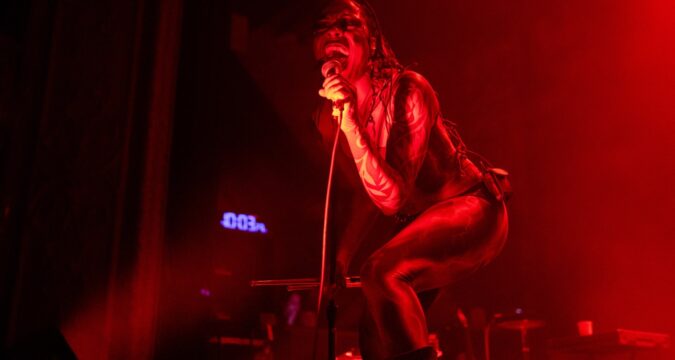
Sudan Archives came across as a one-woman wrecking crew Thursday at a sold-out Thalia Hall. On her first tour with production elements such as lighting and dry-ice fog, the singer and multi-instrumentalist secured her standing as one of the more exciting, innovative creatives on the contemporary scene.
Whether remaining in near-constant motion for the 90-minute set, simultaneously juggling an assortment of roles or mining visceral currents from songs, she left no doubt about the answer to the question she asked on the anthemic “Selfish Soul.” Yes, she is good enough. And then some.
Save for a surprise duet with opener Cain Culto and a one-off appearance by a fan she selected from the crowd, Sudan Archives went it alone. Demonstrating confidence and charisma on par with that of veteran arena headliners, she made it difficult for anyone to turn their focus away from her. She avoided vapid banter, shunned cliches, bypassed outfit changes and moved with a purpose that mirrored the raw physicality of her latest tunes.
Cain Culto performs during the Sudan Archives concert, Feb. 5, 2026, at Thalia Hall. (Josh Boland/Chicago Tribune)
Wearing black boots, a sleeveless blue-and-purple body suit and headset microphone, Sudan Archives commanded a spartan stage and got up close with the audience via an elongated step perched a few feet above floor level. Other than clusters of instruments, tangles of wires and a horizontal illumination bar that evoked a gymnastic balance beam, the sole prop took the form of an elevated circular platform. She used it as an accessory for performance-art routines, yet its limited real estate could not contain her fluid energy for long.
Though elements of the show leaned on rehearsed choreography, Sudan Archives directly engaged with the moments at hand and the fans within arm’s length. She operated as if leading a liberation. Her extroverted body language signaled a desire to free everyone in the building — including herself — from fears, heartbreak, cynicism and restraints. She pumped her fists. Flexed her biceps. Sprung from a crouched position, ready to strike. Crawled on all fours. Struck deliberate robotic poses. Held her violin high above her head. She also shook it, pretended it morphed into a shotgun and twirled it as a baton.
Occasionally, Sudan Archives treated the fiddle bow as if it were an arrow — and wore a container slung across her shoulder like a quiver. Quick on the draw, she played a normal violin and a custom “violin guitar” whose shape echoed a shrunken Gibson Flying V model and amplified higher-pitched tones suggested those of a hot-rodded mandolin.
Scraped, plucked, strummed or struck, the string parts supplied foundational riffs. They frequently dovetailed with rhythmic loops, house beats, glitchy synthesizers and vintage-minded techno and drum-and-bass grooves. Sudan Archives sang and rapped over the multi-layered architecture, which retained healthy tension and remembered the importance of soulful melody.
Her basic aims: To spur people to dance, feel empowered and embrace the possibilities of music that zigs in different directions — and usually at unexpected times. In achieving those goals, she eviscerated the stylistic limitations associated with music streaming algorithms. Such homogeneity and predictability had no call in Sudan Archives’ eclectic fusing of R&B, folk, hip hop and assorted electronic disciplines.
Born Brittney Denise Parks, Sudan Archives grew up in Cincinnati and became interested in violin after fiddlers visited her elementary school. She taught herself the instrument by ear and cut her teeth practicing techniques in church. Her inquisitive nature soon led her to discover how the violin factors into African music and other forms that exist outside of classical spheres.
Sudan Archives performs at Thalia Hall in Chicago on Feb. 5, 2026. (Josh Boland/Chicago Tribune)
Having relocated to Los Angeles after getting kicked out of her childhood home in her late teens, Sudan Archives — the former part of the moniker was suggested to her by her mom, and the latter represents an acknowledgment of her admitted obsession with ethnomusicology — began experimenting with loops and attending open-mic nights. The Ohio native scored a record deal and debuted in 2017 with a self-titled EP that attracted considerable attention from independent outlets
In the years since, Sudan Archives won mainstream accolades and released three acclaimed LPs. In the studio and on the stage, she established a reputation for being the kind of rare pop artist who seems immune to caring about trends. Bound by the confines of her imagination, her work remains accessible even as it transcends conventions. Her curiosity for vivid sounds and stringed instruments is perhaps equaled only by her flair for fashion.
Hunkered over keyboards, banging sticks on electronic drum pads, smoothly sliding her feet across the floor as she delivered lyrics at clips ranging from drowsy to rapid-fire: Sudan Archives offered interpretations of the analog past and digital future intersecting on both a sonic and emotional level. She primarily featured material from her recent club-forward record “The BPM,” with narratives involving an alter ego dubbed Gadget Girl and concerning the convergent relationships of susceptible humans, powerful machines and cyber realities.
Sudan Archives performs at Thalia Hall in Chicago on Feb. 5, 2026. (Josh Boland/Chicago Tribune)
Tracing any defined conceptual thread required a leap of faith. It proved easier, and more rewarding, to succumb to Sudan Archives’ multifaceted singing, swirling hooks, and thumping-tempo bravado. She cleverly laced thinly disguised hints of fearless sexuality throughout dense tracks such as the claustrophobic “Noire,” boisterous “Ms. Pac Man” and booming “My Type.” She revved up the aggression on a vengeful “Ciara” and delirious “A Computer Love.” And she protested with Culto via a fast-paced, sweat-soaked version of his “KFC Santeria.”
For all of the occasional bursts of provocative bluster and in-the-red distortion, Sudan Archives maintained an understated cool and vulnerable intimacy indicative of someone seeking deep truths rather than settling for blissful pleasure. She seldom allowed arrangements to explode or offered easy catharsis. Her personal victories and joy, documented on the lush “Heaven Knows,” Irish jig-accompanied “She’s Got Pain” and finger-snapping “Come Meh Way,” seemed hard-earned. And as close to permanent as things get in the upside-down landscapes of the 21st century.
She appeared to acknowledge a need for lasting certainty and communal connectivity during a celebratory encore. It witnessed her wade into the crowd and carve out an aisle down which audience members paraded, uninhibited, like a gleeful wedding party.
The impulsive feat emphasized the humanity behind Sudan Archives’ high-tech approaches and underscored the collaboration she should pursue before graduating to larger venues. Specifically, pairing with a flesh-and-blood band that would help send her dynamics, spontaneity and interactivity into another orbit. And lessen her sporadic temptations for theatricality, an obvious weak spot.
Stay tuned.
Bob Gendron is a freelance critic.
Setlist from Thalia Hall on Feb. 5:
“Dead”
“Noire”
“Yea Yea Yea”
“NBPQ (Topless)”
“Touch Me”
“Nont for Sale”
“Ciara”
“Come and Find You”
“Freakalizer”
“My Type”
“A Bug’s Life”
“Ms. Pac Man”
“She’s Got Pain”
“A Computer Love”
“Come Meh Way”
“Heaven Knows”
“Selfish Soul”
Encore
“KFC Santeria” (Cain Culto cover)
“The Nature of Power”
“The BPM”
https://www.chicagotribune.com/2026/02/06/review-sudan-archives-thalia-hall/


