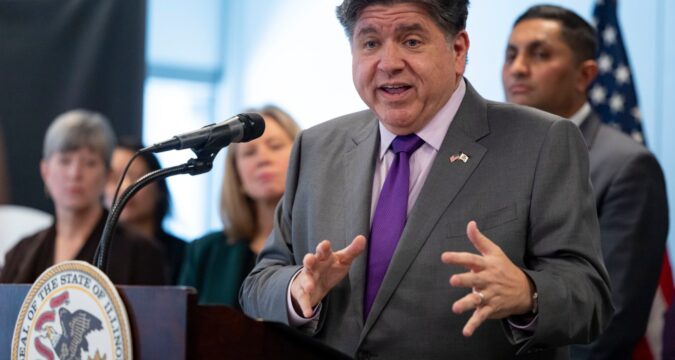
When Gov. JB Pritzker was asked last week whether Illinois will opt into a new federal tax-credit scholarship opportunity, he didn’t rush to judgment.
“Those rules when they’re issued, we’ll be able to evaluate whether that’s good for the state of Illinois and the people of Illinois, or not,” he said.
That restraint matters, because the pressure campaign is already underway. Teachers unions are demanding an immediate rejection, and given Pritzker’s role as one of President Donald Trump’s most vocal critics, the easy political move would be to treat anything connected to Trump as automatically toxic.
But governing isn’t about reflexes. It’s about results.
The governor’s “wait for the rules” approach is consistent with his position during the fight over Illinois’ Invest in Kids tax credit scholarship program. He was not opposed to extending it; he only wanted to shift some of the cost to the federal government.
Now that option exists. This program is funded entirely through a federal tax credit. The cost is carried by Washington, not Springfield, an important distinction for a state that consistently sends far more to Washington than it gets back.
Even more significant, this opportunity can benefit public school students as well as nonpublic school students. Unlike most tax-credit scholarship programs, the federal framework allows donations to support tutoring, after-school programs and other educational expenses for public school families.
Teachers union members themselves could participate and direct donations to public school students. The potential infusion for public school children could reach hundreds of millions of dollars.
If the goal is helping kids learn, opting in should be an easy yes.
Opponents argue, as they did with Invest in Kids, that any policy assisting nonpublic school students is an attack on public education. But that claim has never matched reality. When Invest in Kids ended, public schools did not receive new funding. Thousands of low-income students, however, lost access to scholarships. With unions still celebrating the program’s demise despite the absence of a public school windfall, it’s fair to ask what their real agenda is.
There’s also a critical fact being ignored: Even if Illinois refuses to opt in, Illinois taxpayers can still claim the federal credit. The only question is where the money goes.
Opt in, and those dollars support Illinois students through Illinois-based organizations. Decline, and the money flows to other states, taking tens of millions in tutoring and academic support with it.
The standard talking point is that this is a “voucher program.” It isn’t. Vouchers involve government funds sent directly to families. Tax credit scholarships are funded by voluntary private contributions. Illinois public schools lose no local, state or even federal funding when someone donates and claims a credit.
Another refrain is that this is part of Trump’s agenda to destroy public education. That’s not an argument; it’s an attempt to avoid one.
Strip away the slogans, and a pattern emerges: Some interest groups seem determined to block any benefit for nonpublic school students, even when public school students benefit too. That view is out of step with public opinion. Even Democratic voters see this as help for children, not a culture war prop. That’s why Arne Duncan, former Chicago Public Schools CEO and U.S. secretary of education, has called opting in a “no-brainer”.
Pritzker is right to be deliberate. This isn’t a referendum on Trump. It’s a decision about whether Illinois will accept a tool that helps students, especially public school students, without reducing state revenue, or whether it will send those dollars elsewhere.
The governor should keep doing what he started: Wait for the rules, ignore the noise and choose the option that maximizes help for Illinois kids.
That’s not just good policy. It’s the leadership our state needs.
Rabbi Shlomo Soroka, director of government affairs for Agudath Israel of America, was involved in the advocacy for Illinois’ Invest in Kids program.
Submit a letter, of no more than 400 words, to the editor here or email letters@chicagotribune.com.
https://www.chicagotribune.com/2026/02/06/opinion-federal-tax-credit-scholarships-jb-pritzker/


