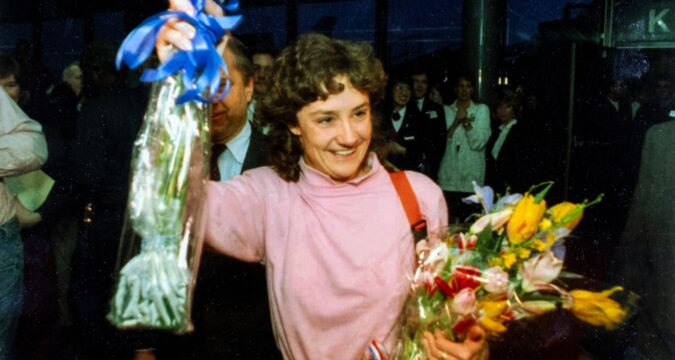
The Chicago area has long produced athletes with Olympic dreams.
Billy Fiske won gold as the driver for the United States’ five-man bobsled team in the 1928 Olympics. Speedskater Bonnie Blair is one of the most decorated U.S. women in Winter Olympics history. Rockford’s Janet Lynn, considered by many to be the greatest figure skater ever, took the bronze medal at the 1972 Olympics, won five U.S. titles and earned two world medals.
As the 2026 Milan Cortina Games approach, take a look back at some of our local Winter Olympians of Games past. Thanks to Tribune editor Stacy St. Clair, who has covered five Olympics, for suggesting these athletes.
Kevin Bickner (Ski jumping)
Kevin Bickner takes his last jump of the day at the 29th annual Norge Autumn Ski Jump competition in Fox River Grove on Oct. 5, 2014. (Stacey Wescott/Chicago Tribune)
Hometown: Wauconda
His credentials: Bickner, who attended Wauconda High School, is preparing for his third Olympics. During the 2018 Winter Games in Pyeongchang, South Korea, Bickner was one of three Olympians — with Mike Glasder, 29, of Cary and Casey Larson, 19, of Barrington — from the Norge Ski Club in Fox River Grove. It was the first time the club was represented at the Winter Games and the first time three men from the same ski club represented the U.S. in ski jumping at the Games. Bickner finished 18th in normal hill and 20th in large hill. The three athletes were inducted in August 2018 into the American Ski Jumping Hall of Fame.
Bickner finished 43rd in the 2022 Olympics in Beijing and didn’t advance to the round of top 30 jumpers. A week later, the U.S. team of Larson, Decker Dean, Patrick Gasienica and Bickner teamed up to finish 10th — ahead of only the host Chinese team.
Kevin Bickner looks on during a news conference for the U.S. Olympic ski jumping team at the 2026 Winter Olympics on Feb. 4, 2026, in Italy. (Alex Slitz/Getty)
From the archives: Maureen Bickner said her son, who has been downhill skiing since he was 4 and took to ski jumping when he was 10, learned on the artificial surface at the Norge Ski Club and its training center. He fell the first three times, landed on his next try and was hooked from that moment, she told the Tribune in 2018.
“The following winter we were out downhill skiing, and Kevin said to me he always had thought he’d be in the Olympics for downhill, but now he would be there for the ski jump. He was so serious. So sure of himself,” she said.
Bonnie Blair (Speedskating)
Speedskater Bonnie Blair celebrates after claiming the bronze medal in the 1,000 meters at the Winter Olympics in February 1988, in Calgary. (Charles Cherney/Chicago Tribune)
Hometown: Champaign
Her credentials: One of the most decorated U.S. women in Winter Olympics history, Blair competed in four Olympics and won five gold and one bronze speedskating medals between 1988 and 1994. The three-time World Sprint Champion also won 19 world sprint medals.
From the archives: After Blair won Olympic gold in the 500 meters at the Lillehammer Games, the silver medalist from Canada, Susan Auch, seemed genuinely more elated to be runner-up to Blair, according to the Tribune.
“My name under Bonnie’s is very exciting,” Auch said.
After she took home her fourth gold medal on Feb. 19, 1994, U.S. speedskater Bonnie Blair said her fifth trip to the medal stand — she also has a bronze medal from Calgary — was as fresh as the first. “It’s never routine for me,” she said after smiling through the national anthem with beaming eyes. “Once you think it’s routine is when it’s going to be taken from you as fast as you can imagine.” (Chicago Tribune)
In her words: Blair retired from competition in 1995 but remains active in the sport. She continues to be a tireless ambassador for the sport, leading efforts to inspire young athletes to give speedskating a try.
“First and foremost, it was my love of the sport that keeps me coming back,” she told a Milwaukee television station in 2022. “It’s something that I’m very proud of — that I have been able to accomplish and do for our sport — and now we look to the future and what the future holds.”
Shani Davis (Speedskating)
Shani Davis works a turn en route to his gold medal in the 1,000 meters during the 2006 Winter Olympic Games on Feb. 18, 2006, in Italy. (Scott Strazzante/Chicago Tribune)
Hometown: Chicago
His credentials: Davis became the first Black athlete to win an individual gold medal at the Winter Games in Torino with his 1,000-meter victory in 2006. Davis became the first skater to defend his title in that event four years later. He also won silver medals in the 1,500 both years.
From the archives: When the Evanston-trained Davis competed in his fourth and final Olympics in Pyeongchang in 2018, the Tribune wrote: “Davis isn’t here to make you or U.S. Speedskating or the U.S. Olympic Committee comfortable. … He’s a complex man reminding us that athletes don’t have to come in perfectly wrapped packages to root for them.”
U.S. speed skater Shani Davis, of Chicago, skates around the Oval Lingotto with his bear and a White Sox hat acknowledging the fans after his gold medal performance in the 1,000 meter men’s long track speedskating at the 2006 Winter Olympic Games in Turin, Italy, on Feb. 18, 2006. (Nuccio DiNuzzo/Chicago Tribune)
In his words: After a disappointing finish in Sochi in 2014, a 31-year-old Davis told reporters, “It kills me inside to know that the attention I am getting now is the thing I’ve always wanted since 2002 — to be a speedskater Americans knew, loved, followed and cheered for. But I come away with nothing to show them and give back to them and say thank you for believing in me and following me. So I am really disappointed not only for myself — that I couldn’t meet me expectations — but for the people that have been watching, that I couldn’t do more for them.”
Aja Evans (Bobsled)
Olympic bobsled hopeful Aja Evans smiles while training on Aug. 12, 2013, at EFT Sports Performance in Highland Park. (Chris Walker/Chicago Tribune)
Hometown: Chicago
Her credentials: Evans won Olympic bronze in the two-woman bobsled in 2014, the pinnacle of a stellar multisport career for the Morgan Park graduate and University of Illinois alumnae. In addition to representing the United States at two Olympics, she was a five-time All-American and three-time Big Ten champion shot-putter at Illinois.
From the archives: Evans comes from a family of athletes. Her brother Fred spent eight seasons in the NFL; her cousin Gary Matthews Jr. spent 12 years in Major League Baseball, including a stint with the Cubs; and her uncle, Gary “Sarge” Matthews, was an MLB All-Star and fan favorite during his four seasons with the Cubs in the ’80s.
Fred Evans, however, insisted his sister is the one who has achieved the most. In fact, everyone else’s resume seems provincial by comparison.
“By far, she’s the top,” Fred told the Tribune as he watched her compete at the Sochi Olympics in 2014. “The Olympics are something special to the entire world. … I love what I do and I’m blessed to be an NFL athlete, but my sister is an Olympian. That far exceeds anything anyone else in our family has ever done.”
Bronze-medal winners Jamie Greubel, left, and Aja Evans pose during the flower ceremony after the bobsled competition at the 2014 Winter Olympics on Feb. 19, 2014, in Russia. (Michael Sohn/AP)
In her words: The first time Evans took a run down the bobsled track — a sensation she likened to being stuffed into a garbage can and pushed off a cliff — she wasn’t sure she wanted to do it again. Her mother insisted she not give up.
Two years later, Evans was on the Olympic medal stand.
“She told me to fight through it,” Evans told the Tribune after winning the bronze. “She told me I was in this for bigger reasons than that one run. And I’m so glad I listened to her.”
Billy Fiske (Bobsled)
Billy Fiske, the champion of the Cresta run, noted bobsled slide, poses for the camera at the St. Moritz resort, circa 1937. (Acme News)
Hometown: Chicago
His credentials: Fiske lived a brief but extraordinary life. Born in Chicago in 1911 into a wealthy banking family that could trace its roots to the Mayflower, he was educated overseas during his teen years.
From the archives: He was chosen — at age 16 — as the driver for the United States’ five-man bobsled team in the 1928 Olympic Games in St. Moritz, Switzerland. The team won gold.
New York Mayor James J. Walker, right, at the wheel of a two-man bobsled, while William Fiske, driver of the U.S. four-man Olympic team and gold medalist at the 1928 Games in St. Moritz, Switzerland, gives him pointers on the working of the speedy contraption. They are shown on Feb. 14, 1932, in Lake Placid, New York, during the preliminary Olympic bobsled heats. (AP)
Fiske piloted the 1932 team to a second Olympic gold medal on Feb. 15, 1932, at the Winter Games in Lake Placid, New York.
He died at just 29 — the first American pilot to be killed during the Battle of Britain.
Cammi Granato (Ice hockey)
U.S. women’s hockey team captain Cammi Granato (21), right, hugs teammate Jenny Schmidgall after the U.S. defeated China 5-0 in their debut Olympic game in 1998. Granato scored two goals, while Schmidgall had one. (Nuccio DiNuzzo/Chicago Tribune)
Hometown: Downers Grove
Her credentials: Granato represented the U.S. when women’s hockey made its Olympic debut in 1998, upsetting Canada to win gold. She was a flag bearer during the closing ceremony. Four years later, the U.S. settled for silver with Granato again the captain.
She is the first female to be inducted into both the Hockey Hall of Fame and the U.S. Hockey Hall of Fame.
Granato was believed to be the first female professional scout working for an NHL team when the Seattle Kraken hired her in 2019.
Olympian Cammi Granato greets children at Highland Elementary School in Downers Grove, which she attended as a child, on Feb. 26, 1998. (Ed Wagner/Chicago Tribune)
From the archives: Granato came from a hockey family with four brothers who also competed in the sport. At a college booster event in 1990, Colorado College coach Brad Buetow and Wisconsin coach Jeff Sauer jokingly argued over which team received the better Granato brother — but they agreed on who the best athlete was in the family.
”You know, come to think of it, neither of us has the best Granato,” Sauer said in 1990. “The best one is their sister, Cammi.”
In her words: “For so many years, people told you that you shouldn’t be on the ice because it was women’s hockey and you couldn’t go anywhere,” Granato said after the 1998 win. “And here you are with a gold medal around your neck.”
Dianne Holum (Speedskating)
Olympic skater Dianne Holum shows off her medals in 1968. Editors note: this historic print shows some damage. (Hardy Wieting/Chicago Tribune)
Hometown: Northbrook
Her credentials: At an age when most teenagers were learning to drive, Holum was winning Olympic medals in speedskating. She earned silver and bronze medals in the 500- and 1,000-meter events at the 1968 Games in Grenoble, France — despite a bout of food poisoning due to “tainted cheese” — making her the youngest medal winner at those Olympics.
Four years later, Holum was chosen to be the flag bearer for the United States during the opening ceremony of the 1972 Winter Olympics in Sapporo, Japan. Then focused on longer races, she took home the U.S. team’s first gold medal of that Games — and set an Olympic record — in the 1,500-meter race before following it up with a silver medal in the 3,000 meters. At a time when most speedskating competitions were held outdoors, Holum also earned 15 world medals before retiring from competition at 20.
She then coached athletes — including medal-winning brother and sister Eric and Beth Heiden — in the next three Winter Olympics and wrote “The Complete Handbook of Speedskating” in 1984. Holum’s daughter, Kirstin, participated in the 1998 Winter Olympics under her mother’s guidance. For her achievements in skating, Holum was inducted into the National Speedskating Hall of Fame in 1986, and for coaching she was enshrined in the International Women’s Sports Hall of Fame in 1996.
Anne Henning and Dianne Holum were given a large welcome in Northbrook as they returned home from the XI Winter Games, held in Sapporo, Japan, in 1972. The two speedskaters each won a gold medal. (Earl Gustie/Chicago Tribune)
From the archives: Among Holum’s earliest competitions were the Tribune-sponsored Silver Skates derbies, which occurred yearly from 1917-1974. In 1964, she won the juvenile girls division race.
In her words: Frustrated that her Olympic speedskaters began without a single corporate sponsor in 1985, Holum bucked the United States International Speedskating Association and hired a fundraising coordinator. She secured donations of racing suits and skate-sharpening equipment by making her own calls.
“When I skated, I didn’t have a coach behind me every day, but you have to keep striving,” she told the Tribune in January 1985. “I’ve probably gotten $30,000 to $40,000 worth of stuff that’s been supplied for us that our national governing body didn’t get.
“So I went out and got it. I wasn’t going to sit around and wait for the money.”
Janet Lynn (Figure skating)
Rockford’s Janet Lynn arrives at O’Hare International Airport on Feb. 15, 1972, from the Winter Olympic Games in Japan after winning a bronze medal in figure skating. With Lynn is her grandfather, Gus Gehrke, of Rockford. (David Nystrom/Chicago Tribune)
Hometown: Rockford
Her credentials: Considered by many to be the greatest figure skater in history (the Tribune dubbed her “Cinderella girl”), Lynn took the bronze medal at the 1972 Olympics, won five U.S. titles and earned two world medals. Her free skates were so popular with the fans — and that much better than her peers — the International Skating Union changed the scoring system and reduced the weight given to compulsory figures to make the sport more understandable for spectators.
When she retired from competition in 1973, she signed a three-year, $1.45 million contract with the Ice Follies, making her the highest-paid female athlete of her time.
From the archives: Long after she stepped away from the spotlight, Lynn continued to inspire generations of Olympic skaters, including Brian Boitano and Tara Lipinski. Both revered the way she combined effortless skating with formidable jumps.
“As soon as the music starts,” Boitano told the Tribune in 1997, “you can see an energy go into her body in a way that’s spiritual. When she smiled, it wasn’t a false smile just to connect with the audience, it was an inner glow emerging.”
Five-time U.S. champion Janet Lynn, who started in the Ice Follies on Oct. 22, 1973, at Chicago Stadium. Lynn first skated in an exhibition at Chicago Stadium when she was 3 1/2 years old. (James Mayo/Chicago Tribune)
In her words: The daughter of an Evergreen Park pharmacist, Lynn won the hearts of the Japanese public during the Sapporo Games when she fell during a flying sit spin and got up with a smile. At the time of the fall, Lynn knew she wasn’t in contention for gold because of her placement in the compulsory figures. She had been disappointed but then realized the free skate would give an opportunity bigger than any medal.
JANET LYNN DOESN`T MISS THE SPOTLIGHT
“I gathered myself all I could and thought, ‘Perhaps there was a bigger purpose to my skating, to show God’s love and express the gift for skating He gave me.’ Because of that attitude, when I fell, I was able to keep smiling,” she said. “The next day, I was an instant heroine in Japan.”
Evan Lysacek (Ice skating)
Evan Lysacek skates in the free skating program at the Winter Olympics in Vancouver on Feb. 18, 2010. (Nuccio DiNuzzo/Chicago Tribune)
Hometown: Naperville
His credentials: In his second Games, Lysacek won a gold medal at the Pacific Coliseum in Vancouver during the Winter Olympics in 2010. He upset defending champion Evgeny Plushenko of Russia.
Shaking off the suffocating pressure of the moment — which actually lasted 4 minutes, 30 seconds — Lysacek delivered a brilliant, career-best performance to become the first U.S. man to win the Olympic skating gold medal since Brian Boitano in 1988.
Evan Lysacek, the 2010 Olympic gold medal winner in men’s figure skating, visits his alma mater, Neuqua Valley High School, on March 26, 2010, in Naperville. (Chris Salata/for the Chicago Tribune)
From the archives: Nine years before Lysacek won the World Figure Skating Championships, he told the Tribune he was going to sit out the junior world meet.
“I think that was a smart move,” Lysacek said. “I don’t have enough stuff yet technically.”
Phoebe Mills (Gymnast/Snowboarding judge)
Phoebe Mills shows off her bronze medal in 1988. (Tony Berardi/Chicago Tribune)
Hometown: Northfield
Her credentials: Mills won a bronze medal in the balance beam at the 1988 Olympics, becoming the first American female gymnast to win an individual medal at a boycott-free Olympics. The Northfield native was also the only U.S. gymnast, male or female, to medal at the Seoul Games.
After retiring from gymnastics in 1989, Mills took up diving and competed for the University of Miami, winning three Big East titles. She later took up snowboarding, acting as a coach and instructor with the U.S. national team, and was a judge at the 2014 Olympics in Sochi.
From the archives: After her childhood coach moved, Mills attended a summer camp run by legendary gymnastics coach Bela Karolyi in Merrill, Wisconsin. Karolyi, who had trained a young Nadia Comaneci, immediately recognized Mills’ potential.
“She was a little fighter, a little hardworking girl,” Karolyi recalled in a 1987 interview with the Tribune. “It was a pleasure working with her, no question about it. Yes, I told her, I can see a strong upcoming gymnast.”
Phoebe Mills looks at her trophies that adorn her windowsill on July 17, 1989, in Northfield. (José Moré/Chicago Tribune)
In her words: Mills became a breakout star in 1988, winning the U.S. nationals, American Cup and U.S. Olympics trials. The Seoul Games, however, etched her place in the gymnastics history.
“No matter what I do from now on, I can already say I’ve accomplished something,” Mills said. “When I was standing on that platform and the Russian and Romanian and American flags were going up side by side, it was everything I dreamed of. One of my goals was to get up to the level of the Russians and Romanians.”
Want more vintage Chicago?
Become a Tribune subscriber: It’s just $1 for a 1-year digital subscription.
Thanks for reading!
Subscribe to the free Vintage Chicago Tribune newsletter, join our Chicagoland history Facebook group, stay current with Today in Chicago History and follow us on Instagram for more from Chicago’s past.
Have an idea for Vintage Chicago Tribune? Share it with Kori Rumore at krumore@chicagotribune.com.
https://www.chicagotribune.com/2026/02/05/vintage-chicago-tribune-local-winter-olympians/


