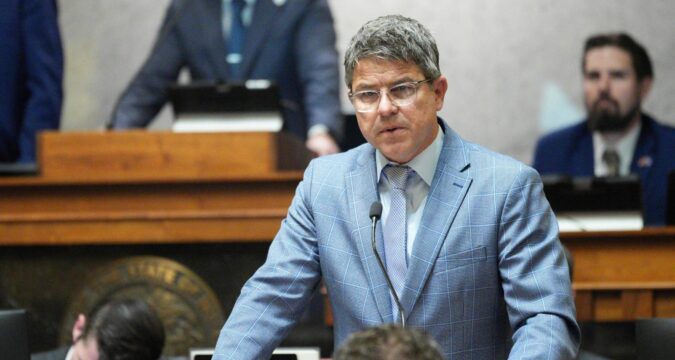
Indiana’s mid-census redistricting debate seemingly has settled into two camps — with House Republican leadership supporting Gov. Mike Braun’s call to meet in December to pass new Congressional maps while Senate Republican leaders would back the GOP candidate in the First Congressional District in its current boundaries.
When Organization Day, the ceremonial start to a legislative session, ended Tuesday, House Speaker Todd Huston, R-Fishers, told the representatives to keep the first two weeks of December, as previously decided, open to address mid-census redistricting.
Indiana Republican House Speaker Todd Huston listens at the Statehouse, April 27, 2023, in Indianapolis. (Darron Cummings/AP)
The Senate held a rare vote to return on Jan. 5, 2026, which effectively ended any chance of passing new Congressional maps, which President Donald Trump and his administration have been pressuring Indiana to do since August.
After Organization Day, Senate President Pro Tem Rodric Bray, R-Martinsville, said the Senate would rather support a Republican candidate in the First Congressional District to “give President Trump another Republican in Congress” as opposed to mid-census redistricting.
“We don’t believe the choice to redistrict is a binary choice where we will either keep a 7-2 map or draw one that automatically becomes 9-0,” Bray said. “I’ve had the honor to speak with the President on this issue, and I have expressed to him that our caucus is supportive of him and wants to maintain Republican control of the House, which is why we believe pursuing Congressional District 1 is the best way forward.”
Indiana was last redistricted in 2021, which left Congressional Republicans with seven seats to the Democrats’ two seats. The Democratic seats are Northwest Indiana’s First District, held by U.S. Rep. Frank Mrvan of Highland, and the Seventh District, held by U.S. Rep. André Carson of Indianapolis, which encompasses most of Indianapolis and Marion County.
Indiana Gov. Mike Braun speaks at the Gary/Chicago International Airport, Oct. 30, 2025. He has called a special session to redraw the state’s House map. (Michael Gard/for the Post-Tribune)
Lake County Republican Chairman Randy Niemeyer, who ran against Mrvan in 2024, said he didn’t receive support from the state’s Republican Party leadership as a Congressional candidate.
“I think that’s a very hollow statement by Sen. Bray because we have been doing the work here,” Niemeyer said.
As a candidate, Niemeyer said he left Bray many voicemails and never received a call back. The state’s Republican Party needs to “be a part of the process” in supporting Republican candidates, he said.
Aaron Dusso, associate professor of political science at Indiana University Indianapolis, said when the Republican-led legislature oversaw the 2021 redistricting process they shifted the First Congressional District to be more competitive for Republicans.
Lake County councilman Randy Niemeyer sings the national anthem during an event to honor veterans at the Lake County Government Center in Crown Point, Nov. 7, 2024. (Kyle Telechan/for the Post-Tribune)
“They didn’t make it a Republican advantage district, but they made it closer so that if they had a good candidate and if the winds kept shifting … maybe they’d be able to capture that with a closer district,” Dusso said.
Election data shows the impacts of redistricting, Dusso said, as Mrvan won the 2024 election with 53.4% of the vote while former Democratic U.S. Rep. Peter Visclosky won the 2018 election with 65.1% of the vote.
Now, Dusso said the Senate has taken the position that Republican leadership should support Republican candidates in the First District as opposed to taking a risk with mid-census redistricting.
“That’s certainly within striking distance,” Dusso said of Republicans’ potential to win the First District.
Julia Vaughn, the executive director of Common Cause Indiana, said she doesn’t see a big shift toward Republican candidates in the First District. But, she’s pleased that Senate Republicans don’t support mid-census redistricting, Vaughn said.
Ultimately, voters in Northwest Indiana don’t support mid-census redistricting, so if the legislature moves forward with it, that would create an “uphill battle” for a Republican candidate in the First District.
“More than anything else, voters in Northwest Indiana want legislators who listen to them,” Vaughn said. “They don’t want a map maker to choose who will represent them.”
The current Congressional map is set up in such a way to secure seven Republican seats and, “if the wind moves their way a little bit,” an eighth seat in the First District, Dusso said.
If they really wanted to, Dusso said, Republicans could probably get away with redrawing the map to further increase the likelihood of a Republican winning in the First District. But, Trump’s request for all nine seats is the issue, he said.
Shifting the lines of all Congressional Districts could backfire on Republicans and create more competitive districts where Democrats could win, Dusso said.
“I understand the logic of the Republicans in the Senate saying, ‘Well, we have a really good map that makes it safe. We can count on those seven districts,’” Dusso said.
Had Trump asked for the maps to be redrawn to give Republicans eight seats instead of all nine, Dusso said that plan would’ve likely been easier for Senate Republicans to support.
“That’s a much easier and simpler thing for them to do. It’s the demand for all nine that doesn’t seem viable,” Dusso said. “It might be too late to even come to that because they’ve pushed so hard at this point.”
It’s likely Senators’ feelings have hardened on mid-census redistricting given the false calls to police or threats targeting at least seven Senate Republicans, Dusso said. The Indiana State Police and other agencies are investigating threats to State Senators Greg Goode, Dan Dernulc, Spencer Deery, Rick Niemeyer, Kyle Walker, Linda Rogers and Andy Zay as of Friday afternoon.
Braun, in a Friday statement condemning the swatting calls, said he and his family have been threatened as well.
If Huston calls the House back in December and is able to pass new maps, Dusso said that would be a pressure tactic on the Senate. That pressure would increase if, along with House-passed maps, Trump administration officials got involved in some way, he said.
But, if the House passes maps knowing the Senate opposes the measure, Dusso said that would publicly show the relationship between Republican leadership in the statehouse is fractured.
While the House could pass new maps in December, that wouldn’t mean that the Senate has to vote on the new maps, Vaughn said. If the House passed maps, that “would be a super aggressive move” on Huston’s part, she said.
Further, if the House passed maps in December, Vaughn said that Bray would likely assign the maps to the Senate Rules and Legislative Procedure Committee, which he chairs, and not move the maps forward.
“That would be a tremendous amount of drama,” Vaughn said.
Any piece of legislation, including new maps, would have to be approved by the House and the Senate before heading to the governor’s desk, Dusso said.
Braun and Trump both made comments about how they would ensure reluctant Republican senators would be primaried, which Dusso said could be the only threat to potentially shift some senators’ minds.
“That’s one thing that could actually be the thing that breaks members of the Senate, if they feel that it’s not just talk — they will actually fund a primary challenger that will actually force (members) to have to actually campaign during the primary” Dusso said.
If an incumbent Republican senator is primaried and loses, Dusso said it’s unlikely that the Democratic candidate would win in the general election given that the state legislative districts have been drawn to favor Republicans.
The public displays of opposing views on mid-census redistricting shows that Braun doesn’t have strong ties with Republican leadership in the statehouse, Dusso said.
“Good politicians are keeping all that kind of stuff behind closed doors, and they’re able to because they’ve been able to build these connections over years and decades,” Dusso said. “What’s happening right now suggests that Mike Braun doesn’t have those connections, doesn’t necessarily have the political pull.”
Without political pull, Dusso said Braun’s threat to primary those opposed redistricting rings hollow because it’s unlikely he’ll be able to find candidates. The lack of political persuasion could result in Braun finding “firebrand” candidates who might make some noise in a primary election, but better connected incumbents would still likely win, Dusso said.
“It’s easier said than done to say, ‘we’re just going to fund a challenger to you in a primary.’ Well, you still gotta find someone who could do it. It’s not just a money thing,” Dusso said.
As Thanksgiving approaches, Dusso said it’s likely the temperature around redistricting will decrease and “cooler heads prevail,” assuming no more pressure comes from the White House.
“Barring outside influence, I think the Thanksgiving time might allow for some emotions to dissipate, the heat to be turned down, and ultimately the House won’t meet in December and try to force the Senate’s hand,” Dusso said.


