
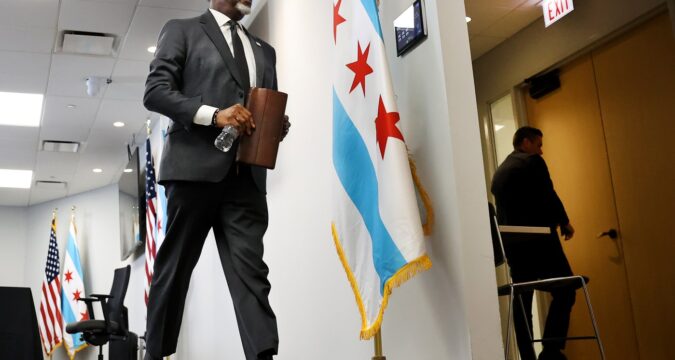
Mayor Brandon Johnson on Tuesday said it’s now up to Cook County state’s attorney Eileen O’Neill Burke to decide whether to prosecute federal immigration agents for crimes they committed in Chicago, after he signed an executive order he said lays the groundwork for the unprecedented move.
Speaking at a City Hall news conference, the mayor sought to redirect focus from his office’s authority by saying it’s up to Burke to approve criminal charges. But he declined to say whether any specific incidents fit the bill, a sign that his office does not have imminent plans to test out the order.
“So I personally, I’m not looking at cases,” Johnson told reporters when asked if he was going to act on his new decree. “I don’t have jurisdiction authority over the state’s attorney, right? … We’re prepared and willing to always lead and to go first to create a pathway for accountability, and then, like any other case, the state’s attorney has their jurisdiction to decide if they’re going to move forward with prosecution. But that’s the autonomy that the state’s attorney has.”
While he was careful Tuesday not to step on Burke’s toes, Johnson said he believes “that as a country, there is a growing groundswell of support for accountability” for the “abusive and deadly force” he said President Donald Trump has ordered federal agents to use.
And the mayor noted that progressive Philadelphia District Attorney Larry Krasner has joined other prosecutors in sharing strategies to potentially prosecute federal immigration officers who violate state laws.
Burke is not part of that coalition, though she has not disputed her office could pursue such cases if provided evidence supporting criminal charges.
Legal experts have said state prosecutors can indeed go after federal agents, but there are challenges if the agent was on duty. One immigration agent is currently facing a misdemeanor battery charge in Cook County, accused of throwing a man to the ground who was filming him at a Brookfield gas station while the agent was off duty.
Johnson’s remarks followed his Saturday decree, dubbed “ICE on Notice,” that directs Chicago police to record evidence of misconduct during immigration raids. The mayor’s office then can direct the Police Department to recommend felony charges to the state’s attorney’s office, according to the order.
Cook County State’s Attorney Eileen O’Neill Burke speaks at a City Club of Chicago luncheon, Dec. 2, 2025. (E. Jason Wambsgans/Chicago Tribune)
Johnson on Saturday said his order had full support from Burke, only for Burke to say that was “not true.” That sparked a back-and-forth between the offices as Johnson’s spokesperson said Burke’s office in fact provided feedback on the order’s language, which the state’s attorney’s team rebuked.
Burke’s office on Monday said “a thorough analysis is being conducted” to assess the legality of Johnson’s order.
Burke’s spokesperson did not immediately respond to request for comment Tuesday. Johnson said Tuesday the decree was more him using “authority to create a pathway for accountability” so other Democrats can fulfill their “responsibility” in this moment.
“I have repeatedly said that we all have to work together and ultimately build progressive power and strength as we push back against the Trump administration and work to protect all of the people of this country,” Johnson said when pressed on whether he and Burke were on the same page. “As far as any individual call, that’s something that that person has to be drawn to do. That has to be a personal conviction.”
The unusual order was touted by the freshman mayor as a first-of-its-kind effort to rein in the excesses of Trump’s aggressive deportation campaign against Democratic-led cities such as Chicago, even as the details of how enforcement would work remain fuzzy and have been questioned by Burke.
Burke took office in December 2023 after winning the Democratic primary as the more moderate candidate. She and Johnson have largely avoided the public fracas that punctuated their predecessors, former Mayor Lori Lightfoot and Cook County state’s attorney Kim Foxx, amid a historic decline in gun violence, but dissatisfaction over how to push back against federal agent activity could open a rift between the two leaders.
Last fall, Trump’s Operation Midway Blitz tore through the Chicago area’s immigrant neighborhoods and sparked intense community backlash against the U.S. Customs and Border Patrol and Immigration and Customs Enforcement agents’ aggressive tactics. Though the feds packed up after nearly three months of raids and demonstrations and now are focused on Minneapolis, leaders such as Johnson warn they expect Trump’s campaign to return to Chicago in the spring.
Those concerns come after last month saw two fatal shootings of U.S. citizens by federal immigration officers in Minneapolis. In Chicago, Marimar Martinez was also shot by a Border Patrol agent in October, on top of other allegations such as illegal use of force and improper use of tear gas.
The Trump administration has claimed federal agents have broad immunity from prosecution for their actions, but Johnson’s strategy chief, Sheila Bedi, has shot back “that’s not the law.” Such a standoff would be largely untested.


