
Conventional wisdom has it that Wolfgang Amadeus Mozart’s “Così fan tutte” has been a bankable opera house favorite for more than 200 years due to the whimsical cleverness of romantic plot and score alike, delighting audiences with its charming, if lengthy, perfidy among six principal characters as it makes lite-FM hay with the typically serious matter of infidelity.
Peter Shaffer’s play “Amadeus,” a recent hit for the Steppenwolf Theatre Company, expounded on that theory. Not only did its protagonist, Antonio Salieri, himself try and fail to set to music Lorenzo Da Ponte’s silly libretto about two young couples who fall for a loyalty test engineered by their elders, but his rival’s fast-paced ability to compose light but sublime music was enough in the play to drive Salieri to manslaughter most foul.
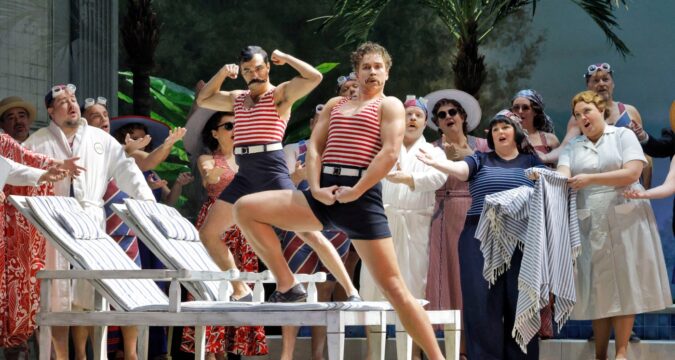
If whimsy is your bag, the very lively staging at Lyric, originally directed by Michael Cavanagh for the San Fransisco Opera in 2021, has it aplenty, notwithstanding the lack of color in Erhard Rom’s greige setting, a riff on architectural drawings. Cavanagh, whose staging is re-created here by Roy Rallo, sets the events in a swell, 1930s country club in the horsy environs of the nation’s capital (telephone number: Amadeus1790).
After mine host Don Alfonso (the robust Rod Gilfry) sets the indoor-outdoor caper among his members in motion with the aid of his sneaky staffer Despina (Ana María Martínez), we watch the sisters Fiordiligi (Jacquelyn Stucker) and Doraballa (Cecilia Molinari) joust with their ever-morphing macho beaus Ferrando (Anthony León) and Guglielmo (Ian Rucker) as they swim in the pool, work out on amusingly archaic treadmills, play badminton (badly), shoot pool and complete their calisthenics along with an ensemble alternately exercising and munching petit fours, a temptation with which I sympathize. Stucker and Molinari are costumed and bewigged by Constance Hoffman and John Metzner so as to truly appear sisterly, and they come replete with a whole gamut of facial expressions and little pointy hats that reminded me of pieces on the Parcheesi board. As befits the milieu.
But here’s the thing. Every so often, there is a moment of silence, a silent click into another world, a nod from conductor Enrique Mazzola and then Stucker’s Fiordiligi, or León’s Ferrando, launch into these beautiful expressions — “Come scoglio,” “Un’aura amorosa” — of the travails of love and its twin-sister, power, as if Mozart had just decided to temporarily abandon all of the implications and trivial comic assumptions of a caper opera and summoned beauty and vulnerability all at once. In some great rush of inspired feeling that, well, stands outside the walls of the country club games or whatever may have interested Emperor Joseph II, you might say.
One raises one’s head to the performers in those moments, or should, and the payoff is a renewed sense of what it’s really like to put yourself out there, be it in 1790, 1930 or 2026, without knowing not only whether that love will be returned in the moment but also being utterly unaware of how it will fare over time. In that regard, “Così fan tutte” is an otherwordly experience and that’s really why it has stayed an opera house favorite — even if audience think they are just having fun and opera houses are happy to be selling that perception.
With all due respect to Martínez, whose vocal performance is filled with amusing outre contrasts, entertaining all, this staging is dominated by Stucker and the authentic and unpretentious Molinari. Stucker’s singing is transporting throughout (Fiordiligi succumbs to the temptations of the flesh far more reluctantly than Dorabella, so Stucker has the best part) and the deft American soprano’s ability to switch style and find that which works upon the heart, not just the funny bone, is quite something. She offers here the most invigorating of performances, technically adroit but also informed by equal measures of artistry and youth, and there’s a humility to her singing, along with a sense of her character’s smallness in the face of life’s travails and machinations, few of which Fiordiligi has lived long enough to comprehend.
Rucker and León certainly fill out their roles vocally and comedically, but the women have all the power here, which is the only way really to do “Così fan tutte” these days. The audience has fun, of course, but one cannot say that of the four lovers in the thick of the fray, the pain forgotten by those who have grown older and remember it only as sport.
Chris Jones is a Tribune critic.
cjones5@chicagotribune.com
Review: “Così fan tutte” (3.5 stars)
When: Through Feb. 15
Where: Lyric Opera House, 20 N. Wacker Drive
Running time: 3 hours, 30 minutes
Tickets: $47-$379 at 312-827-5600 and lyricopera.org
https://www.chicagotribune.com/2026/02/02/review-cosi-fan-tutte-lyric-opera/


