
Author and journalist Garrett Graff once called Border Patrol the “Green Monster, ”America’s most “out-of-control law enforcement agency.”
On Friday, he testified that Border Patrol has only grown more menacing since writing about the agency in a 2014 Politico article, in large part because they have recently focused on policing the country’s cities — such as Chicago — rather than the border.
“Today, we’re creating something even more dangerous to our country, a masked monster of a law enforcement agency, one uniquely unsuited for its new power, authority, reach and funding levels,” Graff said at the second public hearing of the Illinois Accountability Commission.
Gov JB Pritzker launched the commission in October to scrutinize federal immigration agents’ actions during Operation Midway Blitz, the monthslong aggressive immigration enforcement campaign waged in Chicago. Agents arrested thousands of immigrants, most of whom didn’t have a criminal record, and repeatedly deployed tear gas and pepper spray during the operation.
“Unjustified” use of chemical crowd-control weapons was the commission’s main topic of conversation at its December meeting. An ICE Accountability Project launched by former Chicago Mayor Lori Lightfoot and a commission helmed by faith leaders are also attempting to publicly document agents’ actions.
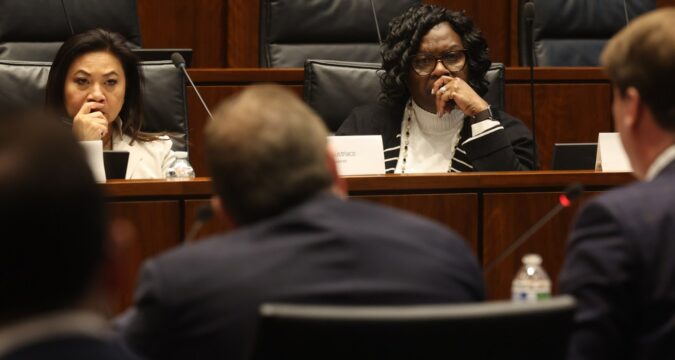
On Friday, about 50 residents and community leaders gathered downtown to hear from experts, such as Graff, on alleged overreach by agents. Graff testified that the Immigrations and Customs Enforcement and Customs and Border Protection agencies have long been “troubled.”
Author and journalist Garrett Graff speaks at a public hearing of the Illinois Accountability Commission, Jan. 30, 2026. (Antonio Perez/Chicago Tribune)
He cited a statistic, included in the 2014 article, that between 2005 and 2012 nearly one CBP officer was arrested for misconduct every single day. But until recently, agents managed to go about their work in a way that “didn’t cause ordinary law-abiding U.S. citizens to fear for their lives,” he said.
“Border Patrol and ICE are just not trained, prepared or accustomed to patrolling regular America and rolling through neighborhoods, school grounds and parking lots,” Graff said. “They’re not regular police, and they don’t know how to behave or navigate urban civilian environments.”
“They don’t have the muscle memory or de-escalation skills of dealing with angry citizens or innocent police,” Graff continued. “It’s clear that many of them lack real world policing skills. The fact that they’re instead approaching their work not as law enforcement, but as an occupation and military force is clear in the language officials are using.”
The commission, headed by former federal Judge Rubén Castillo, also released its preliminary report Friday which laid out issues it would like to address, such as limiting agents’ use of tear gas, pepper spray and masks that conceal their identity. The report said, for example, it would want to improve “existing federal standards for use of crowd control weapons.”
However, it offered little insight into how it would accomplish these goals. The commission is restricted by the state’s limited authority. It has no subpoena power and no direct law enforcement authority. It simply said it would be interested in hearing proposals from the public.
Members of the public are also now able to submit information on excessive force directly to the commission through an online interest form, which followed a Tribune report from last year highlighting a lack of one. The commission’s final report is expected by the end of April.
“We will have conversations with those in local law enforcement to suggest prosecutions that should be occurring even as we speak. That’s where we’re headed,” Castillo said Friday. He’s previously said “nothing is off the table” as far as recommendations the commission can make to the state.
Pritzker also requested this week that the commission examine the conduct of high-ranking Trump officials, such as U.S. Secretary of Homeland Security Kristi Noem and Greg Bovino, the face of Chicago’s operation who was reportedly ousted from his role of “commander at large” this week following the death of U.S. citizen Alex Pretti in Minneapolis.
“Bovino packing his bags cannot detract from our mission accountability,” Pritzker said in a news release. “Greg Bovino, Kristi Noem, and Donald Trump’s other lackeys should find lawyers because they must still be held responsible for the killings and the damage they’ve done to our country.”
Deborah Fleischaker, who previously was the Department of Homeland Security’s executive secretary, suggested at Friday’s hearing that forcing agents to reapply for their jobs might be a way to increase training and vetting among a force that’s rapidly swelled.
She testified that federal immigration agents have prioritized arrest quotas rather than public safety, inflaming tensions in Chicago and beyond. She acknowledged that immigration enforcement has never been perfect but said it was “constrained by internal guardrails.”
Throwing out policies that prevented enforcement at “sensitive locations” such as schools and hospitals has been particularly damaging, Fleischaker said.
“It should not be controversial to say that children should be able to attend school without fear that a parent will be arrested in the carpool line, that families should seek shelter during natural disasters without fear of immigration enforcement, or that parents should be able to take sick children to the hospital,” she said.
https://www.chicagotribune.com/2026/01/30/pritzker-illinois-accountability-commission-border-patrol/


