
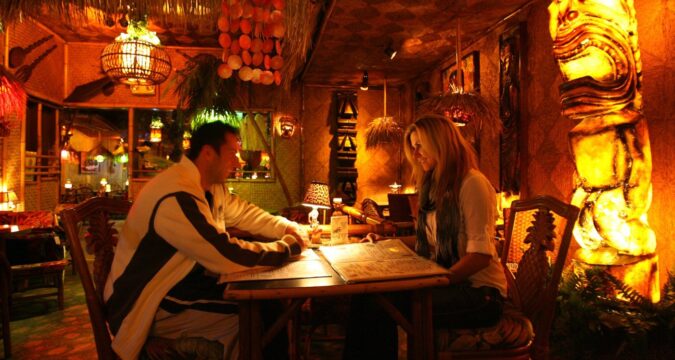
For decades, Chicagoans have looked for an easy escape from winter’s bitter cold and mounds of snow. Generations of them have found a temporary reprieve inside the small clubs, lounges, bars and restaurants that cited Pacific Ocean island escapes as their inspiration.
Many of these establishments popped up during or after World War II, when service members were shipped to the South Pacific for duty. Others were inspired by the Rodgers and Hammerstein musical and 1958 film of the same name — or “Gilligan’s Island,” or Elvis Presley in 1961’s “Blue Hawaii.”
But let’s take a moment to discuss authenticity. Those who dreamed of re-creating crystal clear waters and lush botanical scenery with lulling music in Chicago were guided by their own interpretations of what island life, cuisine and art should be — not what it actually was.
Chinese lions dance outside Jimmy Wong’s restaurant to celebrate Chinese New Year on Feb. 12, 1965. (Chicago Tribune historical photo)
Others — Won Kow and Jimmy Wong’s included — served American versions of traditional food. Though tropical drinks were on the menu, those weren’t the focus of the dining experience.
A search of the Tribune’s archives to find photographs of these local places was more complicated than expected. We hit a dead end on: Ted Cirals’ House of Tiki; Joker Joe’s Typhoon Club; Shanghai Lil’s; South Pacific Restaurant; Tiki Lounge on Lawrence; Tong’s Tiki Hut in Glendale Heights and Villa Park; Trade Winds; and The Tropics Bar in the Hotel Chicagoan.
Still, there are a few local places that will transport you to a warmer climate without leaving the Chicago area.
Hala Kahiki — which means house of pineapple — in River Grove has been serving up potent punches since 1964.
Three Dots and a Dash, 435 Clark St., Chicago, opened in 2013, and remains the go-to tropical terrace in the city.
Zombie Punch, a popular drink for several people, is served on fire Aug. 8, 2014, at Three Dots and a Dash, 435 N. Clark St., Chicago. (Jessica Tezak/Chicago Tribune)
Here’s a look back at a sampling of long-gone island oases we wish we could duck into from the cold this winter.
Why do we miss Chicago restaurants so much when they’re gone? You could write a book
Bamboo Room at Country Club Hotel
The Bamboo Room was a tropical-themed cocktail bar located in the Country Club Hotel, 6930 South Shore Drive, Chicago, from the mid-1940s to the 1960s. (Chicago Tribune)
6930 South Shore Drive, Chicago
In operation (according to Tribune archives): 1943-1963
Tribune critic Kay Loring enjoyed a buffet “and its modest price” on the hotel’s ninth floor in 1961, but the Bamboo Room received few reviews in the paper.
There was, however, news of a “hotel bar holdup” on Sept. 12, 1949. Three bandits stole $541 and $1,600 worth of jewelry and another $500 from the Bamboo Bar’s till, the Tribune reported.
The hotel — which was across the street from the South Shore Cultural Center — closed in the early 1970s and is now an apartment complex.
Black Pearl
Dorothy Owens and Edman Chin are at the Black Pearl restaurant, 590 W. Diversey Parkway in Chicago, on April 13, 1963. The restaurant was inspired by tropical locations in the South Pacific. (Arthur Walker/Chicago Tribune)
590 W. Diversey Parkway, Chicago
In operation (according to Tribune archives): 1963-1992
Loring wrote the Polynesian cafe’s owners Frank Peck and Lewis Mustari “have never been closer to the South Seas islands than California,” but recruited knowledgeable chefs to prepare the Black Pearl’s cuisine.
The decor was bamboo, traditional tapa cloth, straw and exotic props — including seashells and wood carvings.
Allen Chin was the second owner of the Black Pearl restaurant. (Chicago Tribune)
“The food is quite tasty,” Loring wrote. “We thoroughly enjoyed the crispy egg rolls, the lobster almond, the beef imperial, the beef with snow peas.” She complimented Chef Jimmy, who had apprenticed at Trader Vic’s in San Francisco, for his recipes.
Allen Chin became the restaurant’s owner in 1964, and its focus became Cantonese and American recipes — including “chop suey to go.” Chin moved the restaurant to 28 W. Golf Road, Schaumburg, in the 1970s.
Lincoln Park Plaza now occupies the Lakeview site.
Don the Beachcomber
Employees of Don the Beachcomber from the Philippines and China make the first contributions to the Chicago Herald-American’s “Buy a Bomber” campaign, circa 1942. Max Alexandrio, from left, John Lee, Tafa, Don the Beachcomber, Liani, Tommy Tobalero and Lee Jone drop their tips into a giant clamshell. (Chicago Herald-American archive)
101 E. Walton Place, Chicago
In operation (according to Tribune archives): 1940-1981
“Restaurant with man’s name has lady in control,” read the headline to Loring’s review of the restaurant in July 1958.
Donn Beach (formerly known as Ernest Raymond Beaumont Gantt) founded the original location of his namesake bar — nothing more than a shack — in Hollywood in the early 1930s. It’s there where he mixed fresh juices, a variety of rums and experimented with garnishes to create his secret tropical drink recipes.
Sunny Sund, owner of Don the Beachcomber’s Chicago location, at the restaurant on May 8, 1958. (Harold Norman/Chicago Tribune)
Sund, a Minnesota native, met Beach and quickly became enamored with him and his enterprise. They became partners in business, then in life in 1937. She brought class, dedicated staffers and celebrities to the expanded operation. The private relationship ended in divorce in 1940, which gave Sund the opportunity to open her own Chicago location of the restaurant. Her new business partners, however, had connections.
Don the Beachcomber’s restaurant served Cantonese-style food. (Chicago Tribune historical photo)
“She was very much involved with the mob,” Sund’s daughter wrote in “Sunny Sund: The Woman Behind Don the Beachcomber, Inc.” “They were eager to partner with her and called on her to do so many times.”
Sund expanded the franchise around the U.S., and Beach retreated to Hawaii after his service during World War II.
Hawaiian Room at the Congress Hotel
The Hawaiian Room at the Congress Hotel opened May 26, 1933, according to this advertisement published that day in the Tribune. (Chicago Tribune)
520 S. Michigan Ave., Chicago
In operation (according to Tribune archives): 1933-34
The Polynesian-themed establishment at the Loop hotel offered “a deluxe international dinner” for $2 (or $51 in today’s dollars) and dancing to the music of an orchestra made up of native Hawaiians during its grand opening May 26, 1933. The Hawaiian Room replaced an old formal dining room, the Tribune reported.
But the theme didn’t last. The room was transformed into a French dining room in February 1934.
Honolulu Harry’s Waikiki
Honolulu Harry’s Waikiki, 804 Wilson Ave., Chicago, flew in authentic bands, singers and dancers from Hawaii for its entertainment. (Chicago Tribune)
804 Wilson Ave., Chicago
In operation (according to Tribune archives): 1950-1962
Musical groups were flown in from the Hawaiian islands by club owner “Honolulu” Harry Nakamura to be the featured entertainment.
The Kalima brothers played typical hula fare, but also a variety of others genres that “knock the customers out of their rattan chairs,” the Tribune’s William Leonard wrote in January 1953. The Hilo Hawaiians made their mainland debut at Honolulu Harry’s in 1959.
But when Nakamura’s wife filed for divorce in July 1962, she alleged he had plans to move out of state. That’s the last time Honolulu Harry was mentioned in the Tribune.
Kahala Terrace
In August 1974, Tribune critic Kay Loring enjoyed Kahala Terrace in Northbrook’s “unusually good food in the Chinese-Cantonese tradition.” (Chicago Tribune)
3065 Dundee Road, Northbrook
In operation (according to Tribune archives): 1973-1993
Brothers Walter and Bob Chinn were born in Minnesota, but their family’s restaurant legacy is well-known in the Chicago area.
Bob Chinn operated Golden Pagoda in Evanston and House of Chan on Green Bay Road in Wilmette in the 1950s. Walter Chinn was maitre d’ at Kon-Tiki Ports and ran Chan’s Tea House in Highland Park. Together they opened Kahala Terrace in 1974, which featured “unusually good food in the Chinese-Cantonese tradition accented with an occasional American touch such as steak with salad and french fries,” Loring wrote. The “luau” dinner began with soup or juice followed by a “puu-puu platter” of assorted appetizers. Exotic mixed drinks were the restaurant’s specialty.
Bob Chinn in front of his restaurant, Bob Chinn’s Crab House, in Wheeling on Sept. 7, 1989. (Michael Fryer/Chicago Tribune)
Why Northbrook? Parking in the White Plains shopping center was plentiful, there was easy access to the Kennedy Expressway and an industrial complex was on the rise nearby.
In the early 1980s, Bob Chinn sold his half of Kahala Terrace to Walter Chinn. Bob Chinn’s Crab House opened on Dec. 23, 1982, in nearby Wheeling. Kahala Terrace remained open into the early 1990s. Walter Chinn died in 1995, and Bob Chinn died in 2022.
Kon-Tiki Ports at Sheraton-Chicago Hotel
The Papeete Room in the Kon-Tiki Ports restaurant in the Sheraton-Chicago Hotel at 505 N. Michigan Ave., Chicago. (Chicago Tribune historical photo)
505 N. Michigan Ave., Chicago
In operation (according to Tribune archives): 1961-1986
Stephen Crane was an actor from Crawfordsville, Indiana, who was probably better known as being the husband — twice — of Lana Turner. Like Don the Beachcomber, Crane opened a stylish Polynesian restaurant called The Luau on Rodeo Drive in Beverly Hills that became popular with celebrities — and expanded his restaurant portfolio across the country.
More than $1 million was poured into building this 350-seat luxury dining experience inside the Sheraton-Hotel Chicago (now Intercontinental Chicago) that was essentially several restaurants in one. Diners were seated in one of four dining rooms: Papeete, Singapore, Saigon and Macao.
“The Polynesian restaurant menu is usually Cantonese in style, and only Polynesian in concept,” Crane told Loring in 1965. “As a matter of fact, most of what goes into our Polynesian dishes — bean sprouts, water chestnuts, tomatoes, and pea pods — don’t even grow on the islands.”
Kon-Tiki Ports restaurant at the Sheraton-Chicago Hotel (now known as InterContinental Chicago), 505 N. Michigan Ave., was opened in August 1962. It featured four distinct dining rooms named for locales on the Pacific Ocean — Macao, Papeete, Singapore and Saigon, which is shown here. (Chicago Tribune archive)
“Despite these far-east sounding names, the hotel expects to do 75 percent of its business in American food orders and only 25 percent in Polynesian and far eastern dishes,” Tribune reporter James M. Gavin wrote before its opening in August 1962.
A change of ownership at the hotel meant closing it in 1986 for renovations. This also brought the closure of Kon-Tiki Ports — and the auction of its custom cocktail glasses, and 8-foot statues.
Kona Kai Polynesian Restaurant inside the Chicago Marriott Motor Hotel
Diners watch the hula show at the Kona Kai Polynesian Restaurant at the Chicago Marriott Motor Hotel (now Marriott Chicago O’Hare) at 8535 W. Higgins Road in Chicago. The restaurant opened in 1973. (Chicago Tribune historical photo)
8535 W. Higgins Road, Chicago
In operation (according to Tribune archives): 1973-1998
The 583-seat eatery was the largest of its kind in the city when it opened in late 1973. Yet Loring noted the ambiance provided by a waterfall, lush plants and soft lighting made Kona Kai more intimate than expected.
Kona Kai Polynesian Restaurant inside the Chicago Marriott Motor Hotel, 8535 W. Higgins Road, was the largest of its kind in the city when it opened in 1973, with seating for 456 people in the dining area and another 127 in a multilevel cocktail lounge. (Roy Hall/Chicago Tribune)
After a brief foray into Chinese food, diners lured Kona Kai back to its Polynesian fare in the early 1990s — and its popular music and hula shows. The Barefoot Hawaiians presented authentic island dances from Hawaii, Samoa and other Pacific Islands.
Though Kona Kai was part of a national chain, it outlived all other locations — remaining open into 1998.
Lost Lake
The Tic Tac Taxi drink at Lost Lake on April 16, 2015. (Dana J. Ardell/for the Chicago Tribune)
3154 W. Diversey Ave., Chicago
In operation (according to Tribune archives): 2015-2022
Lost Lake opened in early 2015 as a tiki-themed bar after acclaimed beverage director Paul McGee departed another well-regarded tiki-themed bar, Three Dots and a Dash. Lost Lake quickly became one of Chicago’s most esteemed cocktail bars, and was a finalist for a national James Beard Foundation Award for Outstanding Bar Program, in 2019 and 2020. In addition to the Beard nominations, it was named one of Esquire magazine’s best bars in America in 2017. It was also chosen as best American cocktail bar in 2018 by judges at Tales of the Cocktail’s Spirited Awards.
The Lost Lake tiki bar on April 16, 2015, in Chicago. (Dana J. Ardell/for the Chicago Tribune)
After closing because of the COVID-19 pandemic in March 2020, Lost Lake pivoted to sell bottled cocktails to go, winning the Tribune’s Readers Choice Takeout Award for best to-go cocktails for the year.
When it finally reopened in 2021, it did so without the tiki motif, which has come under fire for cultural appropriation. Instead, Lost Lake said it was embracing a tropical theme. Lost Lake closed in January 2022.
“As it turns out, a super-spreader surge that wiped out what would usually be our busiest time of year was the last little straw this camel could handle,” the Instagram post read. “Maybe someday we’ll be back in one form or another, but it looks like this is it for now.”
Polynesian Room at the Edgewater Beach Hotel
Johnny Pineapple, left, serenades Kealoha and Leilani inside the Polynesian Room at Edgewater Beach Hotel in Chicago, circa 1955. The maestro and his orchestra played during dinner and post-meal dancing at the venue. (Chicago Tribune archive)
5300 N. Sheridan Road, Chicago
In operation (according to Tribune archives): 1954-1964
Formerly known as the Marine Room, the island spirit arrived at the hotel just in time for New Year’s Eve. Described as romantic and exotic by the Tribune’s Will Leonard, the Polynesian Room embraced a dinner and dancing concept — emceed by Johnny Pineapple — with dimly lit terraces encircling the open dance floor.
Fred Natividad, left, and Louis Patrolla dust lamps on Dec. 31, 1954, at the Polynesian Room inside the Edgewater Beach Hotel in Chicago in preparation for New Year’s Eve. (George Quinn/Chicago Tribune)
“You want some plain old American dishes? Sure, You want ham and eggs? They’re served with fried pineapple and banana fritters. You want a filet mignon? It comes seasoned and simmered in an imported oyster sauce. You want ice cream? Cocoanut flavor you can have. But why have ice cream for dessert when you can have tropical guava, steeped in rum and served with cheese?” he wrote.
The Juan Carlos Copes revue from Argentina was the last act to appear at the Polynesian Room before it closed in January 1964 — and the Marine Room returned.
Trader Vic’s at the Palmer House
A giant head sculpted out of wood greets diners at the entrance to Trader’s Vic’s restaurant at the Palmer House in Chicago on Jan. 6, 2006. (Phil Velasquez/Chicago Tribune)
17 E. Monroe St., Chicago
In operation (according to Tribune archives): 1957-2010
Victor Bergeron was a man of adventure and pluck who had a wooden left leg (which had been amputated when he was 6) and a love of the islands (though he had never sailed there due to seasickness).
Bergeron borrowed under $1,000 to build his own restaurant in Oakland called Hinky Dinks. But it was after a night at Don the Beachcomber in San Francisco that he was really inspired.
“I felt I could do it better,” he told the Tribune in 1979.
‘Trader’ Vic Bergeron in the 1960s with some of the food and drink creations that are served at his restaurants. (Chicago Tribune archive)
Hinky Dinks became the original Trader Vic’s.
Bergeron opened the South Seas-themed Traders inside what was formerly the Chicago Room at the Palmer House on March 28, 1957, after a half-million dollar renovation. It was a homecoming for Bergeron’s wife, Helen Harwood, who was originally from the city.
“Suckling pigs, Indonesian lamb roast, hens and squab will be barbecued in the expensively fired ovens in full view of the guests,” Loring wrote in a preview.
Guests took an escalator to the hotel’s lower level where they were transported to a tropical locale that featured idols carved from coconut trees and decor that lived up to Bergeron’s reputation as a trader in native artifacts.
The Trader Vic’s dining room inside Palmer House in Chicago on Aug. 2, 2002. (Erik Unger/for the Chicago Tribune)
Trader Vic’s remained in the same location until 2006. New owners of the hotel canceled the restaurant’s lease, forcing it to move to 1030 N. State St. in 2008.
Want more vintage Chicago?
Become a Tribune subscriber: It’s just $1 for a 1-year digital subscription.
Thanks for reading!
Subscribe to the free Vintage Chicago Tribune newsletter, join our Chicagoland history Facebook group, stay current with Today in Chicago History and follow us on Instagram for more from Chicago’s past.
Have an idea for Vintage Chicago Tribune? Share it with Kori Rumore at krumore@chicagotribune.com.
https://www.chicagotribune.com/2026/01/29/vintage-chicago-tribune-tiki-bars-tropical-restaurants/


