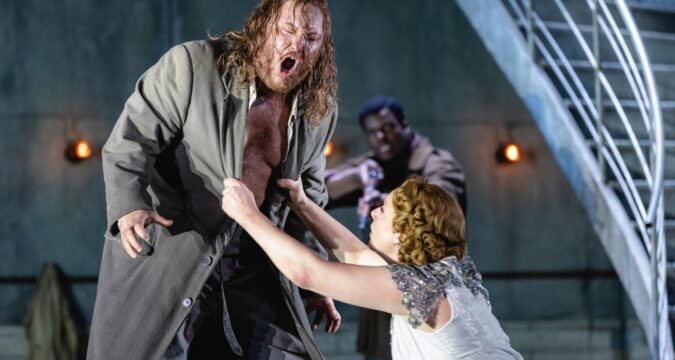
The Royal Opera House in Covent Garden opened its fourth revival of David McVicar’s famous 2008 production of the Richard Strauss opera “Salome” one day after the death of the Queen of England in 2022.
Can you even imagine? The relatively tame “Don Giovanni” (everything else is, by comparison) had been canceled the night before, but less than 48 hours after the death of Her Majesty, opera goers were plunging back into the height of operatic depravity as Salome makes orgiastic love, of a sort, to a severed head. Even as a book of condolence rested in the lobby. Talk about compartmentalization.
Not so necessary now in America, at least to many minds, as excessive behavior with catastrophic consequences has been rendered ubiquitous. We’re all too familiar with demands taken to the extreme.
McVicar hardly stinted on depravity. His eye-popping staging, now seen Stateside for the first time at the Lyric Opera of Chicago, not only imagines a fascistic underworld (we are nominally in pre-war Italy), but his underworld has an underworld from which the ill-fated Jochanaan (Nicholas Brownlee) first emerges like Typhon, roaring his Biblical resistance to the machinations of his crazily consumed admirer, Salome, sung at the Lyric by Jennifer Holloway. Holloway spills out Salome’s all-consuming pain even as she explains why she loves it, and thus has to have him, so much. And the actions of these players have observers: a disempowered domestic staff, forced only to watch in a kind of trembling horror, like Palm Beach waiters seeing altogether too much, linking this work based on Oscar Wilde’s famously controversial play to classic Greek tragedy.
Salome is not the first woman in McVicar’s carefully kinetic production we see prone, maybe drunk, stoned, somehow inured to the agonies of the past. The opening image is of another soul, splayed on set designer Es Devlin’s stairway down to hell, even as the fascistic one-percenters cavort upstairs, the set structured so we see little more than their partying torsos, oblivious to what they have wrought and how much the consequences are about to come home to roost.
Desire as a sedative, desire as a consequence of being desired, desire as a fetishistic perversion, desire as a ticket to a personal hell: all of these are themes of the Strauss opera, which has a libretto from Hedwig Lachmann’s translation of Wilde’s scandalous drama (which I last saw in Chicago back in 1995 at the Athenaeum Theatre in a whiteface treatment from the radical British writer-performer-director Steven Berkoff, also set at a posh dinner party, as it happens).
The music itself does a number on you, of course, even without McVicar’s horrifyingly maximalist staging. Its seductive chords, its shocking sounds, somehow pierce one’s normal resistance, cutting through snow and ice and whatever else has gummed up one’s works.
But it’s Salome on the marquee and Holloway plants her feet firm on the stage, even rocking her soles to ensure terra firma before blasting out what Salome wants, feels and now has become (or always was). Brownlee is every bit as determined to counter her demands and thus this 100-minute opera (long enough, god knows) is at its peak when his head remains on his shoulders and we are listening to the astonishing musical back and forth along the lines of “I want to kiss your mouth” and “go right to hell, lady.”
McVicar eschews the traditional Dance of the Seven Veils and I won’t spoil what he does exactly, except to say that he has Salome traverse through the world as if on a kind of treadmill through a fascist landscape. McVicar and Holloway, an American who makes her Lyric debut with this performance, have no interest in the erotic Victorian combo of delicacy and determination that so interested Wilde; on the contrary, this Salome starts and ends everything low down in the body, where deeper truths reside. Holloway delivers a phenomenal leading performance, not least because of its unstinting focus on all-consuming desire, and it was duly greeted by great roars of approval at Sunday afternoon’s opening.
Lyric had a late casting change when it came to Herod, with Alex Boyer solidly assuming the role. But finding this is a primal singing party with a stiff price of entry, gravitas-wise, especially with the conductor Tomáš Netopil whipping the Lyric orchestra into an atypical frenzy, Tanja Ariane Baumgartner’s Herodias assumes a slightly cynical air, aptly enough for what can Herodias really do, sending one’s mind musing on issues of resistance and complicity, while Ryan Capozzo’s Narraboth implies a character who once had potential, prior to being consumed by the multifarious dimensions of desire.
That’s really what McVicar’s not-to-be-missed production is saying: we are all of our milieu, all consequences of our past, all subject to the pressures both of our bodies and our environment.
One finds oneself wanting to yell “stop,” both in and outside the opera house. Which is the point of the deadly experience. To life!
Chris Jones is a Tribune critic.
cjones5@chicagotribune.com
Review: “Salome” (4 stars)
When: Through Feb. 14
Where: Lyric Opera of Chicago
Running time: 1 hour, 40 minutes
Tickets: $47-$375 at 312-827-5600 and lyricopera.org
https://www.chicagotribune.com/2026/01/26/review-salome-lyric-opera/


