
In 1988, Public Enemy released the song “Don’t Believe the Hype,” which warns of being bamboozled by false narratives coming from the corridors of power. It speaks of the peril of being ignorant to the truth. Today, this message is more important than ever. We live in a day in which the seeking of truth seems to have become a forgotten value and the difference between truth and lies has been blurred by those promoting their own power.
We see the distortion of truth daily from the golden Oval Office and the crowd of false witnesses attending it without ever voicing criticism. The administration is cavalier in its repetition of hype, be it about false crime reductions under federal watch in Washington, false assertions about affordability or repetitions of fictitious election claims so blatant we all know them as “the Big Lie.”
We see the distortion of truth too often in the media and elected officials. These are dark times for the media, when misinformation and disinformation are as rampant as a mentality that equates “bias” with stories one side doesn’t like, as former journalist Dan Rather explains. In recent months, one of the four major TV networks has drawn increasing scrutiny for political decisions made in place of editorial judgments. And two of the four major networks have laid off journalists of color disproportionately since the 2024 election, diminishing the aperture through which the news is reported.
We also see the distortion of truth from pulpits that have chosen to compromise their holy books out of fear because they have bought into the blurring of truth. We saw this during the COVID-19 pandemic; we witness this today with too many Christian leaders promoting the great replacement conspiracy theory.
Yes, this intentional distortion of the truth, “the hype,” has become the norm; unfortunately, truth has been put on life support. This surrender to the hype has allowed narratives to demonize individuals and entire races of people, legitimized mistruths and stereotypes, allowed character assassination to become acceptable, sanctioned the weaponization of religion and authorized killings.
The hype is deadly. Just ask the families of Renee Good and Silverio Villegas González.
The killing of Good in Minneapolis by a federal immigration agent fills us with outrage. Following this wholly avoidable tragedy was a horrific wake of hype, which some have called a “torrent of untruths.” ICE agents spread mistruths about the situation, the secretary of the Department of Homeland Security made statements that contradict videos and the Department of Justice pushed for an investigation into Good’s widow. This tragic situation does not surprise us: We have witnessed this same systematization of lies and hype. We have seen the same state-sanctioned killing under similar circumstances, followed by the same fictitious spin, here in Chicago.
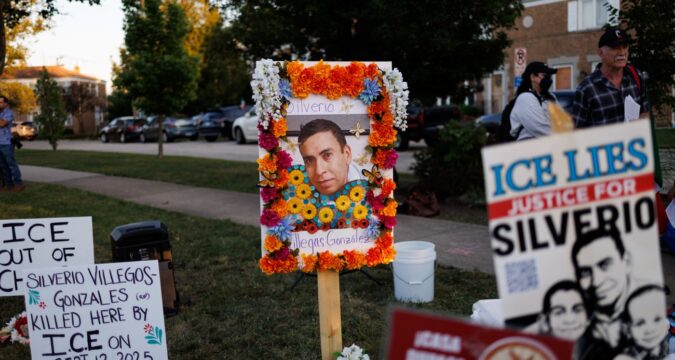
Early on in Operation Midway Blitz, an ICE agent shot and killed González, 38, a father of two. ICE responded to this killing with lies, that González was a violent criminal, that he attempted to drive his car into agents and that the agent who shot him was seriously injured. All of these claims were proved untrue. The president, one of his Cabinet secretaries and the federal agent who killed this man all responded to the incident with lies, with hype.
This playbook of lying in the face of fact, trotted out first in Chicago, has been employed in Minnesota.
Twentieth century political philosopher Hannah Arendt learned about the role of hype in her study of how the Nazis perpetrated their atrocities. “What makes it possible for a totalitarian or any other dictatorship to rule is that people are not informed; how can you have an opinion if you are not informed? If everybody always lies to you, the consequence is not that you believe the lies, but rather that nobody believes anything any longer.” That propaganda playbook of hype has hit America hard this past year.
When the line between the truth and lies become blurred, so does the line between right and wrong. That’s when righteousness and justice become merely personal opinion and morality is rendered so subjective that a world leader can claim immunity from international law and the Constitution and that he is only limited by his “own morality.”
Under these conditions, hate becomes acceptable, conscience is silenced, division is fostered, murder is sanctioned, and evil is justified. It is a sad day for America and for humanity when morality is relativized.
Recently, we honored the living legacy of the Rev. Martin Luther King Jr., a guiding light for each of the four of us. In an early sermon from 1954, “Rediscovering Lost Values,” King stressed the importance of ensuring universal morality was at the center of American society. “The first principle of value that we need to rediscover is this: that all reality hinges on moral foundations. In other words, that this is a moral universe, and that there are moral laws of the universe just as abiding as physical laws.”
The hype of our present day is not only dangerous for this present moment but also for the generations to come. We cannot leave our children a relativistic world where might makes right, where moral vision has been intentionally blurred, because that will shape them. When truth and lies, and right and wrong, are blurred, souls and conscience die. So, too, do very real people such as González and Good.
Don’t believe the hype. Believe in human morality and strive to restore that morality to our ailing America.
Chicago faith leaders Rabbi Seth Limmer, the Rev. Otis Moss III, the Rev. Ciera Bates-Chamberlain and the Rev. Michael Pfleger joined the Tribune’s opinion section in summer 2022 for a series of columns on potential solutions to Chicago’s chronic gun violence problem. The column continues on an occasional basis.
Submit a letter, of no more than 400 words, to the editor here or email letters@chicagotribune.com.
https://www.chicagotribune.com/2026/01/25/opinion-hype-donald-trump-administration-lies-renee-good/


