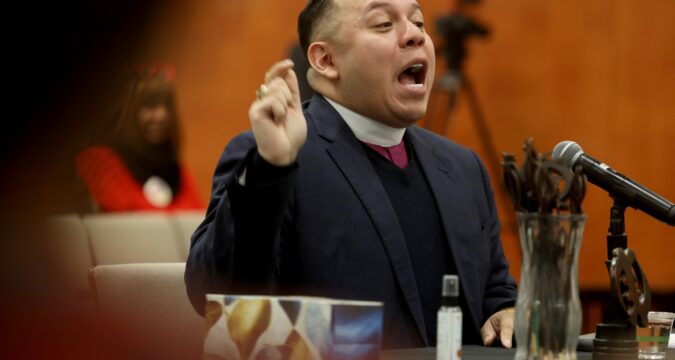
John-Michael Villarreal, a bishop and former high school teacher, was teaching a five-person advanced Spanish class in the Chicago area last year when he noticed his students weren’t acting like their usual, upbeat selves.
Villarreal said he asked the students, all native Spanish speakers who have immigrant parents, what was wrong. A student, with her voice shaking, replied that federal immigration agents were in her neighborhood. She didn’t know what to do if they knocked on her door, Villarreal said.
“I had no clue what to answer, because prayers and thoughts were not going to be enough,” he said. “Prayers and thoughts was not going to stop ICE from knocking and pounding down their doors. Prayers and thoughts was not going to change the situation.”
Villarreal spoke this week at a public hearing of the Human Rights, Anti-Authoritarianism, Reparatory and Restorative Truth Telling Commission, held at the McCormick Theological Seminary in the Hyde Park neighborhood. During two days of testimony, faith leaders and elected officials shared various harms and civil rights violations they alleged to have witnessed during Operation Midway Blitz, the monthslong aggressive immigration enforcement campaign waged in Chicago.
Federal agents arrested thousands of immigrants, most of whom didn’t have a criminal record, and repeatedly deployed tear gas and pepper spray during the operation. Various initiatives, including a state accountability commission and the ICE Accountability Project launched by former Chicago Mayor Lori Lightfoot, are also attempting to publicly document agents’ actions.
“ICE raids and other fear-based policing produce predictable human-rights violations, because human dignity is not negotiable,” said Iva Carruthers, the director of McCormick Theological Seminary’s Center for Reparatory Justice, Transformation and Remediation.
Villarreal, a pastor at Asamblea Misionera del Evangelio Completo, testified that the primary concern of his students weren’t themselves, but their family members.
“They didn’t have questions of, ‘What am I going to wear to prom?’ They didn’t have questions of, ‘What movie am I going to see next week,’” he said. “Their questions were, ‘What am I going to do if Mom doesn’t come home?’ Their questions were, ‘What am I going to do if Dad is stopped on our way to church?’”
He noted that the students in this particular class were high-achievers who had 30 college credit hours before they graduated high school. Many of them had emergency bags backed just in case of an arrest, Villarreal said.
“These are not troubled students, but these children are learning fear before they learn hope,” Villarreal said. “These families I’m talking about, they’re not criminals, they’re not drug dealers. They’re cooks, they’re janitors, they’re caregivers, they’re landscapers, they’re factory workers, they’re churchgoers.”
Villarreal also said, for the first time in his life, he felt nervous speaking Spanish in public because of the operation. He said he was getting pizza with a friend from Mexico when he saw federal immigration agents. Other Latino U.S. citizens have told the Tribune of instances when they were racially profiled by agents during the operation.
“I fit the profile, (my friend) fit the profile of who they were looking for,” Villarreal said. “Even though they were not there for enforcement, and they were there to just eat, in that moment, fear entered my heart.”
Tariq El-Amin, the resident imam of Masjid Al-Taqwa in Calumet Heights, testified that he witnessed the aftermath of a vehicle crash involving a U.S. Customs and Border Protection vehicle in October. Federal agents deployed tear gas on a residential block of the East Side neighborhood as residents demanded they leave. El-Amin said the atmosphere was one of powerlessness and confusion.
“Neighbors were present. Children were present. Elders were present,” El-Amin said. “By the time I arrived, the agents were gone, but the trauma remained.”
Related Articles
Immigrants often don’t open the door to ICE, but that may no longer stop officers
Iranians in Chicago still struggle to communicate with loved ones in Iran after deadly protests
Lawsuit over use of force by immigration agents in Midway Blitz officially dismissed
Federal officers detain a 5-year-old boy who a school official says was used as ‘bait’ in Minnesota immigration arrest
Chicago Bulls’ Tre Jones, a Minnesota native, saddened by ICE crackdown in home state: ‘It’s tough to watch’
Even in places of worship, people don’t entirely feel safe, El-Amin said. He said members of his congregation have asked what happens if agents target their worship space.
“(Masjid Al-Taqwa) is a place of prayer, a place of healing, of community service and spiritual refuge. But even that sense of sanctuary has been shaken,” El-Amin said. “The question is not what our response would be. The question is why people now feel unsafe in spaces that should be protected. When fear enters places of worship, something fundamental has been damaged.”
Several local officials testified at the hearing. Stacy Davis Gates, the Chicago Teachers Union president, said the union created “sanctuary teams” to help protect students during Immigration and Customs Enforcement activity. Communities also formed “walking school buses” to transport kids as well as mutual aid groups to deliver groceries and homework during the heightened immigration enforcement.
She also criticized the Trump administration’s dismantling of the Education Department, saying “they are defunding the public good in order to finance the war on Minneapolis, the same one that they are roving around the country and have promised to return to our neighborhoods.”
Illinois Attorney General Kwame Raoul said federal immigration agents used “unlawful and violent” tactics while in Illinois, including during a raid on a South Shore apartment building, where agents reportedly forced residents out of their homes and zip-tied some of their hands.
On Wednesday, the Illinois Department of Human Rights filed a housing discrimination charge alleging the owner and management of the complex prompted the raid by telling the federal government there were Venezuelan immigrants living in the complex who were “unauthorized occupants …”
Raoul said Trump’s “circumvention of the rule of law” has required a “multifaceted approach” from his office. He pointed to the lawsuit Illinois joined last year challenging the constitutionality of Trump’s executive order ending birthright citizenship as something personal to him as the child of Haitian immigrants.
“African Americans and other historically marginalized groups should not have to fear being unlawfully detained by federal officers or any law enforcement,” Raoul said. “We should not have to fear the loss of citizenship, employment, legal protections, military recognition or face inequities in health care, education or other opportunities.”
https://www.chicagotribune.com/2026/01/23/chicago-faith-leaders-ice/


