
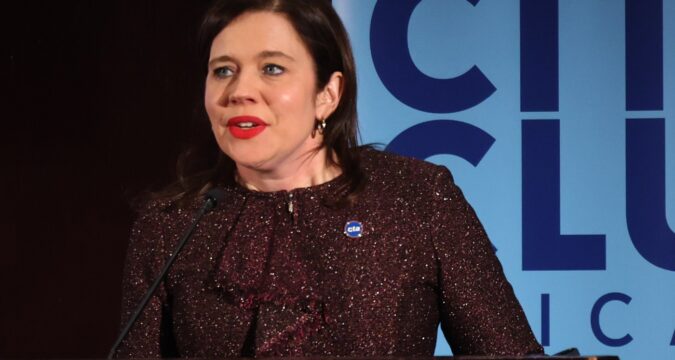
The CTA will focus on safety, cleanliness and improvements to bus service in 2026, its acting president, Nora Leerhsen, said Thursday.
Leerhsen’s speech at a City Club of Chicago luncheon comes at a critical juncture for the CTA. Until state lawmakers passed a landmark transit funding bill by the skin of their teeth last fall, the agency had spent months planning to make drastic service cuts and layoffs this year. But after lawmakers approved $1.5 billion in annual funding for mass transit, the agency reversed course almost overnight.
The CTA said it would no longer raise fares or lay off workers this year. Instead of cutting service, it said it could improve it.
But the CTA is also starting 2026 fending off threats from the administration of President Donald Trump, which last year froze almost $2 billion in federal grant dollars for the agency’s long-awaited Red Line Extension on the Far South Side before invoking high-profile violence on the system in threats it might withhold millions more dollars from the transit agency.
On Thursday, Leerhsen touted progress she said the agency had made in hiring and transit service while carefully observing how close the agency had come to disaster.
“The structural deficit faced by CTA, Metra, Pace and (the Regional Transportation Authority) could have led to the largest service cut in CTA’s history, threatening to derail the progress we’ve made in recent years,” she said.
The state’s landmark transit bill doesn’t go into effect until June. Agency officials have cautioned that they do not know exactly how much money the CTA will receive in new funding this year, and have thus far avoided making too many specific commitments regarding plans for service improvements.
Leerhsen has already announced that the agency plans to run Orange Line trains 24 hours a day. Currently, only the Red and Blue lines run 24 hours.
On Thursday, Leerhsen said the agency also plans to work to address “bus bunching” — when buses pile up and arrive one after another in quick succession — and large gaps in bus service.
“We’re really laser-focused right now at monitoring where we’re seeing bus bunching complaints come in, where we’re seeing gaps in service,” she said speaking with reporters after the City Club event.
Leerhsen said she also wanted the CTA to push for more bus priority infrastructure — like dedicated bus lanes — that she said would improve bus service, efforts that would require the cooperation of the Chicago Department of Transportation.
Leerhsen also touted the agency’s planned Red Line Extension, of which early-stage work is underway.
The CTA’s 95th Street station in the Dan Ryan Expressway median connects the end of the Red Line with multiple bus routes as seen on Dec. 15, 2025. (Brian Cassella/Chicago Tribune)
But in October, the Trump administration froze almost $2 billion in funds for the project, citing the agency’s diversity requirements for contractors. The CTA has maintained that the massive project remains on track, although sources have indicated that the agency could start having trouble continuing to make payments if the freeze continues.
In December, the U.S. Department of Transportation told the Tribune that the CTA had been informed it had “contracting practices that are inconsistent with Equal Protection principles of the U.S. Constitution” and would need to “eradicate” those practices to regain access to the grant funds.
When asked about the Red Line extension status by RTA board Chairman Kirk Dillard Thursday, Leerhsen reiterated that the agency was “full speed ahead” on the project.
“We are in an exchange with the federal government regarding certain requirements around it, we’ve been fully responsive, and we’re hopeful to have a resolution soon,” Leerhsen said.
Leerhsen also focused on safety Thursday, which she said is the issue that comes up the most when she talks with both riders and CTA employees.
Nora Leerhsen, acting CTA president, speaks during a City Club program at Maggiano’s Banquets, in Chicago, Jan. 22, 2026. (Antonio Perez/Chicago Tribune)
While violent crime on the system remains elevated from pre-pandemic levels, it has dropped about 10% since 2022.
Despite those improvements, the agency has become the target of threats from the Trump administration, which has threatened to withhold $50 million in federal funds from the agency unless it addresses safety issues to its satisfaction.
Transit leaders have at times struggled to reconcile their ongoing efforts to fight crime on the system with doubts about the intentions and approach of the Trump administration, which has repeatedly used the threat to withhold federal funds as a political cudgel against blue cities and states.
In December, the feds issued a “special directive” to the CTA, telling the agency to improve safety or face funding cuts. The Trump administration rejected the agency’s first safety plan, which included a boost to the number of Chicago police officers who participate in a program to patrol the transit system on their days off. The feds asked the CTA to submit an updated plan, which is still in the works.
Leerhsen said Thursday the agency was “working closely” with Chicago police on an updated safety plan to submit to the federal government.
Leerhsen also announced the CTA this week had begun a new “transit rider interaction program” in coordination with Chicago police officers who serve on the transit system. The program will involve groups of police officers lining train platforms and “getting on and off each train as it passes through to see if anything needs attention,” Leerhsen said.
“This visible law enforcement presence will serve as a deterrent to crime,” she said.
Leerhsen also spoke to the challenge of addressing safety concerns on a system that is open to the public 24 hours a day.
“CTA’s vehicles and platforms are in many respects a stage upon which the city’s greatest triumphs play out, while at the same time, yes, some of its tragedy,” Leerhsen said.
https://www.chicagotribune.com/2026/01/22/cta-safety-buses-cleanliness-nora-leerhsen/


