
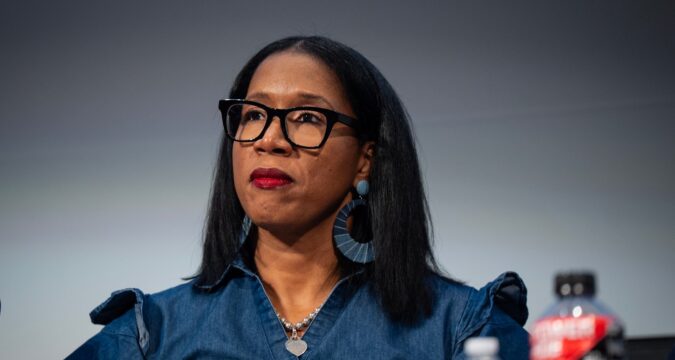
In a new TV ad, Democrat Melissa Conyears-Ervin declares to viewers she’s not “afraid to stand up to Donald Trump” and will “fight” for affordable health care and groceries.
Various graphics beneath her name flash that she will “Fight Trump and MAGA” and “Protect Medicare, Medicaid and SNAP from Trump’s Cuts,” referring to the Republican president’s “Make America Great Again” followers and the Supplemental Nutrition Assistance Program, issues befitting a U.S. House candidate seeking the Democratic nomination in a crowded race for the 7th Congressional District.
At the end of her ad, another graphic displays, “Melissa Conyears-Ervin, Democrat, 7th Congressional District.” But look a little closer, and in smaller letters are the words “State Central Committee.” The ad also says: “Paid for by Melissa for Chicago.”
The subtleties might not seem significant to the average viewer, but they signal a tightrope Conyears-Ervin is walking that allows her to pay for the ad with money from her more robust state campaign fund.
Generally, candidates for federal office are prohibited from using state campaign cash because state fundraising rules and contribution limits are much looser than federal restrictions.
But in seeking a seat in Congress and a position on the state central committee, both from the 7th Congressional District, Conyears-Ervin is taking advantage of a loophole in federal campaign finance law that allows her to use state campaign cash for the commercial.
While the ad is ostensibly for her campaign for state central committee — a state Democratic panel elected from each of the state’s 17 congressional districts with largely ministerial duties such as setting party rules and platforms, coordinating budgets, and planning voter turnout and candidate recruitment programs — it also helps her congressional bid by spreading a message appealing to congressional voters.
Conyears-Ervin, the current Chicago city treasurer, is among several candidates seeking the March 17 Democratic nomination for the downtown and West Side Chicago congressional seat being vacated by retiring U.S. Rep. Danny Davis.
By using the state campaign committee to pay for the ads, Conyears-Ervin doesn’t have to tap into her federal congressional campaign account, Melissa Conyears-Ervin for Congress, which had $223,775 in it as of Sept. 30, the last federal campaign reporting deadline.
In contrast, her Melissa for Chicago state campaign fund, which on Nov. 1 changed its purpose from helping her run for city treasurer to “state central committeeperson,” had $398,555 at the end of last year. That fund was boosted by $145,000 from two local political funds controlled by her husband, 28th Ward Ald. Jason Ervin.
The $72,500 contributions from the 28th Ward Democratic Organization and the Ervin for (Ward) Committeeman fund occurred on Dec. 31 — just two weeks before Conyears-Ervin began her TV ads. Each of those donations was just below the state limit of $72,800 but far in excess of the $5,000 federal limit a political committee can give to a candidate for Congress per election.
On Jan. 2, Jason Ervin transferred $72,500 back into his ward committeeman fund from his ward organization account.
The ad has prompted one complaint to be filed with the Federal Election Commission, alleging Conyears-Ervin is violating the prohibition on the use of state funds. The complaint contends the issues she raises in the ad are “clearly directed at voters for Congress and not for state central committeeperson.”
“It is clear that the Advertisement, paid for by a non-federal committee with non-federal funds can only be interpreted as an in-kind contribution from Melissa Conyears-Ervin’s non-federal committee to her federal committee in support of her campaign for Congress, in violation of the Federal Election Campaign Act,” said the complaint filed Jan. 15 by Nathan Bean of Chicago. Bean did not return calls seeking comment.
But Brian Svoboda, an attorney at Perkins Coie representing her campaign, called it “a meritless complaint that we are confident will be dismissed. The FEC has specific rules for candidates seeking multiple offices and this advertisement meets all the clear legal requirements.”
Thomas Bowen, a political consultant and spokesman for Conyears-Ervin, added that “the idea that fighting Donald Trump isn’t relevant to seeking Democratic Party office in 2026 is absurd.” The campaign also said the FEC complaint appeared to be legally defective due to an error by the notary who witnessed it.
A review of the ad by the Campaign Legal Center, a nonpartisan group founded and headed by former FEC Chairman Trevor Potter, said it was legal for it to be paid from state campaign funds.
Candidates running simultaneously for federal and state office “are allowed to spend money from their state campaign committee on ads with themes or messaging that overlap with their federal campaign, as long as the ads avoid referring to their federal candidacy or opponents in the federal race,” said Shanna Ports, the group’s senior legal counsel.
“An ad referencing only the state office and targeted to voters in the state election would not be tantamount to an (illegal) transfer of state funds to a federal committee, even if the ad has the ultimate effect of benefitting the candidate’s federal campaign,” Ports said.
Conyears-Ervin is not the only candidate using the same fundraising tactic. State Sen. Laura Fine of Glenview is a candidate in the crowded field for the Democratic nomination for the 9th Congressional District seat being vacated by retiring U.S. Rep. Jan Schakowsky of Evanston. Fine is also seeking a spot on the state central committee from the 9th Congressional District.
In a campaign mailer, Fine recalls how she fought an insurance company trying to cancel medical coverage for her husband, who had been injured in a car accident. Fine also lists accomplishments in the state legislature that include “guaranteed abortion rights,” “banned assault weapons” and “championed laws to unmask” federal immigration agents.
“Vote Laura Fine for 9th Congressional District,” the mailer says. Underneath, in smaller lettering, are the words, “Democratic Committeewoman.” The mailer was paid for by Friends of Laura Fine, her state campaign committee, which had $340,180 in cash on hand at the end of 2025. Her Laura Fine for Congress committee had $479,197 in cash on hand as of Sept. 30, the latest available federal campaign reporting date.
Democratic primary voters will find a change in the election of state central committee members on their March ballots.
Previously, Democratic voters cast separate votes for state central committeeman and committeewoman from their congressional district. But under a change in the law effective with the March primary, candidates of both genders run together under the title of “committeeperson,” with the top vote-getting male and female candidate winning a spot on the committee.
https://www.chicagotribune.com/2026/01/21/melissa-conyears-ervin-loophole-federal-campaign-spending/


