If regulators approve its merger with Norfolk Southern, competitors warn that Union Pacific could turn the city of Chicago into a hammer for seizing even more control of the industry.
Their concern centers on two tiny Chicago railroads that have hauled freight across town for all comers since the 1890s.
The Belt Railway Co. of Chicago and the Indiana Harbor Railroad are owned separately by groups of big railroads. Their tracks run in parallel arcs roughly from O’Hare International Airport in the north to Gary in the south.
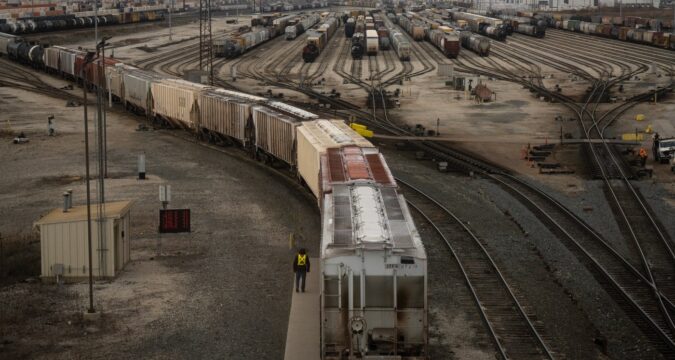
They also operate switching yards that take herds of boxcars, tank cars and auto haulers, brought continually into Chicago by the big railroads, and sort them into specific trains bound for, say, New York or Baltimore.
The merger would boost Union Pacific’s stake in the Belt Railway of Chicago to 33.3% from 8.3% today, and in the Indiana Harbor Belt to 25.2% from zero currently, according to its application to federal regulators.
That would give Jim Vena, chief executive of Omaha, Nebraska-based Union Pacific, more control of the city’s rail traffic than anyone else in Chicago history, said Earl Wacker, a former CSX executive.
“I don’t know how he leverages this, but he’s going to leverage it,” said Wacker, who now works with RINA North America, a global engineering firm with offices in Chicago. “He’s not buying it not to leverage it.”
Vena’s 33.3% stake in the Belt Railway of Chicago, for example, falls just short of what he would need to veto a big capital spending plan even if all the other voters want it.
Jim Vena, CEO at Union Pacific Railroad, speaks with Robert Greebel, managing director with Governors Lane, a New York-based hedge fund, and other analysts and reporters following his speech at the Midwest Association of Rail Shippers winter meeting on Jan. 15, 2026, in Schaumburg. (Stacey Wescott/Chicago Tribune)
In an interview, Vena accused other railroads of greatly exaggerating the competitive threat.
“If you own 30% of something, and you have 30% of the voice, you still have 70% that you have to deal with,” he said.
“We have (8.3%) of the Belt (Railway) and listen, our voices are heard. We’re all equal in there. We hire the best person to operate the Belt railroad to be efficient and to be able to move products for all of us.”
In any case, Vena said, the combined railroad will put less strain on the Belt Railway of Chicago and the Indiana Harbor Belt by running more cross-country trains that either bypass Chicago or pass straight through the city without stopping to exchange freight.
In its merger application, Union Pacific said the combined railroad would send 200 fewer cars to the Belt Railway of Chicago each day. That’s about a tenth of the Belt’s current total.
Vena and other railroad executives from Canada and the U.S. were in Schaumburg last week for the Midwest Association of Rail Shippers meeting, where Union Pacific’s merger was on everyone’s lips. Several executives spoke with the Tribune about their concerns.
Keith Creel, chief executive of Calgary, Alberta-based Canadian Pacific Kansas City Ltd., describes the Belt Railway of Chicago as the O’Hare of U.S. rail freight.
“I’m not minimizing the importance of the Kansas City terminal. I’m not minimizing the importance of St. Louis or New Orleans or Memphis,” Creel said at the shippers conference. “But if this one fails, it’s like cancer going through your whole body,” he said, referring to Chicago’s rail network.
Keith Creel, president and CEO of Canadian Pacific Kansas City, speaks at the Midwest Association of Rail Shippers winter meeting on Jan. 14, 2026, in Schaumburg. (Stacey Wescott/Chicago Tribune)
Creel pointed to the crippling blizzard of 2014 as an example of how Chicago can fail, and of how Vena could use his growing power in the city to dig himself out before anybody else.
Nearly a foot of snow started falling in Chicago on Jan. 4, 2014, and then temperatures plunged to 16 degrees below zero. The Belt Railway of Chicago stopped moving after locomotives it needed got trapped in the wrong places. Some trains couldn’t roll again for weeks, Creel said.
“What happens when you get into the mud, into the snow, into the frozen weather?” Creel asked. “You protect your own. You protect your own network.”
Creel also warned that if the combined railroad — at 43% of all U.S. rail freight — stumbles during the next blizzard, it would be big enough to take all other railroads down with it.
“Think about this elephant walking around the room. When it falls down, there is consequential damage. To stand it back up is almost an insurmountable task,” he said.
Creel said he also worries about St. Louis, Kansas City and Memphis, where a postmerger Union Pacific would own 50% or more of belt railroads, switching yards and even bridges that all railroads use to cross the Mississippi River.
The federal Surface Transportation Board could reject the merger or place limits on how Vena could wield his growing Chicago clout.
On Friday, the STB ordered the railroad to rewrite the application completely, saying it lacked key information. This could delay the STB’s final decision until the second half of 2027.
Related Articles
Union Pacific’s plan to add trains in the Chicago area raises alarms
Union Pacific says rail merger could unclog Chicago. Critics worry about costs and traffic tie-ups.
Belt Junction is a notorious bottleneck. Fixing it could increase rail capacity, but benefits to South Side residents could be mixed.
In his speech at the shippers meeting, Vena said his critics are threatened by the prospect of trains running coast to coast without stopping to exchange freight.
“There’s no way you’re going to beat us on time,” Vena said of his critics. “So what you’re going to have to do is offer a better price.”
In the war for the future of American railroading, the Belt Railway of Chicago and the Indiana Harbor Belt are critical battlegrounds.
In the Clearing neighborhood near Midway Airport, and in the southern suburb of Blue Island, Belt Railway and Indiana Harbor sort cars from all railroads and all points of the compass, using methods pioneered in Germany nearly two centuries ago.
As locomotives push the cars to the top of a small hill, or “hump” in railroad jargon, a single worker walks alongside and pulls out an inch-wide pin to detach the cars one at a time from the rest of the train.
Then, as the cars roll down the other side of the hill, they’re switched onto one of dozens of tracks below to be connected to trains bound for different cities.
Chicago’s “hump” yards are by far the country’s biggest because the city has always been the place where eastbound and westbound trains exchange the most freight.
Trains in the Clearing Yard east departure yard on Dec. 15, 2023. (E. Jason Wambsgans/Chicago Tribune)
Jerry Peck, the Belt Railway of Chicago’s president, declined through a spokesperson to comment, other than to say he expects competing railroads to pick up the slack created by Union Pacific’s shift to different routes.
John Wright, general manager of the Indiana Harbor Belt, didn’t return calls seeking comment.
In his speech, Vena bragged that his new cross-country trains will run from Los Angeles to New York at 70 miles an hour.
But in the interview afterward, he said his trains will slow way down when they reach Chicago, especially on a dilapidated set of tracks along Rockwell Avenue through North Lawndale and West Town.
In that stretch, century-old bridges and hand switches limit train speeds to less than 15 mph.
Union Pacific has contributed to a public-private partnership called CREATE, or the Chicago Region Environmental and Transportation Efficiency Program, that’s refurbishing some of the tracks.
But Vena defended his decision not to invest more in the Rockwell area, even though he’s adding 12 trains — some of them 2 miles long — to the 82 that, according to Metra and the Chicago Metropolitan Agency for Planning, use those tracks now.
The speed of trains along Rockwell Avenue, he said, “is about as good as it gets.”
Vena also said he expects to resolve a dispute with Metra over how much the regional commuter railroad should pay for access to Union Pacific tracks. He said he’s guaranteed Metra leaders he won’t boot them off his railroad, even though his lawyers have insisted in court he has the right to do so.
With the merger, Vena plans to add four trains a day to DuPage and Kane County tracks that already handle 118 commuter and freight trains each day, according to Metra and CMAP.
Metra spokesperson Mike Gillis declined to comment.
Union Pacific outlined its plans for the $85 billion merger in a 6,692-page application to the STB on Dec. 19.
Under STB rules, Union Pacific will need to show that the merger would not just preserve competition but enhance it and produce public benefits that can’t be achieved any other way.
The board adopted this higher standard after a chaotic set of mergers in the 1990s disrupted service and reduced the number of big railroads operating in the U.S to four, increasing the potential for monopoly pricing abuse.
In 1960, three dozen so-called Class 1 or major railroads operated in the U.S.
In his speech, Vena said America needs more railroads to merge than just Union Pacific and Norfolk Southern.
“(Railroads) put the money in. We invest in our rail, or ties, our infrastructure,” he said. “We don’t get the benefit of having somebody build highway systems for us, and we only pay a pittance for the use of those highways.”
When Vena was asked in the interview whether he’s taking the concentration of ownership in American railroads back to levels not seen since the Gilded Age, as Mark Twain described America’s speculative, boom-and-bust economy after the Civil War, he replied by talking about competition, not ownership.
“In the 1890s, the railroads were the way to move products across the country, or by water. Those were your two options,” he said. “There was no highway system. There were no planes.”
“You fast-forward to today … and the amount of market that we actually have of everything that moves by (rail), truck and barge, and we’re down to 12% or 13%,” he said. “So we’re not this big, big elephant in the room. We’re competing against all that.”
Someday soon, he said, railroads could be competing with trucks that not only haul freight for long distances but drive themselves.
In an interview and then her “fireside chat” with shippers, Katie Farmer, chief executive of Fort Worth, Texas-based BNSF, disagreed with Vena on several points.
BNSF will ask the transportation board, she said, to examine how much ownership and control Vena’s combined railroad would have in Chicago and other key freight hubs.
Katie Farmer, president and CEO of BNSF Railway, left, speaks with Monica Freeman, right, director of rail transportation at CHS, during a “fireside chat” at the Midwest Association of Rail Shippers winter meeting on Jan. 14, 2026, in Schaumburg. (Stacey Wescott/Chicago Tribune)
Farmer said that, after a decade of flat revenue and before that widespread service interruptions following several U.S. rail mergers, Vena is unlikely to deliver his promised double-digit volume growth three years after government approval.
When this growth fails to materialize, she said, Vena will still be on the hook for the $15 billion premium he’s promised Norfolk Southern shareholders.
As Vena pays down the premium, she said, Chicagoans can expect longer trains and more blocked street crossings, especially since Union Pacific has announced no new investments to make the merger work in the country’s most important rail hub.
Union Pacific customers can expect fewer shipping options and higher prices, she said.
BNSF, which is owned by Warren Buffett’s Berkshire Hathaway, spent $3.8 billion last year to actually maintain and expand its railroad, she said.
Everywhere she goes, Farmer said, people ask if Union Pacific’s proposed Norfolk Southern takeover will force her to merge with CSX.
“The really important thing is, ‘Why is everybody asking me that?’” she said. “It’s because of the centralization of power that would be created with this proposed consolidation.
“We don’t think we should have to be the remedy for an anti-competitive, monopolistic consolidation.”
John Lippert is a freelancer.
https://www.chicagotribune.com/2026/01/20/union-pacific-norfolk-southern-rail-merger/


