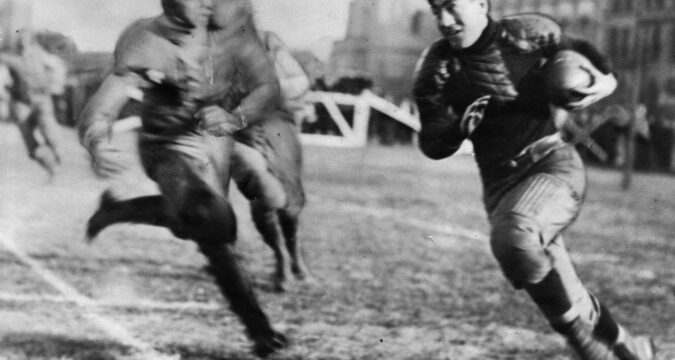
Walter Eckersall never played for the Chicago Bears. One reason is that his on-field exploits took place before the Bears were born (in 1919 as the Decatur Staleys) and, in any case, what chance could a guy who topped out at 5 feet 6 inches tall and weighed between 113-140 pounds have of playing?
You saw that right: 5 feet 6 inches and strikingly lightweight.
Now, we have had a fair share of home-grown sports stars. Baseball’s Bill “Moose” Skowron went from Weber High School to a major league slugger. Dick Butkus, from Chicago Vocational High School to NFL legend. Barney Ross, from Maxwell Street gangs to boxing championships. Cazzie Russell went to Carver High School, Isiah Thomas to St. Joseph High School in Westchester and Derrick Rose to Simeon Career Academy; all went on to NBA stardom. Lou Boudreau went from Thornton Township High School to baseball’s Hall of Fame.
There are many more, but after his athletic glory, Eckersall’s on-field exploits faded. But now his life, which also includes nearly a quarter century as an influential sportswriter for the Chicago Tribune, is colorfully detailed on the 275-some pages of “Eckie: Walter Eckersall and the Rise of Chicago Sports” (University of Nebraska Press).
“I stumbled on his name 25, 30 years ago,” says author Chris Serb. “I was volunteering for the Special Olympics and I was working some events on the South Side at Eckersall Stadium (at 2423 E. 82nd St.). I’m a North Sider, so I wondered, ‘Who is this Eckersall? Some judge? Some politician?”
Serb is a child of Rogers Park, one of the six boys and two girls of father Tom, once a communications executive, and mother Ann, a writer. A graduate of St. Ignatius High School and College of the Holy Cross, he loved to write and aspired to channel that passion into a profession, and so graduated from Northwestern University’s Medill School of Journalism. He worked for a time for Asher Birnbaum’s North Shore magazine and wrote for other publications. But seeking steady work, in 1999 he tested into a job with the Chicago Fire Department, as had some of his brothers.
Chris Serb, author of a new book “Eckie,” about former University of Chicago football great Walter Eckersall. (E. Jason Wambsgans/Chicago Tribune)
As he was rising to his current rank of deputy district chief, getting married and having kids (wife Emily and their daughters Helen and Maggie) and settling into domestic life on the Northwest Side, he wrote.
First there was 2000’s “Sam’s Boys: The History of Chicago’s Leone Beach and Legendary Lifeguard Sam Leone,” a close-to-home tale since Serb had been a lifeguard at the beach for more than a decade, and was Lifeguard of the Year in 1990. Then in 2019 came “War Football: World War I and the Birth of the NFL,” a fine and enlightening book.
Doing research for that book brought Eckersall back into his life. “I fully expected once I started learning about him, that there would be a book about this fascinating guy,” Serb told me. “There was one modest little book and a mention in a book edited by David Halberstam (1999’s “The Best American Sports Writing Of The Century”), but that was about it.”
Serb is a tireless researcher and does a marvelous job of giving us a bygone era, as the number of public high schools and students exploded across the country from about 1890 to 1920. Sports teams were often organized by students rather than teachers or administrators and Hyde Park High School was very active.
As newspapers, and there were many of them then, began to give more ink to high school sports, Eckersall became a big star at Hyde Park, so big that headlines blared such praise as “Eckersall (is) probably the best known high school athlete in the country.”
In a lively recruiting tussle, he wound up at the University of Chicago, then a serious football power, playing for the Maroons rather than for the University of Michigan Wolverines. His statistics — Serb lists many of them — were eye-popping, and those who saw him play were so impressed that even 50 years after his last game, such football titans as Red Grange and John Heisman “named him the All-Time, All-American quarterback.” Polls as late as 1951 did the same.
His most famous game came when he was a junior and led the Maroons to a national championship in 1905 by defeating Michigan in a strange game, score 2-0, but one that Serb makes exciting.
In a story peppered with such big personalities as Amos Alonzo Stagg and Knute Rockne, Serb handles Eckersall with great understanding. This was a hero, yes, but also a human being with flaws aplenty and his life was peppered with troubles — legal, financial, familial and booze-related.
Some caused him to be expelled during his senior year at the U of C, but soon enough, he was hired as a sportswriter at the Tribune and began a career that would last more than two decades and comprise more than 5,000 stories about football, yes, but also boxing, the Olympic games and other athletic diversions. His stories provided, as Serb puts it, a “lens through which Chicago readers came to understand sports.”
He also became pals, and drinking buddies, with Tribune colleague and soon to be famous bestselling author Ring Lardner, who had once felt as a native of Michigan “murderously inclined toward Eckersall” in the wake of the 2-0 Michigan defeat of his beloved Michigan Wolverines, but would years later write that “when a fellow needed a friend, there was none of be found more satisfactory than Eckie.”
Serb’s writing is pleasantly propulsive and smooth, his research deep and his understanding of his subject sensitive and mature. He gives Eckersall credit for helping create the ongoing Silver Skates speed skating competition for the Chicago Park District and the Golden Gloves boxing tournaments. He also details his highly-regarded work as a football official.
“He also was really a social justice advocate,” Serb says. “At a time when it was anything but acceptable, Eckie stood firmly and consistently against racism.”
Serb ends this terrific book by writing that, “Through his three distinct but interrelated roles over the course of 30 years, Walter Eckersall became the most pivotal figure in the rise of Chicago sports.”
He makes a passionate case for a man who died in 1930 and was buried in Oak Woods Cemetery on the South Side, within blocks, Serb writes, of “his childhood home, his grammar school and the vacant lots where he and his friends first learned how to kick a football.” In giving us the man and the legend, Serb makes this remarkable little guy a giant.
rkogan@chicagotribune.com


