
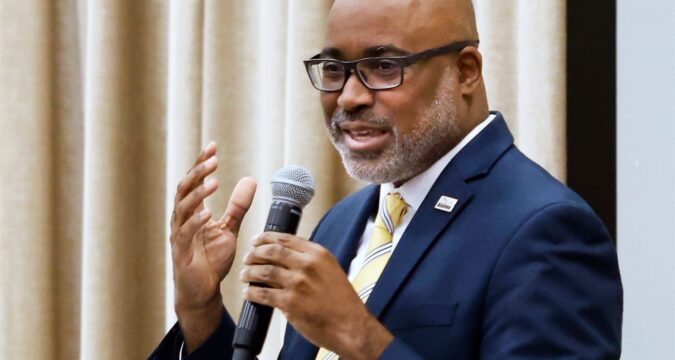
While much of Rev. Dr. Martin Luther King Jr.’s work urged people to speak out strongly and clearly against injustice, Shontrai Irving learned that sometimes, silence carries the message further.
Irving, a local attorney and Business Law professor with Purdue Northwest and the keynote speaker for the first of the school’s MLK celebrations, recalled for a group gathered January 15 at the Hammond campus the time he won an essay contest honoring MLK while he was a student at Indiana University. His victory was reported in The Chronicle of Higher Education, and he and the other students who placed were asked to read their essays at a luncheon, he said.
Jamey Jones (left) and Kaylin Quarles, who are seniors at West Side Leadership Academy in Gary, listen to Purdue University Northwest law professor Shontrai Irving, give the keynote address at the Hammond campus’s MLK celebration on Thursday, January 15, 2026. (John Smierciak/for the Post-Tribune)
Shortly before the event, an administrator approached Irving and told him his essay was “too Afrocentric” and that he needed to modify it, Irving said. If he didn’t, the administrator told him that it would hurt funding for Black student initiatives all over campus.
“He wanted me to change my wording to ‘self-actualization’; I didn’t even know what that was at the time,” Irving said. “I called my mom, I called my grandma, I called my friends (about what to do). The day came; the third-place winner got up and gave their speech, and the second-place winner got up and gave theirs, and then they get to me.
“I got up and said, ‘I was told that if I didn’t change my speech, it would hurt funding opportunities for Black students, so I’m not going to give it’.”
The Indiana Daily Student published his essay, he said, which then attracted local and national media to the story of IU silencing a student voice. The whole experience was hard on him, but it also taught him a lot.
Jamey Jones, (right) a senior at West Side Leadership Academy in Gary, listens to Purdue University Northwest law professor Shontrai Irving, give the keynote address on the Hammond campus on Thursday, January 15, 2026. (John Smierciak/for the Post-Tribune)
“What matters most to me is not the disagreement itself, but what it revealed,” he said. “It revealed how even spaces dedicated to honoring Dr. King can struggle with the fullness of his message; it revealed how institutions sometimes prefer comfort to complexity; and it revealed how Dr. King’s legacy has always been, and remains, challenging.
“Dr. King himself was often asked to soften his tone or wait for a more convenient time. He responded by reminding the nation that justice delayed is justice denied. What I understand now, with time, perspective and experience, is that leadership is not only about speaking the truth, but about carrying it responsibly across time.”
Using slides to illustrate his point, Irving said that between King and his wife, Coretta Scott King, they knew his work would never be finished. More important, however, was that it can’t remain static; it must be examined and renewed constantly.
“Unlike many commemorations, this day does not ask us to look outward first. It asks us to look inward,” he said. “So perhaps the most meaningful way to honor them today is not simply to ask what they accomplished, but to ask what their example asks of us now.”
Purdue Northwest law professor Shontrai Irving (left) and PNW Chancellor Chris Holford great each other before the start of the MLK Day remembrance on Thursday, January 15, 2026. (John Smierciak/for the Post-Tribune)
And the nonviolence for which he advocated was never passive or weak, but a deliberate strategy that required “extraordinary discipline, especially in moments of provocation.”
“It demanded that participants resist not only physical violence, but the temptation to dehumanize opponents,” he said. “This approach reshaped the moral landscape of the Civil Rights Movement. It forced the nation to confront injustice without allowing the struggle to become a mirror image of the violence it opposed.”
Noah Shaffer, a student at Calumet Christian School in Griffith, said he hasn’t studied up on MLK yet, but Irving’s talk inspired him to do so.
“Listening to Dr. Irving talk, I don’t see a lot of people who speak up like he did,” Shaffer said. “People look up to me as a leader at school, so I need to speak up more.”
Kaylin Quarles, a Senior with West Side Leadership Academy, said she was struck by how much more needs to be done in terms of reaching King’s vision.
“This is not just one-and-done. You have to persevere,” she said.
Michelle L. Quinn is a freelance reporter for the Post-Tribune.


