
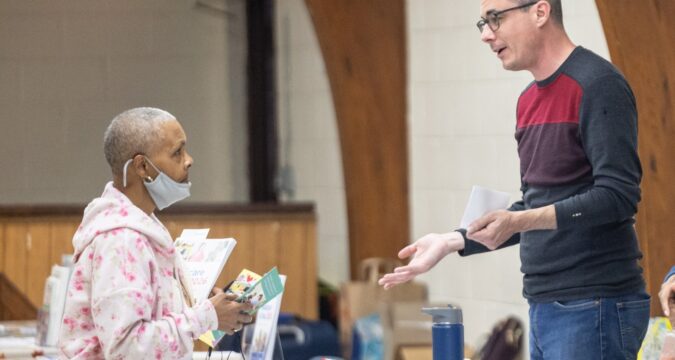
Matthew Siemer was the longtime executive director of Mobile Care Chicago, a nonprofit group that operates four mobile health care units that serve lower-income areas in the region.
Mobile Care Chicago’s free medical units focus mostly on dental care and asthma — a topic that hit home for Siemer, who battled asthma himself.
“He genuinely cared about others — especially, but not only those less fortunate. As someone who had asthma, he empathized with young patients and their families,” said Mobile Care Chicago’s board Chairman Robert Gordon. “But his passionate dedication to their well-being went far beyond mere empathy. He truly loved them, and it showed in everything that he believed in and everything that he did.”
A Rogers Park resident, Siemer, 43, died Dec. 13 of injuries sustained in a seven-vehicle crash on Interstate Highway 57 in downstate Coles County. His wife, Alicia Jean “A.J.” Barks, was also in the car and died Dec. 20 of injuries from the crash.
A St. Louis-area native, Matthew Alan Siemer worked during high school at the St. Louis County Public Library at Prairie Commons.
He then attended St. Louis Community College-Florissant Valley for two years before transferring in 2003 to Truman State University in Kirksville, Missouri. Siemer earned a bachelor’s degree in philosophy and literature from Truman State University in 2006.
After college, Siemer moved to New York City to work for a nonprofit called Bread for the City. He then moved to North Carolina, where he got a master’s degree in philosophy from Duke University in 2010.
Matthew Siemer and his wife, Alicia Jean “A.J.” Barks, died of injuries sustained in a seven-vehicle crash on Interstate Highway 57 in downstate Coles County. (Curtis Bozif)
Siemer and his wife moved to Chicago in 2010 to be closer to family. Two years later, he began volunteering for Mobile Care Chicago. Soon afterward, he was hired full time and began serving as the group’s development and program manager.
In 2018, Siemer became Mobile Care Chicago’s executive director.
Kamari Thompson, the organization’s associate executive director, joined Mobile Care Chicago a few months after Siemer and recalled his “very, very special way of making everybody feel welcome and making everybody feel like they were a friend of his.”
“We’re constantly up against deadlines to do this and do that, but anytime you needed to ask Matt a question … he was never too busy to lend a hand and help,” she said. “Anybody who comes to Mobile Care will see us in communal spaces, where we talk across the table. Matt would position himself right in the middle — as busy as he was, he was never too busy to be in the thick of things. The accessibility to Matt was amazing — that was one of the things that made everyone feel like he was their friend and made everyone feel like they had his support.”
Thompson said Siemer’s strong character was infectious and that “he had such a huge impact on the organization that you can still feel.”
“It’s reflective of that leadership that he led with and instilled in all of us,” she said. “As an organization, Matt empowered every one of us to be good at our job and to actually operate from a place of compassion. He empowered all of us to fully embody all of our pillars of service — compassion, collaboration and community.”
In the time that Siemer worked at Mobile Care Chicago, the organization increased its number of mobile medical units, which are converted RVs, from one to four.
“When Matt became executive director, the organization was struggling financially,” Gordon said. “After just a few years, he was able to turn it into a successful and growing nonprofit with a dedicated staff serving thousands of children. His vision was to bring free health care to people who needed it, directly to where they lived. But unlike many visionaries, he was able to bring that vision to life.”
Chicago visual artist and critic Curtis Bozif, a close friend since high school and a neighbor in Rogers Park, called Siemer “incredibly sensitive and deeply thoughtful.”
“He had little patience for sanctimoniousness and scoffed at religious and political hypocrisy,” Bozif said. “He and (his wife) A.J. practiced generosity like someone might practice a musical instrument, working at it and becoming better over time until their sharing became effortless, until it became their profession — both of them running nonprofit groups — their calling in life.”
Barks, Siemer’s wife, was the interim executive director of the Chicago Women’s Health Center, a nonprofit that provides free or low-cost health care and health education to women, trans people and young people.
Outside of work, Siemer enjoyed reading, writing short fiction, playing games, tossing a Frisbee and cooking, Bozif said. He also adored spending time with his two dogs.
Siemer is survived by his parents, Mark and Pamela; and three sisters, Maggie, Missy and Marcia.
A joint Mass for Siemer and Barks will take place Monday in Florissant, Missouri.
Bob Goldsborough is a freelance reporter.
https://www.chicagotribune.com/2026/01/13/matthew-siemer-mobile-care-chicago/


