
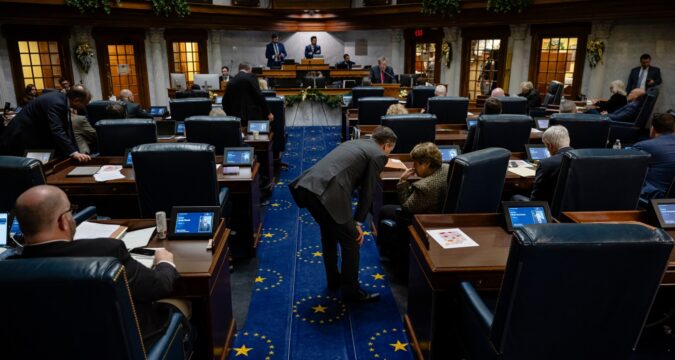
The doxing bill was amended and passed out of the Indiana Senate Corrections and Criminal Law committee, while the firing squad bill was held — with an ominous message from the committee chairman about the death penalty.
Doxing is when a person who knowingly or intentionally posts information, like address or phone number, of a targeted person in retaliation. Under Senate Bill 140, authored by State Sen. Vaneta Becker, doxing will become a Class A misdemeanor and a Level 6 felony if the posting of the personal information results in the targeted person or someone closely connected to the person suffering serious injury or death.
Under the bill, doxing would rise to a Level 5 felony if the posting of personal information of a specific person or someone close to the targeted person experienced catastrophic injury or death.
The bill defines a person closely connected to the targeted person as a child, parent, sibling, grandparent, person living in the same household, or a person involved in a dating relationship with the targeted person. The bill defines personal information as a person’s Social Security number, address, legal name, telephone number, and employer information.
Becker, R-Evansville, said in committee last week she filed the bill because of what many State Senators experienced with doxing and swatting, or false police reports to generate a large law enforcement response, amid the state’s discussion around mid-census redistricting in November and December.
The bill was amended Tuesday to remove a coworker as a person closely connected to the targeted person.
State Sen. Liz Brown, R-Fort Wayne, said she was concerned about the broadness of the bill as it relates to private communications being defined as doxing.
The bill passed 6-1, with both Democrats absent from the committee meeting at the time of the vote. Brown voted against the bill.
“I know the bill will pass, but I just need to preserve my reservations on this. It’s pretty broad right now, so I’m a ‘no’,” Brown said ahead of her vote.
In November, Senate Pro Tem Rodric Bray, R-Martinsville, announced he would cancel the early December session to take up mid-census redistricting because the chamber did not have the votes to pass the measure.
Two days after the cancellation announcement, President Donald Trump issued a statement on his social media site Truth Social calling out “RINO” Bray and Greg Goode, R-Terre Haute, “for not wanting to redistrict their state, allowing the United States Congress to perhaps gain two more Republican seats.”
Hours after Trump posted his comment, Goode received a false swatting call. After Organization Day, when the Senate voted to reconvene in January, at least seven more State Senators — Dan Dernulc, Spencer Deery, Rick Niemeyer, Kyle Walker, Greg Walker, Linda Rogers and Andy Zay — received swatting calls.
Ultimately, the Indiana legislature met in early December to take up redistricting. The measure passed the House, but failed in the Senate.
Senate Bill 140 will move forward for consideration by the Senate.
Committee chairman Aaron Freeman, R-Indianapolis, said he would hold Senate Bill 11, which would allow for firing squad executions for death penalty inmates, until next week.
Indiana is a death penalty state, Freeman said, and it will continue to be a death penalty state “as long as (he) has a say.”
“For those of you that disagree, fine. Good people can disagree and we can do so respectfully. I would just say this: Be careful what you wish for because it just might come true. The more you wanna try to eliminate something, you can’t do it through the legislature, and you try to do it through other means, well, the repercussion of that is you get Senate Bill 11. We’re going to carry out the death penalty some way in Indiana,” Freeman said.
Senate Bill 11, filed by State Sen. Michael Young, would allow for firing squad executions if medications for lethal injection can’t be obtained or the inmate chooses death by firing squad at least 30 days before the scheduled execution date.
The firing squad would be made up of five Department of Correction officers selected by the warden. The firing squad members’ identity would be kept confidential and not subject to discovery in civil or criminal lawsuits, according to the bill.
At the time of execution, four members will have guns with live ammunition and one member will have a gun with blanks. The guns would be loaded without the members knowing who has what kind of ammunition, according to the bill.
Young, R-Indianapolis, testified last week that it could cost up to $300,000 per dose of pentobarbital, which is the drug Indiana uses to conduct a lethal injection, and the medication often expires before use.
In 2024, Indiana resumed executions after a nearly 15-year pause because pharmaceutical companies were hesitant to sell the drugs for executions amid growing public scrutiny, said Indiana University Maurer School of Law professor Jody Madeira.
Three Indiana death row inmates — Joseph Corcoran, Benjamin Ritchie and Roy Lee Ward — have been executed in the last year.
Gov. Mike Braun disclosed in June that Indiana officials spent $1.175 million on lethal injection doses over the past year — $600,000 of which was spent on drugs that expired before use.
Four people testified against the bill before the committee last week.
Samantha Bresnahan, a Senior Policy Specialist with ACLU Indiana, said the organization opposes the bill because it further promotes the secrecy around how death penalty executions are carried out.
With broad language about protecting members of the firing squad, Bresnahan said the state could argue for not disclosing training methods, qualifications, and any safeguards.
“Precisely the information the public needs to evaluate whether the process is lawful, competent, and free from misconduct,” Bresnahan said. “This bill asks this legislature to do something extreme: expand the machinery of capital punishment and then hide how it works.”
As he closed, Young said it’s important for the firing squad member’s information to be private to avoid public harassment. Ultimately, Young said those who oppose the bill want to take away choice from an inmate.
“I just say, let the prisoner decide which way he prefers to have the execution carried out. If he’s okay with it, so am I,” Young said.


