During one of the recent holiday homily sermons at our small rural All-Saints Catholic Church in San Pierre, Rev. Terry Bennis shared his holiday recollections of growing up in LaPorte.
This Sunday of the first weekend of January is observed in our Catholic faith as the Solemnity of the Epiphany, celebrating the arrival of the Magi to worship the birth of Jesus in the manger. Also referred to as “the astrologers,” “the wise men” and “the three kings,” the true designated date for the Feast of Epiphany 2026 is on Tuesday, Jan. 6.
Bennis, 77, recalled the elaborate “live” nativity scene that mesmerized him in his youth in the late 1970s and early 1980s as imagined by Hoosier sports claim-to-fame Charlie Finley at his 260-acre estate along Johnson Road and U.S. 35 in LaPorte.
Finley, who died on Feb. 19, 1996, from a heart ailment just three days before his 78th birthday, was the owner of the MLB team the Oakland A’s, purchased Dec. 19, 1960, while still named the Kansas City Athletics following the sudden death of then-owner Arnold Johnson at age 54. Though born in Birmingham, Alabama, Finley was raised by his parents in Gary, Indiana, and made his fortune by selling insurance and creating the first group medical policies to protect those in the medical profession. The 40-story insurance building high-rise in downtown Chicago was one of his proud monuments to his success.
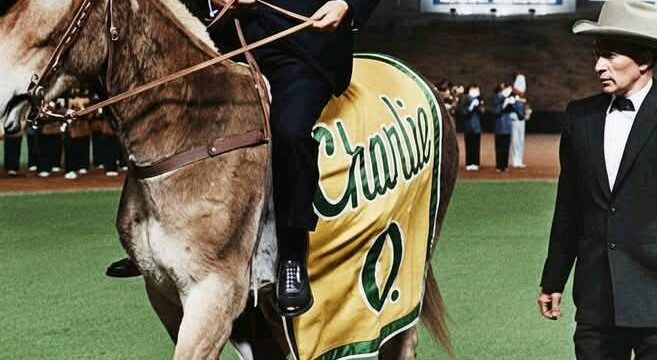
After his purchase of the team, he soon replaced the existing elephant mascot with his own creation, a mule he dubbed “Charlie O.” He loved to parade the live animal incarnation around the baseball grounds as well as indoors at parties, press conferences and public events. By 1968, Finley had moved the ball team to Oakland, California, where they remained until last year while pondering a relocation to Las Vegas.
But Finley always preferred to keep his own home base in La Porte, where he purchased a ranch in 1942 along Johnson Road and just north of the shores of Pine Lake. He opted to expand the working cattle ranch and he let his hired help live in the existing 1800s 11-room colonial house nestled among nine large barns. He had a much larger and grander mansion constructed with even more stately white columns and lofty porticoes, with many comparing the architectural design with the White House.
He had “Home of the Oakland A’s” painted on the roof of the barns (to be visible to traffic along the adjacent Indiana Toll Road) as well as carefully carved into the perfectly manicured hedges along the estate’s signature white wash fencing surrounding the grounds.
Deemed eccentric and difficult to wrangle with by the media, other baseball team management and the MLB officials, Finley was often accused of “running a professional baseball team the same way he successfully sold insurance,” using showmanship, gimmicks and pricey promotions.
During his decades in charge, he changed the team uniforms to “Kelly Green, Fort Knox Gold and Wedding Gown White.” He forced his way into the 1964 Beatles’ U.S. tour and secured a Sept. 17 concert date for his then-Kansas City Municipal Stadium by paying an unprecedented $150,000 to the singers, which is the equivalent of more than $1.5 million in today’s coin.
In 1972, Finley was pushing the idea of “a return to vintage baseball,” and he offered each of his players $300 bonuses to grow mustaches for the 1972 season, with his relief pitcher Rollie Fingers sporting the most impressive waxed handlebar “cookie duster.” By 1975, he was hawking the idea of his invention of “orange, glow-in-the-dark baseballs,” which he touted as “perfect for night games,” a campaign which landed him on the Aug. 18, 1975, cover of Time Magazine. And he insisted on a “mechanical rabbit” (similar to what was used as a running lure for racing greyhounds along betting tracks), which Finely dubbed “Harvey” that “popped up at home plate” to deliver new balls to the umpires as needed.
By the time Finley had sold his professional ball team in 1980, he had funneled his showmanship and promotional tactics for the benefit of his community in Northwest Indiana, with his favorite emphasis being the holidays.
At Christmastime, he opened the perimeters of his estate in LaPorte to all to behold with an incredible holiday display of lights, decorated trees and an impressive finale of the Holy Family depicted with a “live nativity.”
Press clippings from the earlier incarnation of what was United Press International Wire Service in 1983 describe as many as 10,000 cars crowding the surrounding roads and intersections with onlookers eager to gander at the amazing displays and décor.
Life-sized Magi on camels, all carved from wood, are described as pointing in the sky to a 17-foot illuminated “Star of Bethlehem” mounted on the chimney of Finley’s mansion. The wire story dated Dec. 20, 1983, also describes “a live herd of 30 white sheep and one lone black sheep” grazing a field and tended by real dogs and a man dressed as a shepherd. The finale explained is “a hay-lined creche with live actors as Mary and Joseph cradling baby Jesus.”
Our priest said the tradition was lost later in the 1980s as Finley aged and the LaPorte County Police found it more and more difficult to control crowds and traffic.
Another of Finley’s “discoveries” was one of his young “ball girls” for the Oakland A’s team, by the name Debbi Jane Sivyer, born and raised in Oakland. She had a talent for baking scrumptious cookies, especially chocolate chip cookies, which she would bring to Finley to sample. Soon, Finley had Debbi parading with platters of her freshly baked cookies to share with the game umpires. By 1977, now married to Randall Fields, Debbi developed her own brand and business, known today as the Mrs. Fields Cookies empire. Debbi, who will celebrate her 70th birthday this year in September, sold her brand and business to Z Capital Partners in 2013, but she continues to serve as the brand ambassador and founder.
When Debbi published her first cookbook, “The Mrs. Fields Cookie Book: 100 Recipes from the Kitchen of Mrs. Fields” (1992 Time Life Books $19.99), the media press kit folder mailed to food journalists, including myself, shared her recipe for “Mrs. Fields’ Blue Ribbon Chocolate Chip Cookie,” a recipe fit for Finley and royal recipe homage.
Columnist Philip Potempa has published four cookbooks and is a weekly radio show host on WJOB 1230 AM. He can be reached at PhilPotempa@gmail.com or mail your questions: From the Farm, PO Box 68, San Pierre, Ind. 46374.
Mrs. Fields’ Blue Ribbon Chocolate Chip Cookies
Makes 2 dozen cookies
2 1/2 cups all-purpose flour
1/2 teaspoon baking soda
1/4 teaspoon salt
1 cup packed dark brown sugar
1/2 cup granulated sugar
1 cup salted butter 2 sticks
2 large eggs
2 teaspoons vanilla extract
12 ounces semi-sweet chocolate chips
Directions:
Preheat oven to 300 degrees.
In a medium bowl, combine flour, baking soda and salt. Mix well with a wire whisk. Set aside.
In a large bowl with an electric mixer, blend sugars at medium speed. Add butter and mix, scraping down the sides of the bowl.
Add eggs and vanilla extract, and mix at medium speed until just blended.
Add the flour mixture and chocolate chips, and blend at low speed until just mixed.
Scoop cookie dough using a large, rounded scoop onto a baking sheet.
Place cookie dough balls on a baking sheet, 2 inches apart with room for about 6 cookie balls per batch.
Bake for 18 minutes or until golden brown. Allow cookies to cool for 5 minutes, then transfer cookies to a baking rack or cool surface.


