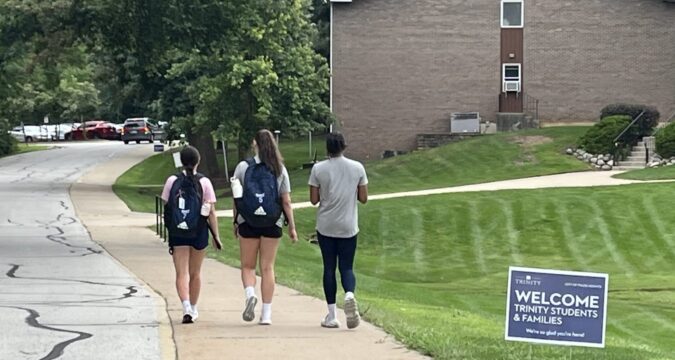
When Chad Meeuse heard about the pending closure of his alma mater, Trinity Christian College, earlier this month, he said he experienced “kind of a devastating feeling.”
“Rumors started spreading before the official word came out, about a day before,” Meeuse said Wednesday. “My phone was blowing up and we’re just trying to figure out what’s going on — and then, all of a sudden, we hear it’s closing.”
Meeuse said his shock turned to anger and eventually, “wanting to do something about it.” He and a small group of other Trinity alumni are searching for answers about what caused the school’s financial decline and closure announcement, leading a few of them to a Palos Heights City Council meeting Tuesday night.
While Meeuse, who lives in California, was unable to attend, 2022 graduate and Orland Park resident Jeffrey Linnert appealed to the council, sharing his love for the Palos Heights school and hopes for its future.
“Trinity is not just a college, it’s a home for many of us,” Linnert said during the meeting’s public comment period. “While I understand there’s a lot of financial burdens going on with the college, and it’s none of you, Trinity can’t just be sold to a developer. The college needs to be, at a minimum, preserved and hopefully saved.”
Trinity announced it will permanently close at the end of the 2025-26 school year, with the liberal arts college’s president and board citing financial struggles caused by declining enrollment and other factors.
“Despite strategic efforts to adjust its growth model and eliminate its deficit, Trinity has faced fast-evolving economic and cultural realities: post-Covid financial losses, persistent operating deficits, a decline in college enrollment, increased competition for students and shifting donor giving and financial circumstances,” the college said.
“These challenges impacted Trinity’s ability to continue providing a transformative, affordable education rooted in its Christian mission.”
Palos Heights Mayor Robert Straz said the city is waiting to hear from the college about its plans for the campus before taking a stance on the property’s future.
“They have to decide what they’re going to come with,” Straz said. “Until they come up with a plan, we really have nothing to respond to.”
Straz said he has received several inquiries from people interested in the 6601 W. College Drive property and connected them with the school.
Jeffrey Linnert, who graduated from Trinity Christian College in 2022, appeals to the Palos Heights City Council Tuesday night as he seeks to preserve the history of the school. (Olivia Stevens/Daily Southtown)
“It’s going to be, ultimately, the school’s decision,” Straz said.
Straz himself taught economics at Trinity for about 15 years, and the school has worked well with the city in the past, the mayor said.
He expects Trinity’s closure to affect the local economy, as the school’s estimated 1,000 students count toward the per capita income that helps determine how much funding the state provides to the city of about 12,000 people.
Trinity Christian College announced Nov. 4 it would close at the end of the 2025-2026 school year. (Olivia Stevens/Daily Southtown)
Palos Heights city attorney Thomas Brown, from left, Mayor Robert Straz and Clerk Shannon Harvey listen to public comments during a City Council meeting Nov. 18, 2025. (Olivia Stevens/Daily Southtown)
“It’s been a good relationship we’ve had with them forever. Shame that it ends,” Straz said.
Meanwhile, Meeuse said he and other alumni are reaching out to other stakeholders in Trinity’s future, including former donors, faculty and board members, as part of a larger effort to keep the college running in some form.
“Right now, our strategy is to kind of get the lay of the land,” said Meeuse, who previously served on the school’s alumni board. “Because it seems to us, by all appearances, that there was a lack of transparency with the constituency, namely the alumni, to kind of put out the word out that Trinity’s in trouble.
“We’re trying to get a sense of numbers and what that big financial picture looks like,” he said, “and then trying to understand what needs to be done in the coming months to make something, anything happen.”
ostevens@chicagotribune.com


