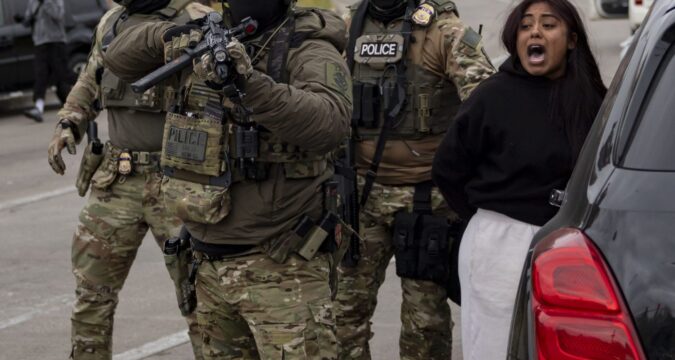
After his inauguration, President Donald Trump quickly got to work fulfilling a campaign promise by increasing arrests and deportations of immigrants in the United States.
Looking back now, the immigration raids in other cities, subsequent protests and National Guard response in Los Angeles gave Chicago a sense of what was to come in the fall. The Department of Homeland Security launched Operation Midway Blitz on Sept. 8 to target “criminal illegal” immigrants and, it said, honor Katie Abraham, who was killed in a drunken driving accident by an immigrant lacking permanent legal status.
Masked Border Patrol and Immigration and Customs and Enforcement agents spread out on the streets of Chicago and its suburbs to ramp up arrests, and their often brutal tactics were met with resistance. Protests increased at the Broadview detention facility, and neighbors in Chicago and its suburbs blew whistles and created informal community groups.
Our commentary from this chaotic time examined the actions and decisions of federal immigration agents, whether the operation honored or marred Abraham’s legacy, and how Chicagoans responded and found solidarity during the worst moments of the blitz.
Here is a look back in excerpts.
June 13: Edwin C. Yohnka, “ICE officers should not be allowed to wear masks”
It is not surprising that some ICE agents want to hide their faces. The work they are doing is unpopular and cruel. The harsh, militaristic nature of their actions is not normal and is being met with protest and opposition across the country. The White House, of course, responded to this opposition and protest in Los Angeles by sending National Guard troops to further militarize the implementation of the administration’s policies. The secretary of defense even plans to deploy Marines, further escalating tensions.
Groups of masked agents, armed with weapons, moving around the streets of a city in unmarked vehicles creates a public safety risk for police and for residents. If an armed group of local police confronts these masked ICE agents, how will they know they are federal law enforcement officers? It is not hard to see a situation like this escalating rapidly.
Worse still, the masks send a signal to ICE officers and the public that they are not accountable for their actions — even unconstitutional and illegal actions — and that their superiors will cover for them and encourage them to hide their identities when they are acting in their official capacity. This is the opposite of accountability. There is good reason why Chicago police officers are expressly prohibited from hiding their nameplates or badge numbers when out on the streets. But federal immigration officers are not held to the same standard.
Oct. 22: Denise Lorence, “My daughter is the face of Operation Midway Blitz. I am reclaiming her legacy.”
A photo of Katie Abraham. (Stacey Wescott/Chicago Tribune)
Katie would not want to be associated with an operation in which kids witness their parents being taken into custody on their way to or from school. She wouldn’t support scaring kids with the use of military efforts in their neighborhoods or in their apartment buildings.
She would not have wanted to be associated with a campaign that targets Chicago — a city she not only loved but felt safe in. Since she was in middle school, she and I took hundreds of drives through the city’s neighborhoods. On those drives, we’d talk about music, life, her future and her thoughts on current events — you name it, we talked about it. I will always cherish those drives because we not only saw what Chicago had to offer, but Katie and I really bonded on those drives. I learned who she was becoming with each passing drive — week after week, month after month, year after year.
Oct. 30: Allison Pleas, “Fear of ICE is stealing the simple moments in my Chicago neighborhood”
Just six months ago, my daughter would beg me for cotton candy from one of the after-school vendors, and we’d stay on the playground a little longer before heading home. Now, the vendors are gone, the playground is closed and the small routines that once made the day feel full have quietly disappeared because of fear.
In recent weeks, many families have decided it’s safer to keep their children home. They’d rather stay together than risk being separated. In some homes, the parent with the safer job goes to work while the other stays home to avoid being taken away. Many street vendors still take the risk, knowing that each day out could be their last. They live with fear every day — fear of waiting for the bus, fear of driving, fear of standing outside the school to pick up their child. Some families have chosen to return to their countries rather than face the possibility of separation. It doesn’t matter whether they were born here, are on the pathway to citizenship or are hoping to become citizens — the fear is the same for everyone.
At the park, I used to sit on the bench watching families grill carne asada while kids played soccer and salsa music blared from a speaker, wishing I could be part of it. That’s what family looks like to me — the same warmth and joy I see every day at school. But lately, some of those same families tell me they’re staying home, avoiding the places they love. Fear is stealing the simple moments.
Oct. 31: Joe Abraham, “We all share my daughter Katie’s legacy — and her death must still mean something”
Katie’s death was preventable. She was killed by a man, Julio Cucul Bol, who entered and remained in our country illegally. He was using multiple aliases, exploiting gaps in an overwhelmed and disorganized immigration system. Illinois’ sanctuary law allowed this monster to roam free. He should have been removed long before he could take my daughter’s life.
It would be unjust and unreasonable to separate my family’s loss from the policies that failed us. We did everything right. We worked hard, obeyed the law, paid our taxes and trusted that government would protect us in return. That trust was broken. Our leaders — from the governor’s office on down — have not treated immigration as a matter of public safety or national security.
Nov. 5: Sen. Graciela Guzmán and Gabe Gonzalez, “There is something deeper at work in Chicago than residents blowing whistles”
Baltazar Enriquez, president of the Little Village Community Council, blows a whistle as people face off with federal agents after a raid at Discount Mall on West 26th Street in Chicago’s Little Village neighborhood on Oct 23, 2025. (Antonio Perez/Chicago Tribune)
While the daily imagery of neighbors standing up to ICE agents is a powerful contagion for courage, there is something far deeper at work than just residents blowing whistles and recording arrests.
Chicagoans are feeling compelled to act — engaging by the thousands because the threat to liberty is personal and clear. What needs to happen next is for that collective action to coalesce into a force that tells the next chapter in American history.
Typical of all authoritarian advancements, public justification is built on a pyramid of lies. The foundational lie is that American cities like Chicago have been invaded by dangerous criminals. That these criminal invaders are to blame for our problems and can only be dealt with by militarized federal forces encroaching on the rights of everyday Chicagoans. But, those who call this city home did not buy into the absurd lie that we should go to war with our neighbors. The forceful rejections from Chicago, Memphis, D.C., Portland and L.A. have shaken the hold that MAGA lies have on our country. In every instance they have tried to operationalize the repulsive idea that some human beings should be considered “illegal” and disposable for merely existing, and they failed.
This has forced the Trump administration into a very unfavorable fork in the road regarding Chicago. They can try to double down on the plan of breaking the soul of this city, which would mean sending more ill-trained, occupying forces — an unwise option, considering unpaid neighborhood defense recruitment seems to be outpacing ICE’s, even with their $50,000 signing bonuses. Or, they can take the path of declaring fictitious victory here and retreat to smaller, more vulnerable cities — a risky option for an authoritarian regime reliant on its image of absolute strength. In either choice, the facade of lies will be badly fractured.
Nov. 8: Jane Charney, “Chicago does not feel safe for anyone, no matter our status”
Border Patrol agents detain a person in a Home Depot parking lot as they conduct an immigration enforcement action Dec. 17, 2025, in Evanston. (Armando L. Sanchez/Chicago Tribune)
Right now, the city of Chicago does not feel safe for anyone, no matter their status. We’ve seen people being arrested without a warrant, tear gas released near schools, people knocked down and car windows smashed. Make no mistake. These tactics threaten all of us. When one person’s right to due process is taken away, all of us have lost that foundational right. Our Constitution ensures that our laws and legal system operate with equity and fairness and apply to everyone who is on U.S. soil. We are seeing the consequences of actions that sow fear in real time, and this trauma will be with our communities for years.
My family came to the United States with three truths firmly rooted in our minds: There’s no antisemitism in America; America is a country of immigrants and values our contributions; and everyone is subject to the rule and protection of our laws. 2025 is proving us wrong on all three counts, and we’re ever closer to resembling the Soviet Union.
Nov. 26: Kerry Lester Kasper, “Chicago has become the ‘City of the Big Shoulders’ once again”
Recently, in issuing a sweeping injunction on the use of force by immigration agents in Operation Midway Blitz, U.S. District Judge Sara Ellis did something you rarely hear in even the most vaunted courtrooms in this country: She read a poem. In its entirety.
Carl Sandburg’s 1914 poem “Chicago” is a powerful, sweeping description of the city at the turn of the 20th century. Chicago’s oft-cited nickname, the “City of the Big Shoulders,” comes from it.
But it’s more than that.
Some 110 years later, Sandburg’s words are illustrative of the moxie this place has always had but only recently visibly reclaimed.
“Come and show me another city with lifted head singing so proud to be alive and coarse and strong and cunning,” Sandburg wrote. “Flinging magnetic curses amid the toil of piling job on job, here is a tall bold slugger …/ Bareheaded,/ Shoveling,/ Wrecking,/ Planning,/ Building, breaking, rebuilding.”
Building. Breaking. Rebuilding. It’s not lost on me that Ellis articulated the legacy of the city in the same halls that only a year before saw her colleagues weigh the fates of some of the city’s power players, the old order. It’s a fitting nod to the sentiment that despite all of our recent trouble, we remain proud to be the scrappy, inimitable city that we are.
This renewed energy across Chicago’s gridded streets emerged as coordinated defiance of federal immigration agents who arrived in September.
Submit a letter, of no more than 400 words, to the editor here or email letters@chicagotribune.com.
https://www.chicagotribune.com/2025/12/28/opinion-2025-chicago-immigration-enforcement-raids/


