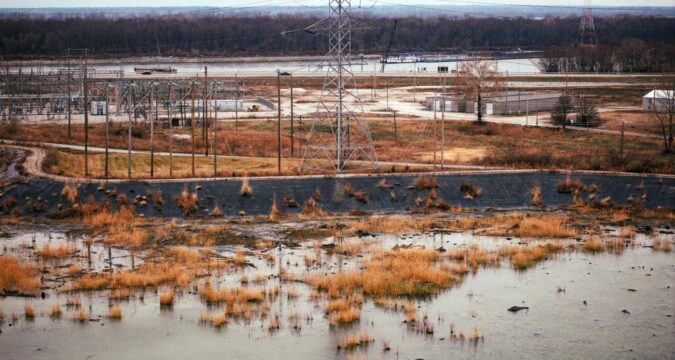
ALTON, Illinois — Where the Wood and Mississippi rivers meet in southern Illinois, over a million cubic yards of toxic coal ash sit on the edge of Illinois’ floodplain, threatening the waterways that surround it.
The retired Wood River Power Station is home to one of 72 coal ash impoundments, or ponds, across Illinois that contain byproducts from former coal combustion plants, according to the Illinois Environmental Protection Agency.
On Black Friday, while many Americans spent the day recuperating from Thanksgiving festivities, Alton residents gathered at a public meeting to discuss the future of Wood River.
“(Developers) have come in and left this desolate brownfield with groundwater contamination leaching into significant bodies of water,” said Toni Oplt, chair of the Metro East Green Alliance. “They have held this community captive.”
The alliance is a local clean energy advocacy group and partner of Sierra Club’s Illinois chapter focused on holding fossil fuel companies accountable for pollution.
Despite a statewide commitment to move beyond Illinois’ history of coal ash pollution, policy experts and community activists say incomplete or delayed permit proposals, and IEPA budget and staffing cuts are stalling closure approvals, prolonging Illinois communities’ exposure to toxic coal ash.
In 2019, Illinois passed the Coal Ash Pollution Prevention Act, which created rules beyond what federal regulators mandate to guarantee oversight at inactive coal plants and ensure proper and timely closure of coal ash ponds.
Under the act, all Illinois utility companies were required to submit permit applications for coal ash closure and cleanup by 2022.
From left, Toni Oplt, Larry Evans and Sally Burgess, who are members of the Metro East Green Alliance, an Alton advocacy group that is partnered with the Sierra Club, stand near the retired Wood River Power Station in East Alton. (E. Jason Wambsgans/Chicago Tribune)
So far, 23 companies have submitted applications, but only two draft permits have been issued by the IEPA.
The IEPA says the complexity of coal ash closures, which require extensive groundwater and engineering analysis, has caused holdups in approving these permits.
“Coal combustion residual permits are among the most technically complex permits issued by the Illinois EPA,” IEPA public information officer Kim Biggs said. “The Illinois EPA is moving forward carefully to ensure permits are accurate, legally defensible and protective of public health and the environment.”
The Illinois rules also require developers to host public hearings like Alton’s to ensure transparency with the public on closure and cleanup plans in their communities.
A historic river town with stunning limestone bluffs and views of the Mississippi River, Alton is known as a former industrial and manufacturing hub of Illinois. But as mills, plants and quarries have closed down, Alton has been left with fewer jobs and more pollution.
For Wood River, a coal plant that closed in 2016, Alton residents have been waiting for nearly a decade for developers to address coal ash ponds that threaten the groundwater that flows into major Midwest river systems.
Wood River is further behind in the process than most retired coal sites, according to Andrew Rehn, the climate policy director at Prairie Rivers Network.
When the coal plant shuttered, a company called CTI Development, which specializes in decommissioning, cleaning up and redeveloping retired industrial sites, purchased Wood River and took on the liability of cleaning up the coal ash ponds.
Three years after the state’s 2022 permit deadline passed, CTI first shared a plan for Wood River ahead of the Black Friday meeting.
“This has gone on basically since Dynegy shuttered that plant in 2016, and we’ve been in constant fights,” Oplt said. “So you can see why the people in this room are very skeptical.”
Last year, Illinois Attorney General Kwame Raoul filed a complaint against the company over failure to meet permit application deadlines for Wood River coal ash ponds.
Wood River is not the only coal ash site that’s been under scrutiny by the the attorney general. Raoul filed a similar complaint against Finch Development last year for delays in submitting its coal ash pond closure applications at Havana Power Station in Havana, Illinois.
Raoul said he’s committed to holding utility companies accountable and enforcing laws that protect the environment, communities and public health, according to a statement from his office.
Beyond Wood River and Havana, dozens of other coal ash ponds across Illinois pose risks because of a lack of state momentum, according to Rehn.
“In (the Wood River) case, the company itself was way behind on the process,” Rehn said. “But what we’ve seen statewide is that even for the companies that submitted in 2022, we aren’t really seeing progress from the IEPA.”
Most sites that submitted permit applications on time are still waiting for IEPA approval, according to Rehn.
Related Articles
Illinois among states with most cuts to environmental agencies, report shows
Biden EPA pushes for federal regulation of toxic coal ash dumps threatening drinking water in Illinois, Indiana and other states
Toxic waste from coal ash pits leaching into Illinois’ only National Scenic River
Waukegan residents fighting decades of industrial pollution: ‘Just because something isn’t perfect doesn’t mean you abandon it.’
Some sites like NRG Energy-owned Lincoln Stone Quarry in Joliet have been waiting over three years for a permit approval from the IEPA. Even Vermilion Power Plant, which was deemed a highly risky site by the IEPA and has been the subject of legal battles between owner Vistra and the attorney general’s office as it sits on a floodplain of Illinois’ only national scenic river, has been waiting nearly four years for its permit closure approval.
The IEPA says it’s still reviewing sites like Vermilion before approving closure permits.
Jennifer Walling, executive director of the Illinois Environmental Council, which advocates for environmental policies, believes these permit delays are the result of major staffing shortages and a shrinking IEPA budget.
“There’s so many impacts that are happening to the coal industry and our ability to enforce and inspect what plants are left,” Walling said. “There are major air polluters that are waiting on permits for a very long time. I’ve heard of decade-long Clean Air Act permit delays.”
A report released by the Environmental Integrity Project this month shows that the IEPA has experienced a 21% budget cut and a 20% decrease in staffing over the past 15 years.
But Rehn said he’s seen no updates on what’s holding up the IEPA on approving these closures.
“There is no external movement at all,” Rehn said. “We have concerns related to ongoing pollution, and then we have concerns related to erosion and the coal ash impoundments failing and having a catastrophic spill.”
When it comes to cleaning up coal ash ponds, Rehn says, “time is of the essence.”
Coal ash is the hazardous byproduct of burning coal, creating a slurry of carcinogenic heavy metals, explained Rehn. During coal plant operations, the sludge is dumped into holes in the ground, sometimes with a liner that prevents heavy metals from leaking into groundwater and sometimes without.
The longer these ponds remain unaddressed, Rehn said, the more chance there is that toxic sludge will leach into groundwater or erode into river systems.
The primary east pond coal ash impoundment at the defunct Wood River Power Station in East Alton on Dec. 11, 2025. Redevelopers are planning to consolidate and move the remaining coal ash from the east pond to the west pond, which has a liner and is farther from wetlands and Cahokia Creek. (E. Jason Wambsgans/Chicago Tribune)
There are an estimated 746 coal ash ponds nationally, according to an Earthjustice report. Under the 2015 Coal Ash Residuals Rule, all unlined coal ash ponds in the U.S. were to stop receiving waste and begin closing by April 2021. An extension until October 2028 was issued in a later ruling.
In November, the U.S. Environmental Protection Agency proposed to extend the deadline once more, allowing 11 major plants to continue burning coal and dumping coal ash in unlined ponds until 2031, including three sites in Illinois: Newton and Baldwin in southern Illinois and Kincaid, south of Springfield.
A cautionary reminder of the stakes is the 2008 Kingston coal ash disaster, when a Tennessee plant collapsed and caused 5.4 million cubic yards of coal ash to pollute the nearby Emory River.
At least 60 cleanup workers died as a result, and Oplt and Rehn underscored the importance of remembering this incident in keeping pressure on Illinois.
“The Kingston coal ash disaster destroyed hundreds of lives, and it’s still not taken care of,” Oplt said. “And it will be the future of many places in this country if something isn’t done.”
In Wood River, there are four coal ash ponds that need to be closed. Contained in an east and a west complex, they sit on a floodplain and in close proximity to waterways including Wood River, Cahokia Creek and the Mississippi River.
During the Black Friday meeting, CTI spokesperson Tucker Clements admitted CTI was to blame for the failure to meet deadlines.
“Why wasn’t this done two or three years ago when it was supposed to be done?” Clements said. “Incompetence on our part, which is why I’m standing here instead of my predecessor. That’s why they plucked the guy doing field samples and put him behind a computer and on a stage. … It was poor management, and that person was held accountable and they’re gone. And I’ve spent the last year trying to right some wrongs.”
Now, the redevelopment company has published its Wood River cleanup permit application that will be submitted to the Illinois EPA at the end of the year.
Although CTI held the required public meeting, Rehn and Alton residents criticized the choice of date.
“This isn’t how you really get input from the public,” Rehn said. “You wouldn’t plan the meeting for Friday after Thanksgiving. Clearly, it is not among the company’s priorities.”
Alton residents had to review the 1,600-page permit application and provide comments to CTI by mid-December.
The plan would consolidate the coal ash from the east pond — which is closest to a wetland and has a damaged liner that leaks into groundwater during flooding — into the west pond complex, an area with only a partial liner, according to Clements. Then it would be capped and closed.
Oplt said she is concerned because the whole area sits on a floodplain, and flooding is inevitable due to climate change.
“If it leaches, then people around here are going to have a problem,” Oplt said. “They’re going to have a problem with their drinking water. They’re going to have a problem with their recreational water.”
Clements agreed that if coal ash leaches into Wood River Creek, that would pose a major problem for recreation in Madison County; however, he assured the group that CTI is required to monitor the water treatment before it enters the creek.
But in the meeting room, many environmentalists said the company’s plan failed to consider long-term impacts to the local community.
Sierra Club member Larry Evans is a lifelong Alton resident, whose father worked in the oil refineries in Wood River. Now an environmentalist, Evans is concerned about how the legacy of industry in river towns like Alton will be addressed.
“How do we live in the middle of the trash we produce?” Evans said. “It’s almost on every avenue here.”
Mississippi River towns like Alton and East Alton, Oplt said, rely on tourism revenue that comes from being a vital migratory flyover for endangered birds.
“With the next big flood that comes along, that berm could breach that, the wetlands could flood and then leach out, and then what goes down the tubes from there?” Oplt said. “Any tourism, any safe drinking water, any property values, any chance of actually bringing new business into this community, onto that site, all those things wash right down the river.”
Clements did not have an answer for many of the questions asked during the Black Friday meeting, but he said CTI will answer all questions and post them to the Wood River website before submitting the application to the IEPA.
Despite leaving with more questions than answers, attendees like Evans are determined to show up to every meeting.
“Never walk out on a meeting, because if you’re not at the table, you’re on the menu,” Evans said. “That’s why I show up.”
Christiana Freitag is a freelancer.
https://www.chicagotribune.com/2025/12/28/illinois-coal-ash-ponds-closure-permits/


