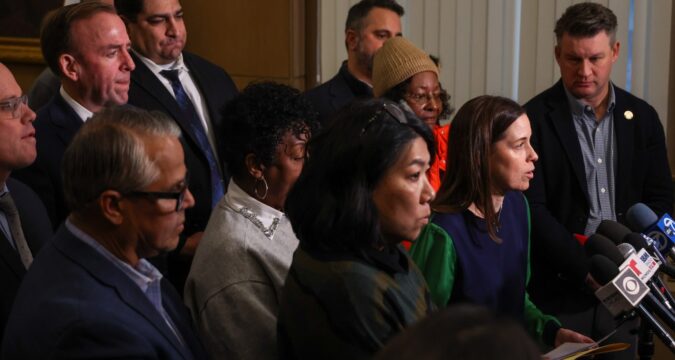
Despite down-to-the-wire deadlines and sometimes-contentious exchanges on the council floor, what we witnessed this budget season is something we should all applaud: a healthy disagreement between factions of our city, almost evenly armed, coming together to eventually compromise on a city budget.
For the first time in decades, Chicago’s City Council did something extraordinary. Aldermen came together to meaningfully engage in the city’s budget process, crafting a serious alternative proposal and asserting their authority as a co-equal branch of government. This was not symbolic dissent or last-minute posturing. It was substantive, coordinated legislative work.
For years, Chicago’s budget process has been dominated by the mayor’s office, with the City Council reacting rather than shaping the budget. Historically, budgets were presented as finished products, not starting points for debate. To the mayor’s credit, his much-disputed head tax seemed as if it was the catalyst for this so-called independence and alternate budget maneuver. Members of the City Council dug into line items, questioned assumptions, identified trade-offs and proposed solutions. They acted not as a rubber stamp, but as lawmakers.
That shift matters. It signals a healthier democratic process and a more accountable government, something my organization, the Better Government Association, has recommended for many years. When legislators scrutinize budgets, residents benefit from transparency, debate and a fuller airing of priorities.
While this moment should be celebrated, the work is not done. If the City Council expects to repeat or improve upon this effort in future years, it must confront an uncomfortable reality: Chicago’s legislative branch is structurally underresourced and understaffed for the responsibilities it is now claiming.
A real legislative body requires real analytical capacity.
The mayor’s office has an army of budget analysts, lawyers and policy specialists, while aldermanic offices rely often on a handful of staff juggling everything from pothole complaints to zoning questions. Their offices are simply not staffed enough to help put together real policy items or budget proposals.
That imbalance has consequences. It forces aldermen to compress months of analysis into weeks, to rely on outside expertise that may not be consistently available and to repeat work year after year without institutional memory. The fact that aldermen were able to produce a handful of alternative budget solutions under these conditions is evidence of how much more effective they could be with proper support.
Legislative branches in many major cities have nonpartisan budget offices, policy research teams and committee staff members who provide continuity across administrations. In Chicago, each budget cycle risks becoming a reinvention of the wheel, dependent on extraordinary effort rather than sustainable process.
City Council members in other cities also do not have the responsibility of being mini-mayors of their districts. If someone has a sanitation issue in New York City, they call the sanitation department, not their local City Council member. In Chicago, the alderman is the face of all city services, despite having no actual administrative authority over them. That must change.
Chicago cannot afford a government where one branch is structurally dependent on another for information and expertise. Checks and balances only function when each branch has the capacity to check and balance.
This year’s budget fight marked a turning point. The City Council showed what is possible when legislators take ownership of their role. The City Council must decide whether this is the new normal or just a response to what they perceived to be inadequate leadership.
If Chicago truly wants a stronger, more transparent and more accountable government, it must invest in its legislative branch. Aldermen stepped up this year. The city should step up for them next year.
Bryan J. Zarou is vice president of policy at the Better Government Association.
Submit a letter, of no more than 400 words, to the editor here or email letters@chicagotribune.com.
https://www.chicagotribune.com/2025/12/23/opinion-chicago-budget-city-council-mayor-democracy/


