The low-slung building shows few signs of life: Ivy branches snake up the exterior walls, weaving through cracked brick and boarded-up windows. Its marquee sign reads like an epitaph, with faded block letters: “John G. Shedd Elementary School. A great place to learn!”
There were 46 buildings left vacant following Chicago’s mass school closures in 2013. At the time, district and city officials dreamed up ambitious repurposing plans: community centers, urban farms, and affordable housing. The lots were touted as a catalyst for future neighborhood investment.
But 12 years later, more than two dozen properties remain vacant. Some of those have been sold and are pending construction. But most are still managed by Chicago Public Schools, racking up millions in upkeep costs each year — between $75,000 and $150,000 per property.
The decade-long dilemma is without a clear solution. The Chicago Board of Education approved three new buyers this week, including a bid for Shedd. CPS will net just $125,000 from the three sales. Though more sales are expected in the coming months, the properties still face long, often rocky roads to redevelopment.
“It’s going to be drawn out at least for the next few years,” said Devereaux Peters, an affordable housing developer whose bid was approved for the former Bontemps Elementary School in Englewood. “It’s going through the processes of working with the city, getting our zoning correctly, getting our tax credits. … It’s definitely going to be a heavy lift.”
The nonprofit Peace for Preston plans to redevelop Shedd into a community center. The two other buildings, Bontemps in West Englewood and Henson Elementary School in North Lawndale, will be demolished to make way for affordable housing.
A total of 21 CPS-owned school buildings were returned to the market in May, most stemming from the 2013 closures. Despite the mountain of maintenance costs from the aging sites, it was the district’s first large-scale push to sell them since 2017. Eight failed to receive any bids at all.
The former Bontemps Elementary School, at 1241 W. 58th St. in Chicago, sits empty on Dec. 18, 2025. An affordable housing developer’s bid was approved for the former Englewood school. (John J. Kim/Chicago Tribune)
‘We stepped out in faith’
The dormant buildings are relics of a deeply divisive chapter in Chicago’s history. In 2013, CPS shuttered 49 elementary schools and one high school program — a move officials said would close the district’s budget deficit and more efficiently allocate resources.
But the controversial slate of closings sowed outrage and anguish across the city. Nearly all of the schools were located on the South and West sides, disproportionately affecting low-income Black families.
In the wake of the closures, an advisory committee of aldermen, civic leaders and district officials published a report projecting CPS could offload the properties within three years. But by mid-2017, just 10 sales had closed.
“(The report) was probably aggressive, given the number of buildings,” said Ron Clewer, a market president at Gorman & Co. who specializes in the adaptive reuse of schools.
Many of the properties that did sell were located on the North and Northwest sides. The first, the former Peabody Elementary School in West Town, was sold to a luxury real estate developer in October 2014 for $3.5 million.
For most buildings, though, attracting bidders proved to be difficult. Many of the aging schools were already in disrepair, rife with asbestos and structural issues. The district prioritized bids from community-based nonprofits, but those groups often lacked the capital for such costly projects.
Basketball hoops are covered in rust at the former Henson Elementary School at 1326 S. Avers Ave. in Chicago on Dec. 18, 2025. (John J. Kim/Chicago Tribune)
The Tribune identified at least eight cases in which a bid was approved by the Chicago Board of Education yet ultimately fell through. Among those was the Pilgrim Baptist Church of South Chicago, which bid $55,000 for the former Garrett Morgan Elementary School in Auburn Gresham in January 2018.
The Rev. Corwin Lasenby Sr. said he wasn’t able to tour the building before the sale. When he finally got inside, he saw the building was “destroyed” and that repairs would be too expensive, he said.
He had envisioned the space as a community hub for worship services, a food pantry and Sunday school. “I thought we might be able to redefine how the community looked,” Lasenby said. “We stepped out in faith, but weren’t set up to succeed.”
During the same bidding cycle, affordable housing developer MR Properties offered $50,000 for Paderewski Elementary School. That deal also didn’t close.
“We just couldn’t make the numbers work,” said developer Philip Mappa. “The windows have to be replaced, the roof has to be replaced. … We would have been off starting for scratch.”
‘They’re eyesores’
The majority of the closed school buildings remain dormant. Some have been repurposed periodically, like the former Wadsworth Elementary School in Woodlawn, which was temporarily converted into a migrant shelter in 2023. But others have been boarded up and vandalized.
The former Dett Elementary School on the Near West Side was demolished after a fire last year.
“The buildings are an ongoing liability,” Stephen Stults, the CPS director of real estate, said at a board meeting earlier this month. “They are continually broken into. Several of them have had fires set inside of them. An open building is very dangerous.”
A man watches as the former Dett Elementary School, at 2306 W. Maypole Ave. in Chicago, is demolished on Sept. 12, 2024. The school had been closed since 2013. (John J. Kim/Chicago Tribune)
Lasenby, the South Chicago pastor, put it bluntly. “They’re eyesores,” he said. “A city is driven by safety, economic development, and education. If you strip a community of those, you don’t have a community.”
A vacant building can lower surrounding property values — a harmful domino effect that can lead to urban blight and exacerbate population loss, particularly in Black communities. The eight schools that failed to receive bids during the most recent two-month bidding cycle are in South Shore, South Deering, Englewood, Auburn Gresham, Washington Park, Woodlawn and Garfield Park, according to the district.
A CPS spokesperson said in a statement that those sites may be repurposed for district needs, transferred to a sister agency or be offered again through additional bidding rounds beginning in early 2026. State law also allows CPS to directly solicit offers for properties valued below $25,000.
“CPS is dedicated to ensuring that the use of its properties aligns with educational programming and community needs, while also generating revenue for the District when possible,” the spokesperson said.
After a Board of Education vote, the bid must also receive approval from the City Council or the Public Buildings Commission to be finalized.
Several aldermen have held community meetings in their wards to gauge how redevelopment bids might meet neighborhood needs. The three recently approved buyers received letters of support from local leadership.
Planters are untended at the former Henson Elementary School at 1326 S. Avers Ave. in Chicago on Dec. 18, 2025. (John J. Kim/Chicago Tribune)
But board member Jitu Brown, District 5A, said CPS should take a more involved approach. He expressed concerns with the pace of redevelopment, describing the properties as an opportunity to right a previous wrong.
“What we’re encouraging CPS to do is a needs assessment with the people in the neighborhood, to find out what the community needs are, because these schools were closed against the wishes of people in the community,” Brown said.
‘Layer of complexity’
Even after buyers assume ownership, transforming a school takes years. Experts say redevelopment is a maze of financial and bureaucratic challenges.
The projects, particularly affordable housing developments, rely on several funding streams. Take the Earle School Apartments in West Englewood, for example, which is set to welcome its first residents in January. Developers used the Illinois Affordable Housing Tax Credit, tax increment financing and a municipal grant, on top of traditional debt. Each source had its own lengthy requirements and approval processes.
The century-old building was sold to developer Gorman & Co. for $200,000 in spring 2023. “It’s a game of figuring out, ‘How do you score to get the resources that are necessary to redevelop the site?’” said Clewer, the developer.
Conventional funding is rarely a simple alternative. In neighborhoods marked by chronic disinvestment, investors and banks may classify developments as high-risk, leading to loan denials or soaring interest rates.
“If you need private market financing, or if you need to get a loan from a bank, that financial institution is going to require a market analysis to understand the risk of getting repaid,” said Geoff Smith, executive director of the Institute for Housing Studies at DePaul University. “That is going to be an additional layer of complexity.”
It took eight years to redevelop the former Robert Emmet Elementary School in Austin into a sparkling community center. The Westside Health Authority purchased the lot in 2018 for $75,000. The $40 million renovation added a community plaza and a three-story, glass-walled entrance.
“There’s deferred maintenance on things like this,” said Max Komnenich, project lead and associate principal at the Lamar Johnson Collaborative. “(CPS) closed it without a huge plan for it. By the time we got in there, every bit of paint was peeled off the wall.”
When the Aspire Center for Workforce Innovation opened this summer, about a dozen former Emmet teachers visited the building. “They were just so thankful the building was back in the community,” Komnenich said. “It’s worth doing. You just have to have the right people involved, who really want to champion it.”
‘What better place than a school?’
Peace for Preston currently operates a mentoring program out of the Harold Washington Library Center. The new Shedd building will expand that programming, as well as offer mental health support, vocational training and youth recreational programming.
“It’s a community center, so what better place than a school?” bidder Dionne Mhoon said.
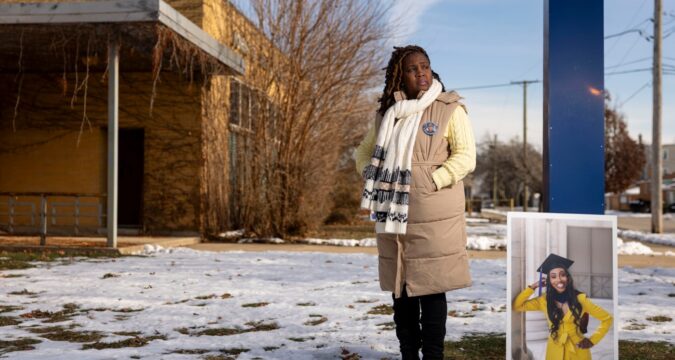
Dionne Mhoon stands on Dec. 15, 2025, in front of the former John G. Shedd Elementary School, which her nonprofit, Peace for Preston, plans to turn into a community center in honor of her daughter, slain Chicago police Officer Aréanah Preston. (Brian Cassella/Chicago Tribune)
Mhoon founded Peace for Preston in honor of her daughter, Aréanah Preston, a slain Chicago police officer. Preston, 24, was shot and killed as she returned home from a late-night shift in 2023. She loved to learn, Mhoon said, and had just completed her master of jurisprudence degree.
The nonprofit is still fundraising for the project, currently at almost half of its $150,000 goal.
“Hopefully someone will see this fixture in the community and know the work that she did,” Mhoon said. “She deserves to be honored.”
On a recent afternoon, Rachel Cooper, 32, stared at the Shedd from her bungalow across the street. She occasionally sees loiterers or vandals near the lot, and even periodic police activity. “It makes me a little bit nervous,” she said.
She moved to the neighborhood with her three young children in May. At the prospect of a community center, her eyes lit up. “If it’s something that my kids could go to, they would love that.”
https://www.chicagotribune.com/2025/12/20/shuttered-cps-schools-sold/


