
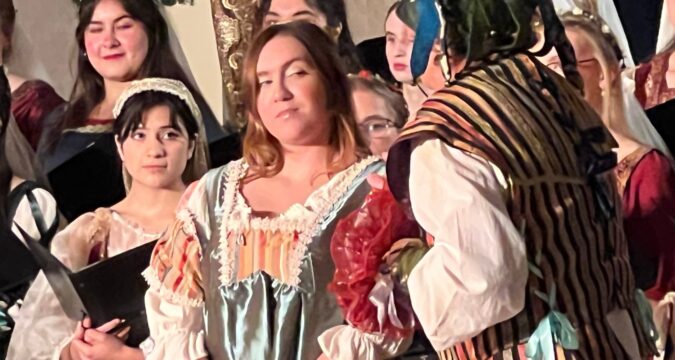
At one time around the start of my newspaper writing career in 1991, Christmas madrigal dinners and concert feasts were fairly common, especially on college campuses.
From my own experience, my first recollection of “the royal treatment” while toasting the holidays was when I attended Valparaiso University from 1988 to 1992.
Students at St. Mary’s College at Notre Dame hoist the poles for a heavy-handled cauldron of “warm wassail punch,” adorned with floating spices and citrus fruits, during a fanfare processional at the 53rd annual madrigal dinner on Dec. 7, 2025. (Phil Potempa/Post-Tribune)
The first madrigal dinner at VU was held in 1977, a decade before my own arrival as a student on campus. Hosted in the “Great Hall” of what was then the previous student union building on the VU campus, it consisted of a multi-course feast accompanied by much fanfare by processionals of “lords and ladies of the manor.”
Musicians ranging from student masters of the harpsichord, lute and mandolin set the evening’s lit by candlelight tone as trumpeters blaring their notes signaled the arrival of each new course being served. Court jesters teased and taunted guests, while other entertainers such as jugglers, acrobats and fire-eaters captivated the entire royal court assembled in an elegant yesteryear era atmosphere decorated with fresh pine boughs, garlands, and large looming tapestries along every wall.
These exquisitely themed — but very labor intensive — dinners take their name “madrigal” from the medieval term which describes short songs originally performed without music incorporating several voices to share a tuneful, bright tale or story. Researchers say the first madrigals were performed “spontaneously” and only later, by the 16th and 17th centuries, were they written down.
The Italians are credited with first bringing madrigal songs to England in the 16th century as a popularized type of private entertainment presented at court in castles or at private country estates of the nobility.
Students at St. Mary’s College at Notre Dame dressed as “serving wenches” hoist the poles for a presentation platter featuring a head of roasted boar adorned with citrus fruits, cherries and floral accents during the 53rd annual madrigal dinner on Dec. 7, 2025. (Phil Potempa/Post-Tribune)
Our American incarnations of madrigal dinners are believed to have first started on college campuses in student unions after a group of eight Tudor student singers hosted a dinner at the University of Wisconsin in 1933. When one of the eight singers transferred to Indiana University, he decided to organize a madrigal dinner five years later.
Unfortunately, VU ceased hosting its madrigal dinners in 2003. Over the decades, my parents, as well as dinner years when we were joined by our farm neighbor friends the Scamerhorns, deemed the annual madrigal dinners (which always sold out quickly) a wonderful way to welcome the holiday season. In later years, I’d host a table and invite my reporter and editor friends from the newsroom to join us.
At the height of popularity, the VU madrigal dinners had to nightly prepare as many as 300 Cornish game hens, 50 pounds of carved ham with raisin sauce, and 10 gallons of warm wassail punch to satisfy appetites.
Chesterton High School began their madrigal dinners about the same time at Valparaiso University and in recent years, the dinners have been limited to just one weekend. This December’s event on Dec. 5-7 marked the school’s 53rd Annual Madrigal Dinner with the usual sold-out attendance. Other area high schools — including my own North Judson-San Pierre High School as well as Wheeler High School in Valparaiso and Highland High School — have all tried hosting madrigal dinners that lasted for several years.
St. Mary’s College in Notre Dame has been hosting Christmastime madrigal dinners for more than half a century. It had been at least 25 years since I attended their wonderful event. Earlier this month, I took a group of friends to feast at St. Mary’s 53rd Annual Madrigal Dinner, and it was just as memorable as I anticipated.
It was a welcome surprise to see Nancy Menk, chair of the music department for St. Mary’s, still waving her baton in full middle ages gown regalia as the coordinator for the annual madrigal dinner, just as she had been when I last attended a quarter of a century ago.
Menk led the 100-plus, all-volunteer member Northwest Indiana Symphony Chorus since 1998 before retiring in 2022. I shared the same loud applause and ovations for Menk as I did for student Abigail Wojtaszek, from Hammond and a graduate of Bishop Noll Institute. Wrapped in royal garb, Abby, who is a junior this year at St. Mary’s, performed as one of the actors during the dinner’s narrative tale.
I also lifted more than just one mug of wassail to toast all of the talent bowing before myself and the other appreciative guests sharing that Dec. 7 delicious menu gathered on the St. Mary’s campus.
Wassail is a very simple warm holiday punch to whip up. It is key to strike a balance for the spices tossed in as key flavor ingredients for the holiday cup of cheer.
Columnist Philip Potempa has published four cookbooks and is a weekly radio show host on WJOB 1230 AM. He can be reached at PhilPotempa@gmail.com or mail your questions: From the Farm, P.O. Box 68, San Pierre, IN 46374.
Madrigal Dinner Warm Wassail Punch
Serves 12
2 cups apple juice
3 cups cranberry juice
1.4 ounce whole cloves
1 stick of cinnamon
1 traditional teabag, which as Earl Grey
Directions:
1. In a large cooking pot, combine apple and cranberry juices.
2. Gather the spices together, along with the tea bag, and place in pouch of cheesecloth or a clean coffee filter and tie the opening tight to create a spice sachet.
3. Bring this mixture to a boil and cook for 2 minutes. Remove from heat and allow to cool to warm before serving.


