
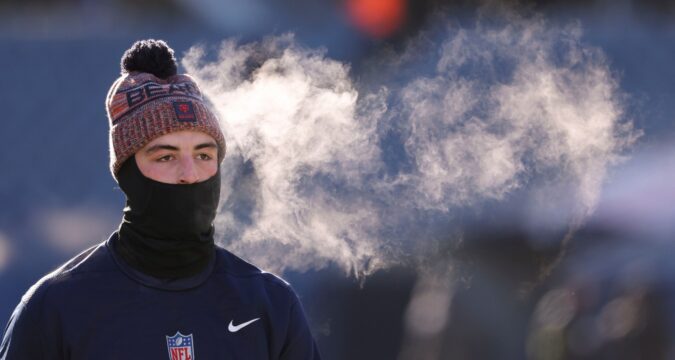
The Chicago Bears don’t have a position coach who conveys more with fewer words than Jim Dray, something rookie Colston Loveland learned quickly.
They were in the tight ends meeting room reviewing the preseason finale at Kansas City, and Dray got to a play on the second series of the game. Loveland was called for false start on a second-and-14 — the kind of mistake veterans were making as well, even into the regular season as it took time to master some of the nuances of what coach Ben Johnson wants done presnap.
It happens, right?
“He was just like, ‘Chatter upstairs is that it’s time to stop being a rookie,’” Loveland said. “That was that. They’ve always pushed me to get ahead of the curve. I respect that. I want that because there is always more to do.”
For a player the team has said has “uncommon” or “rare” intangibles since he was drafted with the No. 10 pick in April, Loveland has been pushing himself the entire way, even through an offseason in which he couldn’t do anything on the field as he recovered from January surgery to repair an AC joint injury in his right shoulder.
In order to know what he was doing when he got on the field in training camp — and produce in game action without allowing mistakes like the false start against the Chiefs to bog him or the offense down — Loveland had to be on top of his game daily.
A lot of coaches will tell you that after quarterback, it’s the most difficult position for rookies to learn. Complete tight ends play a role in every phase on offense — route running, pass blocking and run blocking.
“Typically, rookies are wide-eyed and kind of nervous, just kind of trying to get through the day,” said Dray, who was a tight end for eight seasons in the league. “Colston was always concerned with what he knew, what he didn’t know and what he needed to learn. There was just a rare urgency to get it down. I haven’t met somebody who gets angry because they haven’t heard something yet the first time.”
Passing game coordinator Press Taylor said a lot of times coaches can discern just how much a player is picking up in the meeting room as they can on the field when they’re learning an offense for the first time. With Loveland, there wasn’t any learning happening on the grass as he rehabilitated.
“A lot of times that’s how you kind of get a sense for much a guy is retaining and how much he’s picking up in the meeting room,” Taylor said. “The questions he asked were well beyond 101. We’d put in a play, his follow-up question would be something where we’d say, ‘Hey, we’ll get there. Give us time to develop to that.’
“He wanted it all right away, which is great to see because he wasn’t on the field and he wasn’t accountable for the information the day it’s installed because he’s wasn’t practicing. But you were able to see the retention and the level of engagement.”
Bears coach Ben Johnson greets tight end Colston Loveland before the game against the Browns on Dec. 14, 2025, at Soldier Field. (Brian Cassella/Chicago Tribune)
Loveland was nonchalant when asked about his aptitude for learning the nuances of a complicated position, saying his high school offense and defense in Gooding, Idaho, were relatively sophisticated for the prep level. Of course, playing in a pro-style system at Michigan was a benefit.
Then, there was growing up on a farm. It wasn’t a good idea to head out to perform a task he was given without knowing exactly what needed to be done.
“You know how that goes,” he said with a wry smile. “Each step in life I just keep learning. I never want to be unsure of what I am doing. I’d rather overcommunicate than mess something up and waste everyone’s time.”
Entering Saturday’s game against the Green Bay Packers, Loveland needs one reception to break a tie with Greg Olsen for the second-most by a rookie tight end in franchise history.
Rank, player (year), receptions, yards, average, TDs
1. Mike Ditka (1961): 56, 1,076, 19.2, 12
2. Colston Loveland (2025): 39, 498, 12.8, 4
3. Greg Olsen (2007): 39, 391, 10.0, 2
4. Cole Kmet (2020): 28, 243, 8.7, 2
Loveland’s breakout game in the passing offense came in the 47-42 road win against the Cincinnati Bengals on Nov. 2, when he won the game with a 58-yard touchdown reception with 17 seconds remaining, his second score of the game. His body control to make the catch and then speed to run away from the secondary was impressive. Maybe more indicative of how he can be a true red-zone threat is how he scored on skinny posts against the Bengals and Pittsburgh Steelers.
Loveland showed the ability to weave defenders — Bengals cornerback Cam Taylor-Britt and Steelers safety Kyle Dugger — get them to expand and then open an inside path. From there, Loveland showed the foot quickness at the top of the break to create separation, and at 6-foot-6 and 241 pounds and with a 79-inch wingspan, he doesn’t need a ton. That’s showing the ability to be a wide receiver, which he might need to be in this game with Rome Odunze (foot) and Luther Burden III (ankle) out.
Bears tight end Colston Loveland celebrates a 31-28 win over the Steelers on Nov. 23, 2025, at Soldier Field. (John J. Kim/Chicago Tribune)
Loveland, who is only 21, has caught 15 of 17 targets on third down-plays, converting 10 first downs. The Bears are 2-for-2 on fourth down throwing to him. But talk to teammates and coaches and what they really rave about is the work he has done blocking for the league’s second-ranked running game.
“Even from the first couple weeks he was here, there was just a maturity of how he went about everything,” said tight end Durham Smythe, an eight-year veteran who played at Notre Dame, a school that produces more players at the position than just about any other. “I remember thinking that he was so much more mentally advanced than I was when I got to the league and I thought that was one of my strengths. He comes in and it was like he’s a five-year vet.
“Obviously we knew he had the talent to make plays in the passing game. You’re the 10th overall pick, you’re going to be able to make plays. The development he’s had since he’s come here in the run game, really what he has done on the edge all year in the run game, has been really impressive. That usually takes time.”
The Bears have to feel that Loveland, who helped clear a path for D’Andre Swift’s 17-yard touchdown run last week against the Cleveland Browns, will be even better next season. He’ll actually be able to lift weighs this offseason, something he couldn’t touch much while tackling the rehab. It’s something he’s looking forward to, and his face beams when he talks about his part in the ground attack.
“Guys that I have come across that are really good in the pass game but have the ability to block will a lot of times complain about it,” Smythe said. “Before I knew Colston, that’s something I came to expect. He’s never complained once about being involved in the run or setting the edge. He likes it. That’s something that is new to me.”
Johnson gave props to Dray for the work he has done advancing Loveland’s game. It’s no surprise the Bears are getting so much — in all phases — from the position group because Johnson used to coach tight ends and has very specific ideas of how he wants those players deployed.
Passing-game statistics are a very public part of his game in terms of attention, and the Bears are pleased with the numbers while knowing there’s room for a lot more. But it’s just one part of their evaluation.
Related Articles
What to know about the Chicago Bears’ possible move from Soldier Field
Illinois lawmakers skeptical about Chicago Bears possibly moving to Indiana, while Hoosier leaders tee up the football
Column: Can the Chicago Bears owners find true happiness in an enclosed stadium off the Skyway?
Indiana officials excited by Chicago Bears’ interest
Chicago Bears rule out WRs Rome Odunze and Luther Burden III for Saturday’s game vs. Green Bay Packers
“He’s going to continue to learn and grow,” Johnson said. “He plays with really good pad level for a guy that’s not a prototypical ‘Y’ tight end, that has a little bit more size to him. He still finds a way to play with low pad level and come off the ball and strike, which I really appreciate.
“That’s hard to find for a rookie tight end, much less a guy that’s been kind of tabbed a route runner throughout his college career. I view him as a complete player at this point, and he takes a lot of pride in all facets of what he’s being asked to do. Because of that, there’s really a ton we put on his plate.”
That was the plan from the outset when Dray leveled with Loveland.
“He was told before Week 1 that his rookie season was over, ‘We don’t have time to wait,’” Dray said. “He’s certainly getting better every week. He’s nowhere near where he could be. But he’s doing quite well.”
So, what’s the ceiling for a guy who couldn’t get on the field in the offseason and was limited in the weight room?
“Hard to say,” Dray said. “Pretty much as far as he wants to go.”
Scouting report
Packers cornerback Keisean Nixon intercepts a pass intended for Bears tight end Cole Kmet on fourth-and-1 in the fourth quarter Dec. 7, 2025, at Lambeau Field in Green Bay. (Eileen T. Meslar/Chicago Tribune)
Keisean Nixon, Packers cornerback
Information for this report was obtained from NFL scouts.
Nixon, 5-10, 200 pounds, is in his seventh season in the NFL and fourth in Green Bay, originally adding him in 2022 as a returner and reserve defensive back. He moved into a starting role this season after the departure of Jaire Alexander, and playing cornerback just became more difficult with edge rusher Micah Parsons lost for the season.
Nixon ended the first meeting with the Bears by intercepting Caleb Williams’ underthrown pass for Cole Kmet in the end zone. Nixon has the awareness to drop his man — DJ Moore — and race toward Kmet, a heads-up play. His play has been up and down for the season as a whole.
“Excellent returner, fearless, outstanding ball-carrier vision and toughness,” the scout said. “You see some of that through his game. He’s a very strong tackler. He’s urgent when he has to support the run and he’s physical in coverage, sometimes grabby. He struggles when he has to open and run and match vertically downfield. At times, he allows too much separation at the break point, and that’s problematic.
“But he’s created a ton of on the ball production this season. He’s got 16 pass breakups, second-most in the entire league. The issue with that is he’s got only one pick — the one at the end of the Chicago game. What’s that tell you? This guy is being targeted a lot. People are going after him. He is responding at times but he’s more of a ball disruptor than a playmaker. I would think the Packers will look to upgrade at this position and it’s tougher for defensive coordinator Jeff Hafley now. He’s been zone heavy, and that fits Nixon’s game better. Here’s a question: Can the Packers remain zone heavy without Parsons if the pass rush isn’t getting home?”
https://www.chicagotribune.com/2025/12/19/chicago-bears-colston-loveland-fast-track/


