Border Patrol Cmdr. Gregory Bovino and his agents returned to the Chicago area this week, targeting everyday working people as part of President Donald Trump’s immigration crackdown. Though recently released federal data shows that immigration agents booked roughly 1,900 immigrants in the first half of Operation Midway Blitz — two-thirds of them had no known criminal convictions or pending charges.
Landscapers, construction workers and even ride-share drivers at Chicago’s O’Hare International Airport have been arrested in the past few months. The Illinois Drivers Alliance — a labor coalition seeking to organize ride-share drivers — decried the raids, saying it was “deeply concerned that the drivers’ due process rights were violated.”
What to know about immigration enforcement raids in Chicago
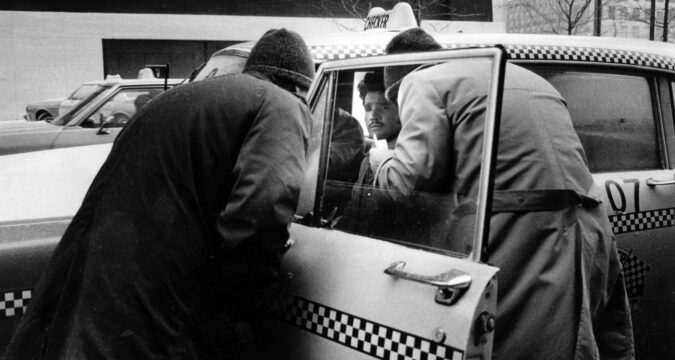
Taxi drivers were also the focus of surprise immigration raids in Chicago 40 years ago. January 1985 began with the city assisting the U.S. Immigration and Naturalization Service in its efforts to arrest migrants who were working behind the wheel but lacked permanent legal status. Several months later, however, Mayor Harold Washington declared the city would no longer participate in INS activities — a standard that remains in effect today.
Chicago’s INS Director Alvin Douglas (A.D.) Moyer continued to target taxi drivers — whose country of origin was listed on their cab license applications. More than 100 cabdrivers were taken into custody as part of a Dec. 17, 1985, effort Moyer called Operation Taxicab.
A sweeping 1986 immigration act signed by President Ronald Reagan introduced a pathway for temporary legal residency for anyone who had been in the U.S. since 1982. The legislation, however, also gave the federal government the power to penalize employers who knowingly hired people who entered the country illegally. Locally, it also led to the opening of the Broadview detention center.
Desperately needed taxi industry reforms were finally introduced in 1990 — along with higher fares.
Here’s a look back at pivotal moments in immigration during the mid- to late-1980s.
January 1985
A taxi sloshes through high water at Lake Shore Drive and Ohio Street on Dec. 2, 1982, in Chicago. (Phil Greer/Chicago Tribune)
The city at first cooperated with immigration officials in a crackdown on immigrants living in the United States without permanent legal status who had obtained licenses to drive taxis in Chicago. Federal authorities used taxicab license applications to find these drivers.
One week later, however, corporation counsel James Montgomery recommended Chicago no longer assist INS authorities in arresting immigrants unless subpoenas were obtained.
Moyer criticized Montgomery’s suggestion.
March 7, 1985
Mayor Harold Washington raises his hand as he talks about signing an executive order to assure that all residents of Chicago, regardless of nationality or citizenship, shall have fair and equal access to municipal benefits, opportunities and services, on March 7, 1985. With Washington is his Latino Advisory Commission, including Jesús “Chuy” García, third from right in background. (Carl Hugare/Chicago Tribune)
Mayor Harold Washington signed an executive order that halted the city’s cooperation with federal immigration authorities and ended the city’s practice of asking job and license applicants about their citizenship status. Washington said citizenship questions would be asked only on applications for jobs or positions that were federally funded.
Though Nigerians made up the majority of people initially arrested in the taxicab investigation, the Hispanic community pressed Washington’s administration for policy changes because of harassment complaints.
May 21, 1985
The Department of Consumer Services displays taxicab medallions (licenses) on Jan. 28, 1976. (Roy Hall/Chicago Tribune)
Five people — including three employees of the Chicago Department of Consumer Services — were indicted by a federal grand jury on charges of accepting bribes of $350 to $600 to issue chauffeur’s licenses to immigrants living in the U.S. without permanent legal status.
The indictments outlined a scheme of payoffs, forged documents, cheating on tests and improper granting of licenses to 24 people — many of whom wanted to become cabdrivers. Three of the five people indicted were sentenced in December 1985, to three years’ probation and 300 hours of community service.
Ironically, Moyer said it was Jesse Madison — commissioner of the Department of Consumer Services — who asked immigration authorities to look into cab licenses. Moyer said Madison had received numerous complaints about taxi drivers who could not find prominent locations and could not speak English.
After the announcement of the indictments, Madison said the city’s system for issuing chauffeur’s licenses was under review.
Dec. 17, 1985
An abandoned taxi is prepared to be towed away from the Merchandise Mart, 222 Merchandise Mart Plaza, Chicago, on Dec. 17, 1985. An early-morning raid on cabdrivers conducted by federal immigration authorities called Operation Taxicab resulted in the arrests of 15 people at the building’s taxi stand. (Ernie Cox Jr./Chicago Tribune)
Federal authorities — in their bid to rid Chicago of what they called “a serious menace” — conducted Operation Taxicab. Cabbies were asked to provide proof of citizenship when stopped by immigration officials at O’Hare, Midway, the Merchandise Mart and downtown hotels.
In all, 129 drivers were arrested. They came from 22 countries, but none was Hispanic. Sixty-eight drivers were unable to prove they were legal residents, according to the INS. But the Washington administration said 86 were living in the U.S. legally. Twenty-eight were released after posting $2,000 bonds. Abandoned cabs littered downtown.
“These people are raising havoc with the city,” Moyer said. “They are a nuisance. They are abusing passengers, taking them to the wrong locations and overcharging them. And they are taking jobs away from American citizens and legal foreign residents.”
“A downright fabrication,” said Jeffrey Feldman, president of Yellow Cab Co. “If Americans want to become taxi drivers so badly, why do I have to advertise in the newspapers? Or put signs on my cars or on bus stop benches?”
Of the 11,000 licensed cab operators in Chicago at the time, Moyer estimated 600 of them were immigrants living in the the U.S. without permanent legal status.
There was, however, no federal law prohibiting employers from hiring these immigrants.
“They’re hurting innocent people,” Feldman said. “I had one driver who was stopped three times. It’s just plan harassment.”
Moyer said his department planned to make weekly raids of 30 to 40 people to “clean up the industry.” Another 47 cabbies were arrested in early January 1986.
Dec. 18, 1985
A stack of complaints against Chicago taxi drivers on May 7, 1986. (José Moré/Chicago Tribune)
City officials — who garnered an average of 170 complaints from cab passengers per week — conceded the written test for cabdrivers did not establish that an applicant knows the city’s geography, speaks English or understands the city’s rules and regulations governing cabs.
At least one of the tests administered to applicants seeking a chauffeur’s license contained a question regarding the location of a Chicago restaurant that had closed five years prior, acknowledged Tony Olivieri, deputy commissioner of the Department of Consumer Services.
The city revoked the licenses of just two cabdrivers in the previous two years for rule or safety violations.
Nov. 6, 1986
President Ronald Reagan signed into law the Immigration Reform and Control Act of 1986, which provided a provision that enabled people living in the U.S. without permanent legal status since before Jan. 1, 1982, to apply to obtain temporary legal residency. After 18 months, that status could be converted to permanent residency for those who could demonstrate an understanding of English, U.S. history and government.
Reagan said the new law will “go far to improve the lives of a class of individuals who now must hide in the shadows, without access to any of the benefits of a free and open society.”
The sweeping reform act, however, also included tough penalties for employers who hire workers without regard to their immigration status.
May 5, 1987
People wait in line outside the Mexican Consulate at 141 W. Ohio St. to get help in securing birth certificates and other documents to use in applying for legal residency in the United States on May 5, 1987, in Chicago. (Phil Greer/Chicago Tribune)
INS began accepting applications at four centers for temporary legal residency. It was estimated that almost 4 million immigrants were expected to qualify for the landmark program — including 300,000 in the Chicago area. The cost to apply was $185 per adult and $50 per child, with a maximum fee of $420 per family.
Several months into the program, only 19,000 people in the area had applied, which was fewer than expected. Potential applicants had many questions. INS — which called the program a “success” — and immigration reform groups blamed each other for the lack of communication.
The growing crowd inside the INS offices at 3119 N. Pulaski Road reflects the now-or-never atmosphere during the last hours in which immigrants could apply for legalization on May 4, 1988, in Chicago. (Phil Greer/Chicago Tribune)
The last applications were accepted on May 4, 1988. Thousands of Chicagoans put fear aside to submit their applications before the deadline, which was later extended until May 4, 1989. Still, advocacy groups said the new immigration law needed to cover more people and make the application process easier.
An estimated 1.5 million people — including about 100,000 from the Chicago area — applied.
Aug. 10, 1987
Javier Nava, who entered the United States illegally from Mexico in 1976, displays the temporary residence card he received on Aug. 10, 1987, while at Forest Park Mall, 7600 W. Roosevelt Road, in Forest Park. Nava was the first Chicago-area resident to receive the status as part of a nationwide program. (José Moré/Chicago Tribune)
Mexican immigrant Javier Nava became the first Chicago-area resident to obtain temporary residency as part of the program and was given a Social Security card from immigration officials.
In November 1988, Alejandro García and his family became the first Chicago-area family to gain permanent residency.
Oct. 19, 1987
Detention officer Joe Kolb processes a Yugoslavian immigrant who was arrested entering the country illegally, at the new Broadview detention facility on Oct. 30, 1987. (Guy Bona/Chicago Tribune)
“After six months of emphasizing the carrot in its new immigration policy, the U.S. Immigration and Naturalization Service has begun to unveil the stick,” Tribune reporters Constanza Montaña and Cheryl Devall wrote.
A detention center for immigrants — with no overnight accommodations — was opened in an industrial park in Broadview. The facility was designed to hold up to 200 people rounded up in raids on area businesses. People could then be shuttled to O’Hare International Airport for deportation.
Detention officer James Gibson, left, and Assistant District Director Roger Piper work in the radio room of the U.S. Immigration and Naturalization Service’s new lockup in Broadview on Oct. 30, 1987. (Guy Bona/Chicago Tribune)
“We’re very proud of this,” said Roger Piper, assistant district director for INS, during a tour of the facility, where detainees would be kept in large, glassed-in rooms equipped with indestructible plastic chairs, stainless steel toilets and telephones.
April 28, 1988
Maximino Carrasco proudly shows off the work permit he just received from the legalization offices at 3119 N. Pulaski Road in Chicago on April 4, 1988. (José Moré/Chicago Tribune)
Molon Motor and Coil Corp. became the first Chicago-area employer to be fined by INS for hiring immigrant workers without permanent legal status in violation of the 1986 federal immigration law. The Rolling Meadows manufacturer was fined $41,000 (or about $113,000 in today’s dollars).
May 1989
U.S. Immigration and Naturalization Service Chicago District Director A.D. Moyer, left, prepares to appear on a Spanish-language television show with Connie Lara, an INS attorney, on May 25, 1990, at WSNS-Ch. 44 TV studios, 430 W. Grant Place, Chicago. (Carl Wagner/Chicago Tribune)
When television station WSNS-Ch. 44 announced plans to give Moyer its inaugural Hispanidad award, many questioned why the local INS director should be given the honor. Moyer had been criticized for opening a detention center at Broadview during a time when the immigration agency was supposedly encouraging immigrants to apply for amnesty.
Yet Moyer, who remained INS director until the mid-1990s, was also beloved by others. He had his own weekly column in a local newspaper, often appeared on Spanish-language radio and his Spanish-language TV program “Linea Abierta” had been nominated twice for Chicago Emmy awards. The Tribune called him “an international celebrity.”
Feb. 7, 1990
Cabdrivers march in front of City Hall on Feb. 7, 1990, as the City Council overhauled cab regulations and increased taxi rates by 30% in Chicago. (Karen Engstrom/Chicago Tribune)
City Council approved a major overhaul on cab regulations that were designed to impose penalties on abusive drivers, improve driver proficiency and upgrade cab safety. The ordinance also brought the city’s first taxi rate increases — of roughly 30% — since 1981. The rate increases went into effect on March 9, 1990.
In response to the rate increase, Chicago cab companies raised the lease rates cabdrivers paid — leaving them no better off financially.
Want more vintage Chicago?
Become a Tribune subscriber: It’s just $1 for a 1-year digital subscription.
Thanks for reading!
Subscribe to the free Vintage Chicago Tribune newsletter, join our Chicagoland history Facebook group, stay current with Today in Chicago History and follow us on Instagram for more from Chicago’s past.
Have an idea for Vintage Chicago Tribune? Share it with Kori Rumore at krumore@chicagotribune.com.


