
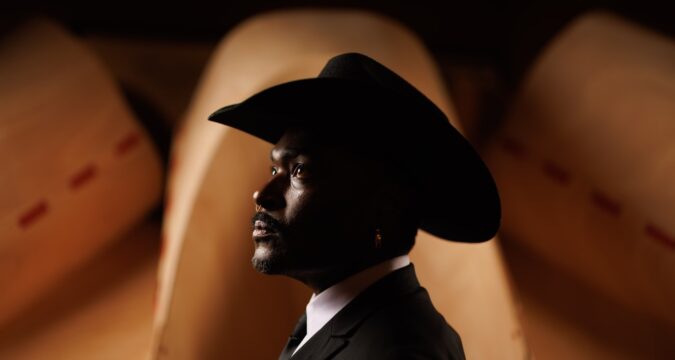
This year has been something of a blessing for Roy Kinsey.
For one, he turned 40, a monumental year for anyone. But Kinsey also checked off a number of artistic accomplishments this year. In April, there was the release of his latest album, “Dandelions: Gods Don’t Cry.” Kinsey often uses a rich storytelling structure in his songwriting and his latest album is perhaps one of his strongest examples of this creativity.
On the record, Kinsey explores the power of built community through art making and music making. With features from local artists like Mother Nature and Ifeanyi Elswith, among others, on nearly every track, “Dandelions: “Gods Don’t Cry” is a love letter to Chicago.
“It’s named dandelions just because it’s this very powerful, resilient flower and herb that is kind of overlooked in a lot of ways,” Kinsey said.
Related Articles
Chicagoan of the Year in Theater: Glenn Davis is helping lead Steppenwolf into a new era
Chicagoan of the Year in Dance: Dancemaker Erin Kilmurray looks for what’s next after ‘Fly Honey’
Chicagoan of the Year in Jazz: In 2025, Gustavo Cortiñas’s drums sang
Chicagoans of the Year for Museums: National Public Housing Museum staff keeps residents at heart
Chicagoan of the Year in Books: If you’re into horror, thank the librarian Becky Spratford
Besides, it’s a familiar story. Everyone has a story of picking dandelions as a young child and someone else, perhaps a parent or older sibling, telling them that they are weeds. It is only now, in adulthood for many of us, that we have learned dandelions are a resilient flower with healing properties for the human and nutrients for the soil.
They allow everything else to grow after they bloom.
“Naming the record that was a kind of reclamation,” Kinsey said. “It was me kind of reclaiming my inner child. It was giving myself permission, and it was growing.”
In addition to his latest record, Kinsey expanded on the Rapbrary, a library he founded to preserve rap and hip hop as culturally important literary art forms. Kinsey originally imagined the Rapbrary as a permanent institution, but he soon realized that expanding the Rapbrary throughout the city could provide more ample opportunities for the community to utilize and learn from it. The first such locations were in the Austin Town Hall and Johnetta Art Center in Bronzeville. The Rapbrary also gave out its first Rapbrary Awards, where four people received $1,000 each.
“To empower them and know that the work they are doing is important in a time where our stories are being banned and challenged, or they’re literally telling us that our histories didn’t exist, I just kind of want Rapbrary and hip hop to be that space that continues to honor the legacy of music, of storytelling and of our literature,” Kinsey said.
For Kinsey, storytelling is truly at the heart of what he does. “What is more powerful than the story? What is older than the story?” said Kinsey. “I understand that just because you can say anything doesn’t mean that you should, right? And so I’m very careful about the stories that I tell.”
Influenced by creative powerhouses like Toni Morrison, James Baldwin, Amiri Baraka and Octavia Butler, Kinsey says his identity as a Black male librarian, a queer rapper, an outsider in the music industry and as a storyteller fuels his mission and purpose moving forward. Stories are not just the means for discussing our lives. They also have the ability to change us for the better.
“More than ever, we need the skills that you develop when you are consuming a story,” Kinsey added. “We need to be able to develop empathy by understanding other people’s lived experiences, and that’s something that I take seriously as a storyteller.”
It was the breadcrumbs left by his idols in their art, whether through music or through books, that helped Kinsey down his own path. And now, Kinsey hopes his work in the community and through song can do the same for younger folks coming up behind him.
Musician and librarian Roy Kinsey poses for a portrait at the Chicago Cultural Center. (Armando L. Sanchez/Chicago Tribune)
Part of that was done through a chapbook, which he described as a legacy project and a collection of his most impactful songs. Part of that will also continue into the next year. In 2026, Kinsey will release “D’Angelo and the Dandelion,” his first children’s book about a young boy who is learning to accept himself and find strength and trust in who he is. He’ll also release his first documentary, a project directed by Aaron Turney in collaboration with OTV. Titled “Rapbrary: Reading Came First,” the documentary will provide viewers a glimpse of Kinsey’s journey of building the Rapbrary and as well as background information about his life. He also has special projects and installations planned for the end of January and through Black History Month at the Oak Park Public Library, as well as a performance of “Dandelions: Gods Don’t Cry” later on the books.
“It is kind of my mission to continue to turn the light on to people who have gotten us this far by being truth tellers and being dedicated to the written word as well as the spoken word,” Kinsey said. “I want people to develop the thing that we need most right now, which is compassion, which is empathy, which is strategy, which is resilience, overcoming obstacles. I want us to get back to being a society of readers and people that care about the soft skills that you develop when you are taking in so many more stories.”
Britt Julious is a freelance critic.


