In his niece’s drawings, Chicago police Officer Andrés Vásquez Lasso now rests inside a cloud.
It’s been hard for the 7-year-old to fully comprehend that her uncle is gone, no longer available to get ice cream with her or play with her, the 32-year-old officer’s mother said.
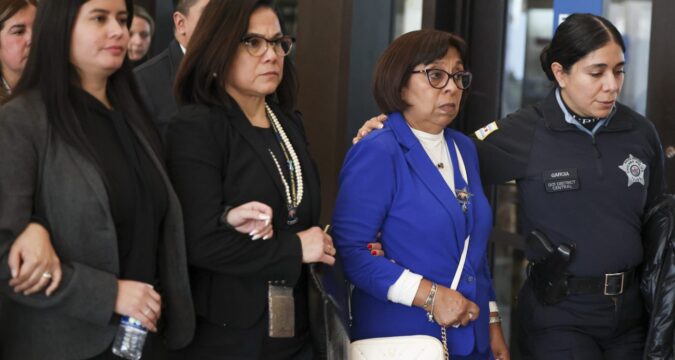
In a tearful statement, Rocio Lasso described her family’s sudden loss on March 1, 2023, when Vásquez Lasso was gunned down while responding to a 911 call.
After several hours of arguments and testimony, Cook County Judge John Lyke ordered a sentence of life in prison for Steven Montano, 21, after a jury in July convicted him of first-degree murder following a weeklong trial that showcased body camera footage of the slaying and emotional testimony from his wife and other responding police officers.
“Part of me died with him,” his mother said, wiping away tears.
Despite the natural life sentence, though, new legislation cracks the door open for a possible future outside of prison one day for Montano. A law that took effect in January of 2024 allows people who were under 21 at the time of the offense to seek parole after serving at least 40 years.
In handing down the mandatory life sentence, Lyke noted the chance at parole one day and declined to give the additional life sentence requested by prosecutors. But he also noted the cost of the loss and said the officer’s mother “painted a great picture of a great man.”
“He was a human being first and foremost,” Lyke said. “The most difficult job of any judge in this country is to impose sentences in murder cases because we are required to balance both the victim’s rights as well as the defendant’s rights.”
After the proceedings, State’s Attorney Eileen O’Neill Burke said the prosecutors were “tireless” in presenting the evidence to the jury.
“Officer Vásquez Lasso was doing his job that he took an oath to do to protect and serve. So while we are gratified with the sentence today, nothing will heal the loss that Officer Vásquez Lasso’s family, his loved ones or his fellow officers have suffered.”
Cook County State’s Attorney Eileen O’Neill Burke speaks at the Leighton Criminal Court Building on Dec. 16, 2025, after Steven Montano was sentenced to life in prison for the murder of Chicago police Officer Andrés Mauricio Vásquez. (Eileen T. Meslar/Chicago Tribune)
Vásquez Lasso, 32, and other officers were dispatched to the 5200 block of South Spaulding Avenue on the city’s Southwest Side after Montano’s girlfriend called 911 to report that he threatened her with a gun, prosecutors said.
As police arrived, Montano jumped out of a window, prosecutors said, and was pursued by Vásquez Lasso, who had arrived at the scene.
As the chase neared a playground, Montano turned toward the officer, prosecutors said, and both fired weapons. Vásquez Lasso hit Montano in the mouth area, and Montano shot the officer in the head, arm and leg.
“Officer down!” a fellow officer yelled into his radio as he arrived at the scene. “Officer down!”
Born and raised in Colombia, Vásquez Lasso immigrated to the U.S. and embraced his new home, family members and prosecutors have said. He got married and bought a home in the same district in which he patrolled each day.
The courtroom was packed with police officers and family members, including Vásquez Lasso’s wife.
In a brief statement, Montano said he never meant to hurt the officer and asked the family to forgive him.
In presenting mitigating circumstances, Montano’s public defender, Brett Balmer, noted that Montano was 18 when he killed Vásquez Lasso, arguing that science and the law are evolving in its understanding of how young adults’ brains work. She said that research indicates people’s brains often don’t fully develop until the mid-20s.
The new law, signed by Gov. JB Pritzker, was meant to take the new research into account and offer a chance for life sentences to be reviewed later in life.
“The teenage brain, the emerging adult brain, is not the same as an adult’s,” Balmer said.
But Kevin Nolan, the lead prosecutor on the case, called Montano “utterly remorseless.” He did not dispute the defense’s arguments that Montano didn’t shoot him in malice or with predatory intent.
“He didn’t want to get caught, that’s it,” Nolan said. “I would suggest to the court that that is more chilling than if he were motivated by some sort of blood lust.”
With few facts in dispute during trial, Montano’s defense attorneys went for a long-shot chance at a second-degree murder conviction, arguing that Montano, only 18 at the time, shot the officer in a moment of stress and panic when he saw a gun, not realizing Vásquez Lasso was a police officer.
His public defender had argued that Montano was in a controlling and dysfunctional relationship with a 37-year-old woman who lied when she called 911 that day, bringing officers to the scene. She said he grew up in the Little Village neighborhood in an environment where he had multiple negative encounters with police officers.
Montano took the stand in his own defense and told the jury he did not know who was chasing him and fired at Vásquez Lasso in self defense.
In the end, though, the jury found him guilty of the more serious offense of first degree murder, essentially guaranteeing a life sentence.
https://www.chicagotribune.com/2025/12/16/steven-montano-sentencing-life/


