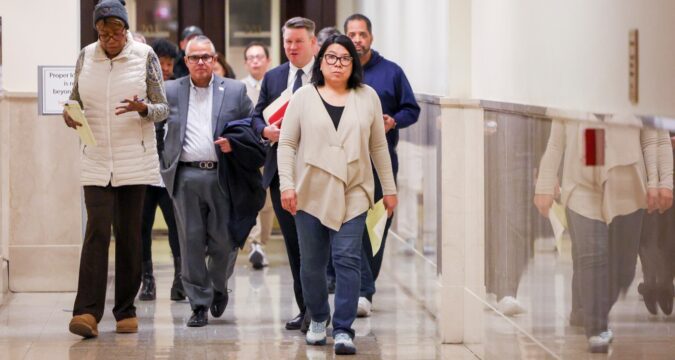
Aldermen attempting to pass their own 2026 Chicago budget over Mayor Brandon Johnson’s objections revealed Tuesday morning that they will try to balance their plan with increases in liquor taxes, plastic bag fees and Uber charges, along with millions from ads on downtown bridge houses and legalized video gambling.
The renegade group claiming a City Council majority released plans to close a $42 million 2026 budget gap created by them removing a garbage fee increase from their package and restoring funding for youth summer jobs.
And the plan — a stunning effort by aldermen to outmuscle Johnson and end Chicago’s tense budget negotiations — will quickly see a crucial test when it faces a Finance Committee vote Tuesday.
“There’s not a budget that’s on the table right now that everybody likes every aspect of,” Ald. Nicole Lee, a leader of the alternative group, said as the meeting started. “But our job is to make sure that the city government continues to run, and do it in a responsible way, and we believe that we have that, that we’re meeting our obligations, and that we’re leaving Chicago stronger for it.”
The spending plan could pass this week, a timeline Johnson argued Monday night leaves his team with too little opportunity to vet it as the city faces an end-of-year deadline to avert a government shutdown.
While the budget’s backers adamantly defend the projections they used to declare it balanced, Johnson has argued it relies on shoddy estimates and will leave the city with a dangerously unreliable ledger.
Chicago Mayor Brandon Johnson speaks to the media after meeting with a group of City Council members who offered an alternate city budget on Dec. 15, 2025. (Terrence Antonio James/Chicago Tribune)
The group withheld details about their plan from Johnson during a tense, short Monday evening meeting.
“They are prepared to move forward with a proposal that I have not had a chance to review, nor my team. That is not how negotiations work,” Johnson said afterward.
But those specifics are finally public now.
The new plan relies upon several tax hikes: a 5¢-per-bag — or 50% — hike in the city’s plastic bag tax projected to bring in $8.7 million; liquor tax increases estimated to raise $6 million; and an expansion of the area where rideshare surcharges apply.
The proposal also relies upon several ambitious plans to earn the city money without taxes. It estimates the city will earn $29.3 million by selling new ads on bridge houses, light poles and city vehicles. And it pegs a new “augmented reality” advertising program as a $6 million boon, an amount lower than previous estimates from the group.
The most eye-catching new cash cow: the legalization of video gambling terminals across the city. That controversial plan, long-debated in the City Council, would clear the way for gambling at bars and restaurants across the city to bring in $6.8 million next year, according to the plan.
The proposal also counts as $46 million in various “efficiencies” recommended by the consulting firm Ernst & Young in a report Johnson requested earlier this year and anticipates an $89.6 million spike from selling debt owed to the city.
But perhaps the most critical piece of the plan is what it does not include: a head tax on businesses.
Johnson has declared a head tax, most recently billed as a monthly $33-per-employee payment from companies with over 500 Chicago employees, his top priority, describing it as an effort to tax the rich — and not working class Chicagoans – as wealthy companies secure tax cuts from President Donald Trump.
Many aldermen have forcefully fought the measure, describing it as a job killer that will harm the city’s economic growth. The measure has been repeatedly opposed by City Council majorities in signed declarations and even a Finance Committee vote.
https://www.chicagotribune.com/2025/12/16/aldermen-bag-tax-ads-on-bridge-houses-balance-budget/


