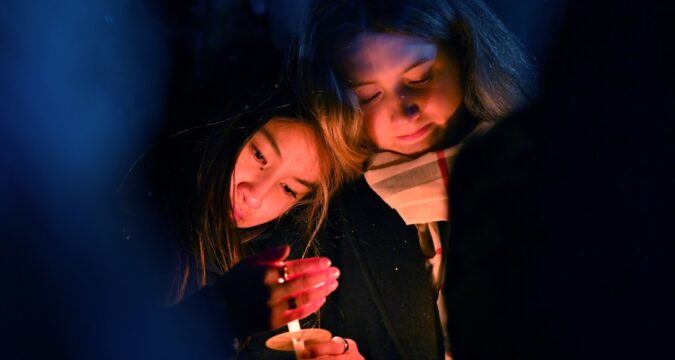
This past weekend, the world was rocked by two mass shootings. Two were killed and nine injured at Brown University in Providence, Rhode Island. On the same day, at least 16 were killed, including one of the perpetrators, at a mass shooting during a Hanukkah celebration at Bondi Beach in the Sydney, Australia, area. While police have yet to establish a motivation for the Brown shooting, the Bondi shooting is being investigated as a terrorist attack. These shootings reflect a troubling pattern of violence and hatred in the United States and the world.
While these shootings may seem far away, this is a dangerous misconception. As the Rev. Martin Luther King Jr. wrote in his “Letter From Birmingham Jail,” we live in an interconnected global community, and hatred, violence and injustice will spread from one community to the next unless we take action.
In the past few years, incidents of antisemitism and Islamophobia and race-based crimes have all increased. It is important to remember that no one group is solely responsible for or solely the victim of hatred. Anyone, regardless of race, gender, religion or sexuality can be a victim or a perpetrator of hate. This can be seen in the Bondi shooting. Those identified as the shooters and the bystander who intervened to stop one of the attackers are Muslim. No one group is solely responsible for spreading hatred or should be blamed for the actions of hateful individuals. The greatest weapon in the fight against hatred is unity.
There are few challenges facing the world today that are more pressing than this rise in hatred and divisiveness, and it is critical we act against it. The first step must come from those who are in power. Too often in this country, leaders espouse hatred rather than stand against it. We must ensure that the leaders we elect to office reflect the values of love and unity that we wish to establish, and we must hold leaders accountable when they fail to do so.
This is the first step in ensuring that the hatred that took the lives of families at Bondi and students at Brown will never reach our communities.
— Fayzaan Virk, Franklin, Wisconsin
Anti-Jewish hatred
This week, as Chicago’s Jewish families began celebrating Hanukkah, we woke to hear that 15 innocent people were murdered and dozens wounded at a Jewish holiday celebration in Australia. When do we say “enough”? The world, our country and, frankly, our city need to start acting on the fact that antisemitism is dangerously getting worse. It’s not acceptable to sound outraged after a tragic incident and then look the other way. Or single out the one Jewish nation as evil and then act surprised when people respond with anti-Jewish hate.
We know the facts; the statistics are in front of us. A young couple murdered outside the Capital Jewish Museum in Washington, D.C., a Holocaust survivor among those firebombed in Colorado, synagogues threatened, congregants harassed and armed guards required just so we can gather and pray. Jewish Americans make up the largest group targeted by religious hate in our country.
In Chicago, antisemitic hate crimes have risen dramatically. Jews make up 3% of the population, yet antisemitic incidents account for more than 35% of Chicago’s reported hate crimes. For those of us in mental health and education circles, this is sadly unsurprising. Social media posts in the name of anti-racism have created lists of “Zionist” providers to avoid.
Last year, a mayor-appointed Chicago Board of Education president resigned after being exposed for posting vile antisemitic content, and an alderwoman on social media asked for recommendations for an “anti Zionist pediatrician.” In public schools and universities, Jewish students have reported being shamed by teachers for genocide and have been harassed and unprotected.
What our leaders say and do matters. Yet, it’s primarily been Jewish groups that speak out. As a psychologist who has taught about bullying and hate and worked with government leaders to advocate for social-emotional learning in our schools, I have sought to be a voice for vulnerable children and communities. It’s painful to experience the lack of voices speaking out for the safety of my own minority community now.
Hanukkah is a holiday meant to remind Jews throughout the world that we have overcome forces much bigger than us. Still, we could use some outside help.
— Alana G. Baum, clinical psychologist, Chicago
Where is gun reform?
As the nation prepared to remember the 26 victims of the 2012 Sandy Hook Elementary School massacre in Connecticut on Sunday’s anniversary, a gunman opened fire at Brown University in Rhode Island on Saturday. At least two were killed and nine injured.
I’d like to know if the shooter planned the attack to occur the day before the anniversary of Sandy Hook. Or was it just a terrible coincidence? Either way, what happened this past weekend is another American tragedy fueled by hate or illness — or both. Once again, I urge the president to convene a Camp David gun summit, with representatives from the National Rifle Association, Second Amendment proponents, law enforcement and families of victims in attendance.
How many more times do we need to experience this madness before true gun reform legislation is enacted?
— Denny Freidenrich, Laguna Beach, California
Bombing campaign
President Donald Trump’s bombing campaign against suspected drug smugglers violates U.S. law, international law and our own military codes.
The Department of Defense’s Law of War Manual forbids attacking those who’ve been captured or incapacitated. It states that our troops must refuse to carry out orders that they know would be a war crime: “For example, orders to fire upon the shipwrecked would be clearly illegal.”
Law enforcement tries to capture criminal suspects alive. Not only is it required by law, but a living suspect is far more useful than a dead one. Someone arrested for drug smuggling could provide evidence that leads to more arrests and drug seizures.
The U.S. Coast Guard recently seized a boat with more than 20,000 pounds of cocaine after disabling its motor from the air, without killing anyone. In November, the Coast Guard reported that it seized a record 510,000 pounds of cocaine in fiscal year 2025.
In a recent letter to U.S. Sen. Rand Paul, the Coast Guard said it interdicted more than 200 boats suspected of drug smuggling without using lethal force, in the year before Trump’s bombing campaign.
News reports indicate that British intelligence stopped sharing information with the U.S. on drug smuggling in the Caribbean because the Brits don’t want to be involved in clear violations of international law.
The fight against drug smuggling requires international cooperation and the use of each arrest to gather more information. State-sanctioned murder at sea is the wrong approach.
— Mike Mosser, Chicago
A question for Trump
Recently, an American delegation was sent to Moscow to continue to negotiate an end to the Russia-Ukraine war, and Jared Kushner, Donald Trump’s son-in-law, was front and center. What diplomatic experience does he actually have? Could it be that Trump is continually proposing deals that sell out the Ukrainians in exchange for Vladimir Putin’s implicitly agreeing post-peace to expand Trump Organization opportunities to do business with and in Russia? Could it be that Trump is so self-centered and money-grubbing that he is willing to sell out Ukraine in exchange for Trump Organization business opportunities?
What Trump needs to be asked soon is whether, if he gets this deal, he will rule out any efforts by the Trump Organization to do business with or in Russia.
After all is said and done, I approve of many of the things our self-centered, blowhard president has done. It is ultimately the policy that matters and not the person. But Trump needs to be asked that question.
— Neil Gaffney, Chicago
Note to readers: We’d like to know your hopes for the new year. Please send us a letter, of no more than 400 words, to letters@chicagotribune.com by Sunday, Dec. 28. Include your full name and city/town.
Submit a letter, of no more than 400 words, to the editor here or email letters@chicagotribune.com.
https://www.chicagotribune.com/2025/12/16/letters-121625-brown-university-bondi-beach/


