For nearly a century and a half, voices have rung out in Chicago each December, proclaiming: “Hallelujah! Hallelujah! Hallelujah, hallelujah, hallelujah!”
The German-British composer George Frideric Handel’s “Messiah” is a fixture of the winter holiday season, although Handel didn’t originally intend for his 1742 oratorio to serve as Christmas music. He had written the score for performance shortly after Easter.
A choral group called the Chicago Musical Union performed it at Chicago’s Metropolitan Hall in April 1859, marking the centennial of Handel’s death. The group hoped this concert would “make the performance of Oratorios a permanent feature in the Musical Entertainments of our city,” the Tribune noted.
But two decades passed before the next noteworthy Chicago rendition of “Messiah.” The Apollo Musical Club, which had formed in 1872, sang the complete oratorio in June 1879 at McCormick Hall, receiving a mixed review from the Tribune.
“Considering the numbers of the chorus, the ‘Hallelujah’ was given with great power and effect,” the newspaper’s anonymous critic wrote. “In accordance with the English custom, the audience stood during its performance. The accompaniments were abominable. The orchestra was out of tune and out of time, and was sadly in need of leading instruments in the principal parts.”
That famous “Hallelujah” portion of “Messiah” was heard again on Dec. 9, 1889, during the grand opening of the Auditorium Theatre, an event considered so important that it filled the Tribune’s entire front page. Handel’s chorus “closed the program with a splendid volume of tone from the great chorus, orchestra, and organ,” the newspaper noted.
The famous “Hallelujah” portion of “Messiah” was heard on Dec. 9, 1889, during the grand opening of the Auditorium Theatre, an event considered so important that it filled the Tribune’s entire front page the following day. (Chicago Tribune)
By that time, the Apollo Music Club’s annual December performances of “Messiah” had become a beloved local tradition. For an 1891 show on Christmas Day at the Auditorium, the club added accompaniment by 54 members of the Chicago Orchestra, as the Chicago Symphony Orchestra was known then. A Tribune critic said this was a great improvement over “the many rough performances one had been obliged to endure in seasons past.”
For its part, the Inter Ocean newspaper praised the Apollo Music Club for exerting a “moral influence” on Chicago through its performances of “Messiah” and other religious music — “an effective answer to the hordes of atheists, socialists, and agnostics that throng our city.”
That Christian element of the music remained important decades later, when the renowned Black singer William Warfield began his annual tradition of singing in “Messiah” concerts at Bronzeville’s Monumental Baptist Church. With Warfield, Monumental’s sold-out “Messiah” concerts drew visitors from all over the country.
After Warfield performed the oratorio’s “Thus Saith the Lord” recitative in 1967, Chicago Defender critic Earl Calloway wrote that Warfield had sung “with the power and spiritual conviction that he was the vessel of ‘The Lord’ speaking to the children of Israel.”
The baritone William Warfield, shown here circa 1963, drew crowds to his performance of Handel’s “Messiah” at Monumental Baptist Church in Chicago. (Chicago Symphony Orchestra)
Warfield’s serious delivery of Handel’s question, “Why do the nations so furiously rage together?” prompted Calloway to comment: “The vigor and force of his expression enticed the congregation to commune with him. The famous baritone obviously enjoyed this performance and sang with a freedom seldom witnessed by this columnist. This was a great act of professional kindness on the part of the artist, who came to sing at the invitation of his friend Rev. D.E. King, pastor of Monumental.”
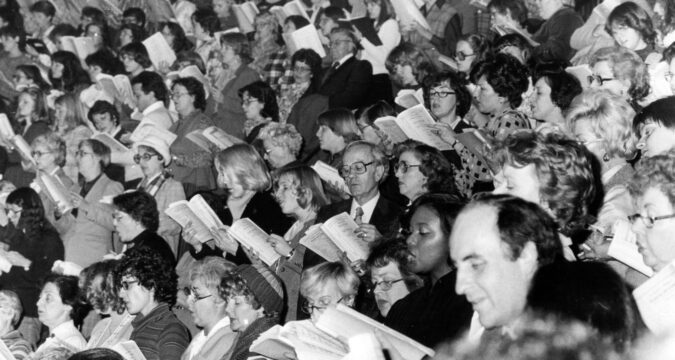
But as time went on, some Chicagoans came to appreciate “Messiah” as a piece of music with appeal that extended beyond its Christian themes. It was a Jewish cantor’s son, Al Booth, who brought the “Do-It-Yourself ‘Messiah’” to Chicago in 1976. Booth, who worked as a real estate agent, got hooked on the idea when he took part in similar sing-along Handel concerts in England. “It was great, marvelous,” he told the Tribune. “Instead of being a listener, you’re a participant.”
Three thousand people would turn out for DIY “Messiah” performances in the late ’70s led by Chicago Symphony Chorus conductor Margaret Hillis, joining their voices together into huge choruses.
“Some members are serious music lovers; some just like to sing in a group, the bigger the better; others are frankly ‘Messiah’ freaks,” the Tribune reported in 1978. “Each year there is a full house of amateur singers who are detectives, teachers, sales clerks, homemakers, truck drivers, used car dealers, bankers, lawyers, businessmen, police officers, postal clerks, and clergy. They come from Illinois, Iowa, Indiana, and Wisconsin.”
Margaret Hillis conducts the “Do-It-Yourself ‘Messiah’” at Orchestra Hall on Dec. 9, 1980, in Chicago. (John Bartley/Chicago Tribune)
Leonore Levitt, a clinical psychologist who’d taken part in the concerts, said in 1978, “It’s a real high to hear this wonderful sound coming out of thousands of people who’ve never sung together before.”
By 1981, Chicago had nine different DIY “Messiah” shows. “If the ‘Messiah’ were sung at any other time, it wouldn’t have quite the same meaning,” Booth said. “But done at Christmas it wakens the feeling among the participants that maybe brotherhood is attainable. Most people want to live in peace.”
That DIY trend has waned in recent years. In 2025, one of the few “Do-It-Yourself ‘Messiah’” shows was staged by the Waukegan Symphony Orchestra and Concert Chorus. But the Apollo Chorus of Chicago — as the Apollo Musical Club is known today — continues its annual tradition of performing “Messiah,” including a concert Sunday at Alice Millar Chapel in Evanston.
Sue Robisch, right, of Hinsdale, sings with 1,400 other participants at a “Do-It-Yourself ‘Messiah’” event with the Chicago Chamber Orchestra at Fourth Presbyterian Church in Chicago on Dec. 21, 1986. The event was sponsored by the Chicago Tribune. (Carl Wagner/Chicago Tribune)
John von Rhein, who retired in 2018 after 40 years at Tribune’s classical music critic, often reviewed performances and recordings of Handel’s oratorio.
“‘Messiah’ is one of those rare musical masterpieces that are genuinely tamperproof,” he wrote in 1977. “Abridge it, bowdlerize it, overlay its dramatic urgency with a thick blanket of sedate piety and you will have a masterpiece. The appeal of ‘Messiah,’ with its ‘Hallelujah’ Chorus, cuts across all differences of age, musical taste, and religious persuasion.”
Robert Loerzel is a freelance writer and the co-author of “The Uptown: Chicago’s Endangered Movie Palace.”
Have an idea for Vintage Chicago Tribune? Share it with Marianne Mather at mmather@chicagotribune.com and Kori Rumore at krumore@chicagotribune.com.
https://www.chicagotribune.com/2025/12/14/handels-messiah-diy-chicago/


