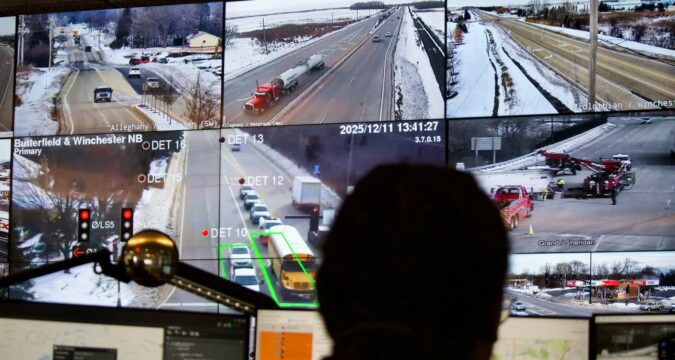
The Lake County Board recently approved $1.2 million for Lake County PASSAGE, which will go toward expanding the 20-year-old network acting as the “central nervous system” of Lake County roadways.
At the county’s Libertyville campus, the Transportation Management Center is something of a miniature NASA control room: A few pairs of desks and computers face a wall of screens, displaying views of intersections across the county.
From there, Lake County Department of Transportation engineers and staffers track, analyze and manage drivers’ daily commute, all part of what’s known as Lake County PASSAGE.
PASSAGE’s work is largely invisible to everyday drivers, but behind the scenes, their engineers are always looking at how to improve traffic flow. That includes modifying signals for holidays, events and weekends, taking into account the different traffic patterns each can have.
Center manager Ryan Legare called PASSAGE an “intelligent transportation system,” which uses various technologies to improve traffic flow. Charles Askar, an engineer of traffic, called it the “central nervous system” of traffic management for Lake County.
It was started in 2006 using federal money, Legare said, and at the time, traffic signals were connected by phone lines throughout the county and fragmented. PASSAGE brought fiber optic cables and consolidation, allowing a central location to analyze and control a growing network of traffic signal infrastructure in real time.
Traffic Management Center Manager Ryan Legare shows off a detection camera, which watch for cars at intersections to inform the traffic signals. Legare said the center’s work is focused on improving traffic flow. (Joe States/Pioneer Press)
Today, there are roughly 300 miles of fiber optic cable in Lake County for the traffic systems. Of the 750 traffic systems in the county, the center is connected to about 680 in real time, meaning staffers get live feedback on equipment status.
That can be critical for managing traffic, Legare said, such as when a light malfunctions and goes into “four-way flash,” where it simply blinks red.
“In the old days, if a traffic signal went into flash, it may be in flash all weekend, and it may go into the morning rush hour on Monday,” he said. “Because we’re connected, we know about it right away.”
Traffic light control isn’t all they have, however. Since its start, Legare said PASSAGE has utilized traffic monitoring cameras, which provide live feeds for engineers that can be seen online on the PASSAGE website.
Legare emphasized that those cameras are not recording video, but instead taking regular snapshots for traffic analysis purposes. Those images are stored for 10 days before being automatically purged, he said.
For practical reasons, the county isn’t in the business of storing the vast amount of data recording the feeds would generate, he said.
If staffers spot an incident on their network’s cameras, PASSAGE can notify emergency responders and law enforcement, and Legare said they have agreements in place to allow them to utilize the video feeds. However, they are not allowed to record.
Beyond the snapshot cameras, some intersections also have cameras meant solely to detect vehicles, which then tell the traffic signal that there are cars waiting at the intersection.
It’s an advancement on the previous method, which was done through sensors built into the road that would detect the metal of the car. But those were “intrusive,” he said, requiring breaking up the road to replace.
Expansion and future
The $1.2 million will be used for further expansion of infrastructure connecting traffic signals, including the installation of a network switch that will allow more redundancy in the western part of the county, where there are more isolated areas of traffic signals, Legare said.
Looking ahead, he said there have been discussions about a variety of new technologies.
The word of the day is artificial intelligence, and Legare said they’re aware of new technologies emerging in their field, with various proposals about how AI could be utilized to move traffic faster.
At this point, “we’re not there yet,” but the network will be able to accommodate such technology, he said.
https://www.chicagotribune.com/2025/12/12/lake-county-traffic-management/


