
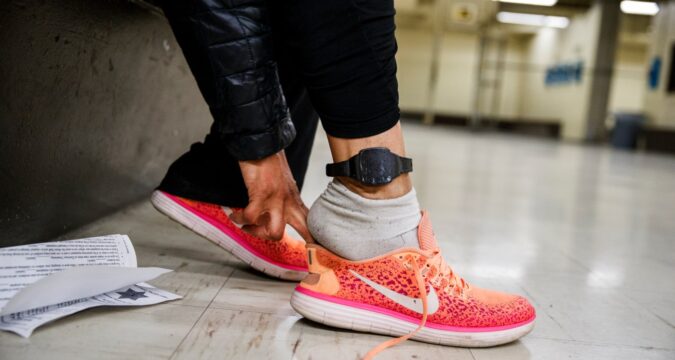
When we learned that the man who allegedly set 26-year-old Bethany MaGee on fire on a Blue Line train last month not only had been arrested more than 70 times but was also out on electronic monitoring after assaulting a social worker at MacNeal Hospital — in spite of the Cook County state’s attorney’s request that he be held — we were alarmed. That man, Lawrence Reed, had violated his electronic monitoring terms multiple times prior to the attack.
Given the shocking, high-profile nature of this story, you might be tempted to believe it an anomaly.
It is not.
In June, Chicagoan Arturo De La Mora was sentenced to 52 years in prison for murdering his girlfriend while he was on electronic monitoring for a prior felony gun case, crime news site CWBChicago reported. In October, a Chicago man received 22 years in prison for carjacking a Facebook Marketplace seller at gunpoint while on electronic monitoring for an earlier case in which he allegedly tried to kill a Cook County sheriff’s deputy.
A little over a year ago, Lacramioara Beldie was stabbed to death in Portage Park by her estranged husband, Constantin Beldie, who was on electronic monitoring at the time. A wrongful-death suit filed this month alleges he had dozens of monitoring violations leading up to the killing without any meaningful intervention from the county or its monitor vendor.
These are but a few horrific examples of a disastrous system that must be fixed, and quickly.
We spoke Tuesday with Cook County State’s Attorney Eileen O’Neill Burke about this serious problem. Burke assured us that her office is committed to requesting pretrial detention whenever the public is at risk, and the data she shared encourages us that the state’s attorneys arguing these cases on the front end are doing their part to prevent more danger.
Her team touted an increase in pretrial detentions under her watch, noting that, for example, detentions for aggravated domestic battery cases had increased to 85% from 61% under her predecessor. For cases involving handguns converted to the equivalent of machine guns, Burke’s office requested detention in 97% of cases, with judges approving pretrial detention 76% of the time. Again, these numbers and the higher frequency of judges approving prosecutors’ requests for detention are encouraging. But the problem of past detention refusals that have left violent folks on the streets with inadequate guardrails — and the potential for more in the future — continues to plague us.
“Electronic monitoring needs a law enforcement component,” Burke added, addressing the need to be able to enforce electronic monitoring terms and restrictions when people don’t comply. She’s right. As the system exists today, there’s next to no accountability and no muscle at all to ensure compliance while people remain free ahead of their court dates. Burke described herself as “the skunk at the garden party” for questioning what happens when someone, say, cuts off their monitor ahead of trial.
We need answers to questions like that. The county cannot continue operating a system without clear protocols for violations, otherwise Chicagoans and visitors to our city aren’t safe. Thankfully, the new chief judge understands this and is taking action. On Dec. 2, Cook County’s new Chief Judge Charles Beach ordered an urgent review of the county’s electronic monitoring program.
His announcement couldn’t have come soon enough. According to the November electronic monitoring report from the office of the chief judge, there are still troubling cases of defendants facing serious charges of violence on electronic monitoring, including individuals charged with murder, attempted murder and aggravated criminal sexual assault, underscoring concerns about who is being released pretrial.
Much of the problem can be attributed to a culture that predates Beach and O’Neill Burke. Electronic monitoring has been part of Cook County’s criminal justice system for decades. But its use has ballooned and been increasingly applied to people charged with serious violent offenses.
That has to change.
It’s clear the county’s electronic monitoring system isn’t working and isn’t adequately protecting the public. O’Neill Burke has committed to requesting detention for those accused of committing serious crimes, but judges have the final say on which defendants are detained. For those accused of violent crimes, there really is no alternative to home confinement and ankle monitors if a judge rules against incarceration.
So Beach needs to treat this as a crisis. We grant that solving the problem of a lack of sworn officers to enforce violations of electronic monitoring conditions will take time. Creating a new unit along those lines within the chief judge’s office should be considered now that the office has sole responsibility for managing the electronic monitoring system.
What happens in the meantime, though? Cook County shouldn’t be expected to endure the status quo a year or longer while the wheels of government spin. No doubt Beach needs to dedicate more personnel to improve compliance for those already on monitoring. But the chief judge should consider issuing temporary guidance to his fellow judges that errs on the side of protecting the public for those accused of violent crimes. Like Lawrence Reed.
Overall crime in the city is down statistically, and all are glad to see it. But no one thinks Chicago is “safe” yet. Unfortunately, the current state of electronic monitoring is a big reason why.
Submit a letter, of no more than 400 words, to the editor here or email letters@chicagotribune.com.


