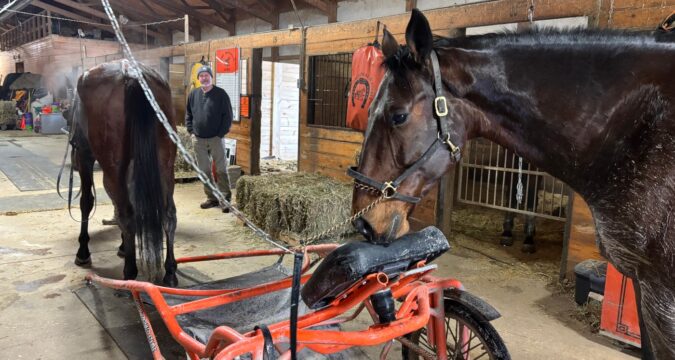
Second Story Ranch, a planned live-in addiction recovery center in Crete set to operate out of a 68-acre horse ranch, purchased its property in March and secured zoning approval from Will County in September. Now, the main thing it needs is money.
“I think I said to somebody, hey, the good news is we bought a farm,” said project director Jim O’Connor. “And the bad news is, we bought a farm.”
The Second Story Foundation launched a public capital campaign Dec. 2 to raise the money needed to construct the project’s planned buildings: Housing for men in recovery to live long term, a 7,000-square-foot communal lodge and a pair of single-family homes for project leadership.
Across the different housing options planned for the ranch, O’Connor said, the property should be able to house a maximum of 30 people at a time.
The project has secured $500,000 in private donations and a $250,000 grant from the Will County Opioid Program,according to a news release. The projected budget to get the program fully operational is $4.25 million.
Right now, O’Connor said, the project is in the engineering and design phase of construction, which he expects will take until April.
“What we really need, if I’m being blunt and straightforward, is we’re looking at about 4, 4 1/2 million that we need committed,” O’Connor said. “And if we have that by April, we’re putting shovels in the ground in June. And then we are built and operational toward the end of 2026.”
One funding source where O’Connor sees potential is in the Illinois Opioid Settlements Initiative.
Like every state, Illinois has a fund comprised of money secured from settlements with pharmacies and pharmaceutical manufacturers like Purdue Pharma, that settled lawsuits regarding their liability in the opioid epidemic for massive sums.
Illinois has received more than half a billion dollars in opioid settlement money to date, according to the Illinois Opioid Settlements Initiative website. Of that, more than half goes to an account intended to fund work to remediate the impact of the opioid epidemic, including recovery programs like O’Connor’s.
“If the Opioid Settlement Fund is going to invest $5 million, $10 million, $20 million in recovery housing, we’re the single best project in the state going right now,” O’Connor said. “And we may be the only one that’s able to say, if you give us the money, we can spend it right away on exactly what it’s supposed to go to.”
The Will County Board approved the zoning for the project by a vote of 17-2 in September.
Ranch hands tend to the horses Wednesday at Second Story Ranch in Crete. (Evy Lewis/Daily Southtown)
“I wanted to look and say, before we open this public phase, do we truly have everything we need to knock this out of the park?” O’Connor said. “And it turns out we do. We really do.”
While the live-in element of the program is a work in progress, the horse farm is operating and providing work to people in recovery. Many of the farm’s workers live in recovery homes in Joliet, and work on the property on a temporary basis, O’Connor said.
“The guys that’ll come here, and the guys who go into recovery homes, they don’t have other options,” O’Connor said. “If you’ve got a girlfriend or a boyfriend that’ll put you up, or you can live in your parents’ basement, that’s what you do.”
One of the ranch hands at the farm, Skip Wheeler, was the Second Story Ranch’s first full-time employee. Wheeler first encountered O’Connor in 2023 as a participant in a different recovery program O’Connor was running.
“He gave me my first shot at actual sobriety,” Wheeler said. “I never thought I would be sober. I thought I was going to be what I was forever.”
War of Will is one of the dozens of horses stabled at Second Story Ranch in Crete. (Evy Lewis/Daily Southtown)
Wheeler plans to live on the property in the main ranch building once some renovations are complete.
“I think this place is going to be a wonderful place. It’s gonna help so many people in very special ways, I think,” Wheeler said. “It’s just going to be all around great, I think, for anybody involved.”
In addition to caring for the horses, men living on the ranch will also raise crops and look after the myriad other tasks that come with the upkeep of a 68-acre working ranch.
“A farm grows, breaks, needs fixing,” O’Connor said. “So the jobs are in things like carpentry, maintenance, land management, landscaping and agriculture.”
One thing that will set the Second Story Ranch apart from other recovery housing programs is that O’Connor has no intention of charging rent, nor of billing Medicaid for the care of his clients.
While O’Connor is hoping for funds from the sources like the opioid settlements to get the project moving, he said he doesn’t want the ranch to be reliant on government funding to operate, especially in a time of increasing cuts and instability for programs like Medicaid.
A sign for Second Story Ranch sits against a stable wall. (Evy Lewis/Daily Southtown)
“We’re looking across the board at Medicaid cuts, Medicaid work requirements, work requirements for people to stay on Medicaid, SNAP cuts and work requirements for people to be on SNAP. We’re also looking at Housing First programs being defunded,” O’Connor said. “What comes next is us saying we’re not waiting around for government programs to save us.”
The ultimate goal of the program is to provide a bridge between short-term 28-day recovery programs and long-term stability.
“Alcoholism and addiction, at the level that we’re talking about, is just a litany of loss and isolation and unhealthy relationships and despair,” O’Connor said. “There are not many programs or places people can go that will give them the care, the love, the time and the structure to rebuild a life.”
elewis@chicagotribune.com
https://www.chicagotribune.com/2025/12/11/crete-horse-ranch-recovery-fundraising/


