Police are no longer required to arrest juveniles accused of domestic violence under a new Illinois law that went into effect last week, and can instead divert them to alternative placements.
The legislation, an amendment to the Illinois Domestic Violence Act of 1986, was introduced by state Rep. Matt Hanson, D-Aurora, of the 83rd District, whose constituency includes parts of Batavia, Geneva, Aurora and Oswego. The idea was first spearheaded by Kane County State’s Attorney Jamie Mosser.
The new law essentially allows officers to connect juveniles with social services and resources, rather than arresting them, according to the Kane County State’s Attorney’s Office.
That might look like, for example, a referral to a mental health treatment resource, or to after-school or community programs, the State’s Attorney’s Office said.
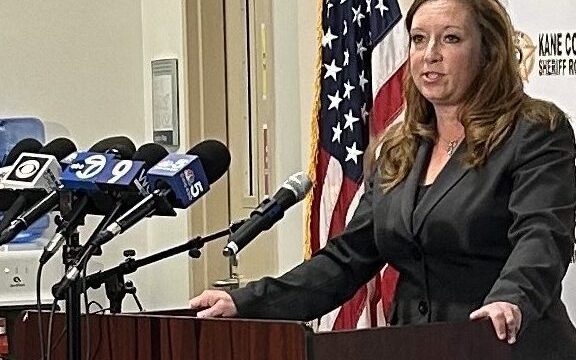
“I want young people who commit domestic battery to receive the support and intervention they need,” Mosser said in an emailed statement, “rather than being pushed into a system that can retraumatize them.”
Before, officers were required to arrest domestic violence suspects “in nearly all cases,” Mosser said in the statement. But that approach does not work for juveniles, she said, suggesting that the law “needed to reflect what we now know about adolescent development and behavior.”
Now, under the new law, a police officer can use the “Adolescent Domestic Battery Typology Tool” — an assessment tool that aims to inform, for example, case processing and treatment decisions for youth — to decide whether or not to arrest a juvenile for domestic violence. If they choose not to arrest the individual, officers must forward the report of the incident to the State’s Attorney’s Office for review.
“We know that, any time a juvenile is either picked up, arrested or charged, that … may change their life forever,” Hanson told The Beacon-News. He spoke of the potential for a juvenile offender to be diverted, rather than incarcerated, in some situations as an “opportunity.”
As for the legislation itself, Hanson said that “everyone agreed with this in principle,” but that there was some discussion about, for example, how to make sure the victim is still protected in an instance where a juvenile isn’t arrested.
It was ultimately signed into law by Gov. JB Pritzker in August, and went into effect Nov. 13. According to the Kane County State’s Attorney’s Office, Mosser will be leading statewide training for law enforcement on implementing the new law.
mmorrow@chicagotribune.com
https://www.chicagotribune.com/2025/11/17/new-illinois-law-juvenile-domestic-violence/


