When I hear Mayor Brandon Johnson rail against the idea of raising Chicago’s paltry $9.50 garbage collection fee to help fill our gaping $1.2 billion budget gap, I remember a beautiful 12,000-square-foot mansion in Kenwood I walked through a few years back.
The four-story masterpiece features a ballroom on top, and turrets flanking the massive front porch. This place has every single room you’d need to play Clue. My daughter and I enjoy attending opulent open houses, so when this one got rehabbed and put on the market, we showed up early. The dining room should have featured a goalpost, since the double living room was the size of a football field.
In contrast, I live in a condo association of about a dozen six-flats. My unit is slightly under 2,000 square feet. Miss Scarlett could only kill Colonel Mustard in a sun porch, front room, bedroom, dining room or kitchen. No observatory. No secret passages.
Yet I pay $18 monthly for garbage and recycling pickup, while whoever waltzes around that private ballroom pays $9.50 — unless they’re over 65, in which case they pay just $4.75.
My friend’s condo association is a single six-flat. They pay $46 per month per unit.
But how can this be, you ask, when the mayor thunders that any garbage fee over $9.50 is an evil regressive tax?
Oh, I’ll tell you how.
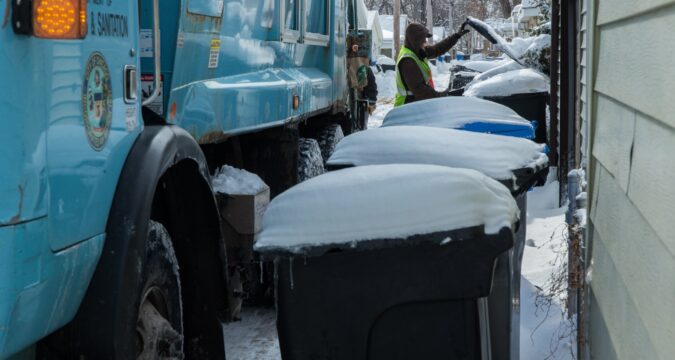
First, the city’s garbage fee hasn’t increased since it was set in 2015. According to Johnson’s “Chicago Financial Future Task Force” report on this year’s budget, Chicago has the lowest garbage fee of almost any peer city. Los Angeles charges $55.95 per month. Chicago’s fee generates about $60 million annually, while the actual cost of garbage pickup is $320 million. That $9.50 covers just 18% of the service.
Plus, Chicago’s fee includes recycling. And they don’t charge extra for lawn refuse or “bulk waste.”
Second, only half of Chicago residences qualify for garbage service — single-family homes and buildings under four units. The other half, us schmucks living in six-flats, courtyards, mid-rises and high-rises? We pay full price for private trash and recycling services.
Then, we schmucks subsidize the 82% of garbage service we don’t even get that’s not covered by fees. Talk about regressive. We help pay the tab for every single-family home, from the smallest one-bedroom slab house in the poorest neighborhood to the Kenwood people who can play a real life game of Clue in their mansion.
The schmucks include Chicago’s poorest citizens, who don’t own houses. They rent apartments, mostly in buildings with over four units. So the poorest Chicagoans pay the full cost of their garbage pickup through their rent, and then they help pay for the Clue people’s garbage too.
Look, nobody wants to sock low-income homeowners with a garbage increase. That’s why I agree with Johnson’s task force report that qualified homeowners should get the same break on garbage as they do for other city utilities. Qualified owners use the Utility Billing Relief Program for a 50% rate cut on water and sewer fees with no late penalties or debt collection. Didn’t Johnson read his own report?
And here’s something the task force missed: Chicago can institute a graduated garbage fee by tying it to, say, a property’s assessed valuation. Finally, Johnson’s chance to soak the ultra-rich! The Clue people could pay the full cost of their garbage service, or more, without hurting less fortunate neighbors. They could even pay according to their volume of garbage. News flash: Big houses produce big garbage.
Johnson’s task force offered several garbage-fee increase plans to raise $20 million to $296.9 million. The alternative budget proposal put forth by 26 aldermen last week, including Johnson ally and Finance Committee Chairman Ald. Pat Dowell, suggests a fee structure raising $55 million. I think my idea could raise a lot more, but like the aldermen, I don’t have access to a budget staff to run the numbers. So we’ll stick with the aldermen’s figure.
That $55 million is over half the amount needed to jettison just one of Johnson’s terrible budget ideas — instituting a $21-per-employee corporate head tax, when Chicago’s downtown business district has a record-high 28% office vacancy rate.
Or we could put that $55 million toward protecting our credit rating, by dropping two other awful Johnson ideas — slashing in half the city’s $240 million extra payment to its perilously underfunded pensions, or borrowing $166 million to cover firefighter backpay. Those are both points that nudged Standard & Poor’s to change Chicago’s credit outlook to negative after Johnson unveiled his 2026 budget.
But no. A fair, equitable, graduated garbage fee increase won’t help close our budget gap this year.
Johnson, who called himself the “collaborator in chief” during last year’s budget process and has claimed for months that he wants to work with aldermen on this year’s budget, quickly batted down the entire aldermanic proposal, including the garbage fee increase.
According to a letter from Johnson’s financial team, any garbage increase would be “imposing another major cost escalation” and “create an immediate and disproportionate burden on households least able to absorb it.”
In fact, Johnson threatens to veto any budget that messes with the garbage fee.
My guess is that when Chicago sees its credit rating tank next year, the culprit will be Johnson, in City Hall, with a veto pen.
Cate Plys is a former Chicago reporter and columnist who now writes the Chicago history newsletter “Roseland, Chicago: 1972” on Substack. She is a regular panelist on WGN’s “Mincing Rascals” current events podcast, hosted by John Williams and airing Saturday nights at 8 p.m.
Submit a letter, of no more than 400 words, to the editor here or email letters@chicagotribune.com.
https://www.chicagotribune.com/2025/12/09/opinion-chicago-budget-brandon-johnson-garbage-fee/


